
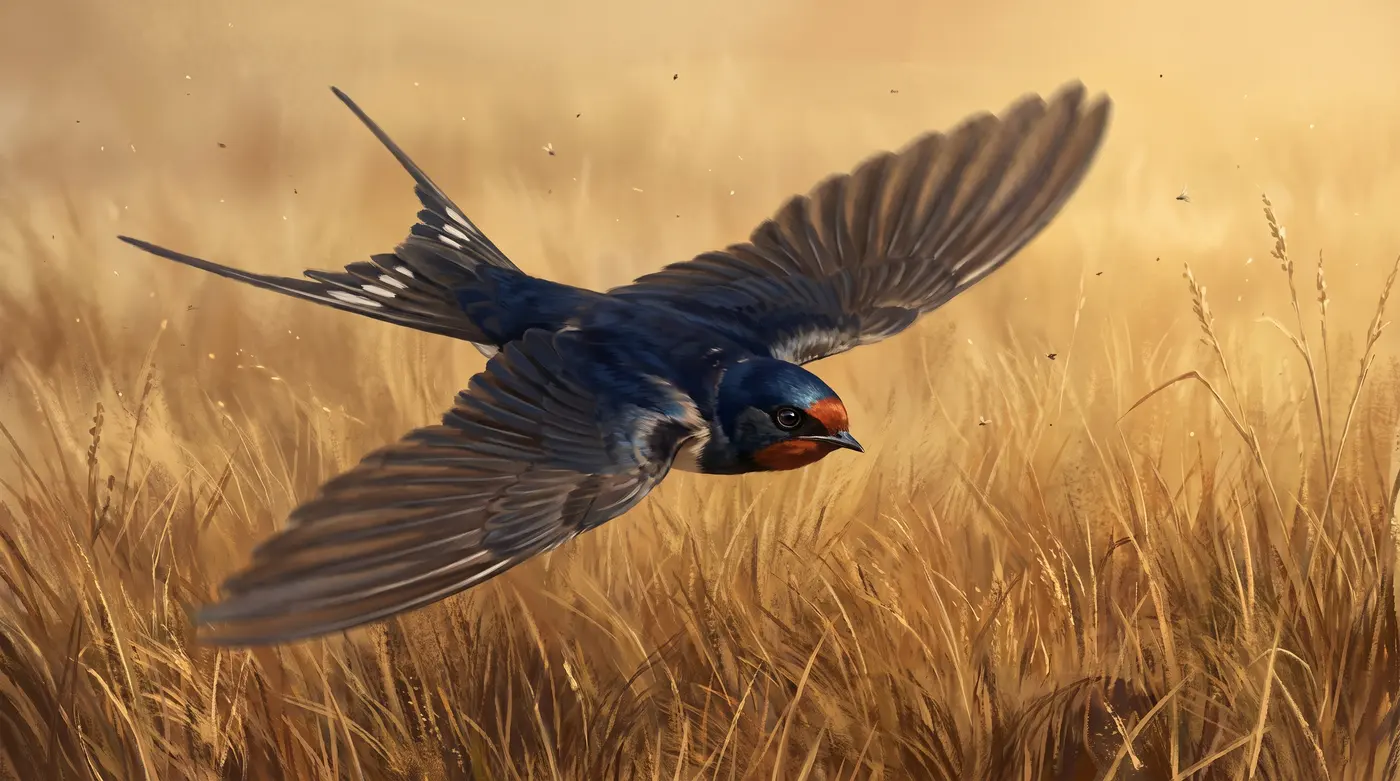
- Status: Safe
- Countryside and barns of Europe, wintering in Africa and the Southern Hemisphere
Numbers
- Weight
- 0,6 oz0.6 to 0.8 oz
- Length
- 7,5 in7 to 8 inches
- Lifespan
- 4 yearsup to 4 years in the wild
- Migration
- 7000 mione way to southern Africa
- Wingspan
- 13 inWikidata entry, descriptive text lists wings five inches long
- Global population
- 200 million individualsglobal estimate, declining
Ten fun facts
its scientific name means country swallow, where Hirundo means swallow and rusticus refers to fields and rural places.
males and females look identical to human eyes, making it almost impossible to tell them apart without close study.
this is the only species in its genus that lives in the Americas, while nearly all other related species are African.
during migration it flies strictly during the day, staying low over the ground and catching insects along the way.
in winter thousands gather to sleep together in reed beds, forming massive roosts far from their summer nesting areas.
it lays four or five eggs per clutch up to three times a season, with the female doing most incubation.
twenty days after hatching, young birds reach adult size and prepare to leave the nest for their first flight.
it became the national animal of Estonia in 1960, where it symbolizes the blue sky, freedom, and human happiness.
according to an old Estonian belief, anyone who kills this bird goes blind, helping protect the species through tradition.
laws protect their nests in many countries, but populations still decline because of pesticide use reducing insect prey.
The quiz answers
The first one is the question printed in your book: here is the answer. The other four are extra.
Question 1 of 5★ this one is in your book
How many miles can a European Swallow travel to reach Africa?
Question 2 of 5
What is the Swallow's nest made of?
Question 3 of 5
What does the Swallow feed on?
Question 4 of 5
In which country is the Swallow the national animal?
Question 5 of 5
Why is the Swallow population declining?
Try it yourself
Use a piece of string on a world map to trace seven thousand miles. That is the distance this bird travels twice a year.
Measure seven and a half inches on a ruler, cut out a bird shape, and hang it near your window to match its real length.
Mark your calendar on the day you spot the first returning bird each spring. Compare your notes across three years to see the pattern.
Data from Wikidata (Q25429) and Wikipedia (Barn swallow).