
Space · Comets and shooting stars
The impact that wiped out the dinosaurs
The day that changed the Earth
Only spacecraft can see it
The numbers
- When
- 66,000,000years ago
- Width of the asteroid
- 11mi(17 km)
- Impact speed
- 19mi/s(30 km/s)
How it happens, step by step
The arrival
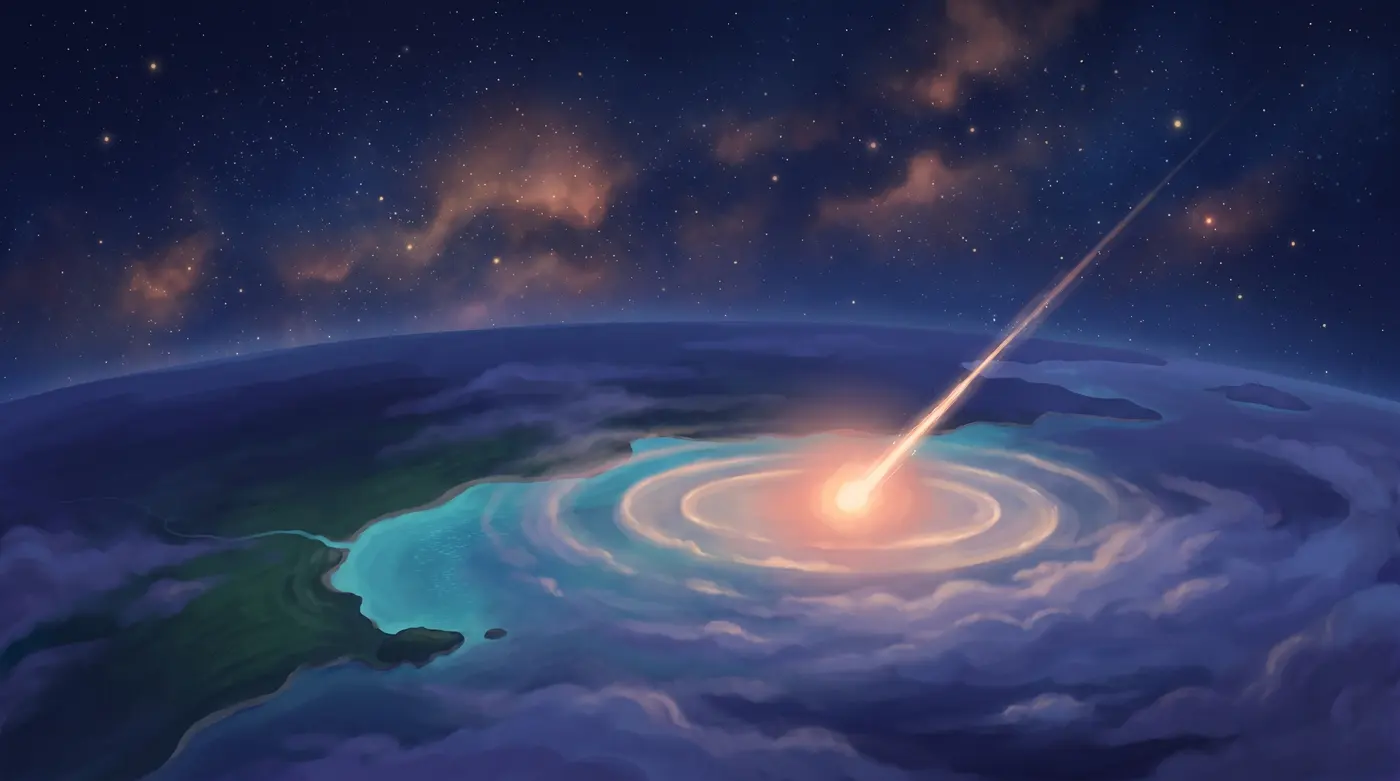
An asteroid as wide as a big city hits the Earth where the Yucatán is today, faster than any bullet.
The blast
The energy released equals billions of atomic bombs. The rock is squeezed down to twelve miles deep.
The sky closes
Dust and vapor are thrown into the atmosphere and spread over the whole planet in a few weeks.
Dark and cold
Sunlight no longer reaches the ground. The temperature plunges fast and the plants stop growing.
Who is left
The big animals vanish first. The small ones survive, and among them the mammals, which then spread everywhere.
To get an idea
The rocks were thrown six miles into the air, higher than airplanes fly.
Fun facts
These are not in the book: there was no room on paper.
More than ten years passed between finding the line of iridium and finding the crater.
The energy released was like five billion atomic bombs like the one dropped on Hiroshima.
It was not the crash that killed the dinosaurs, but the darkness and cold that followed for months.
The Nadir crater formed around the same time, but it was too small to cause an extinction.
Birds descend from dinosaurs that survived: in a way, not all of them died out.
Without that emptiness left in the world, mammals might never have spread so widely.
Test yourself
The first question is the one printed under the QR code, with the answer the book did not give. The other four only exist here.
Question 1 of 5★ is the one from your book
Where was the first proof of the impact found?
Question 2 of 5
Why did iridium point to an asteroid?
Question 3 of 5
Where is the crater?
Question 4 of 5
What really killed the dinosaurs?
Question 5 of 5
How wide was the asteroid?
Riddles
I came only once, sixty-six million years ago, and I changed everything in a day. My mark is hidden under a peninsula in Mexico. What am I?
I am a thin line inside the rock, a couple of inches thick. Inside me there is a metal that is rare on Earth. I was the first proof of a very ancient crime. What am I?
I killed no one with the crash. I killed by taking away the light, then the warmth, then the plants. What am I?
Try it yourself
Look at a wall of layered rock, in the mountains or in a photo. Each line is an age: the story reads from the bottom up.
Put a lit lamp behind a glass of water and then stir in a teaspoon of flour. That is what the dust did to sunlight.
The words
- mass extinction
- The disappearance of a great many different species in a short time.
- Cretaceous
- The geological period that ends with the disappearance of the dinosaurs.
Sources: Wikidata (Q55811), Wikipedia (Estinzione di massa del Cretaceo-Paleogene).