The numbers
- How many layers
- 5Troposphere, stratosphere, mesosphere, thermosphere, exosphere
- Air in the lowest seven miles
- 75%
- How much the air above us weighs
- Like a column of water about 34 feet tall
How it happens, step by step
The troposphere
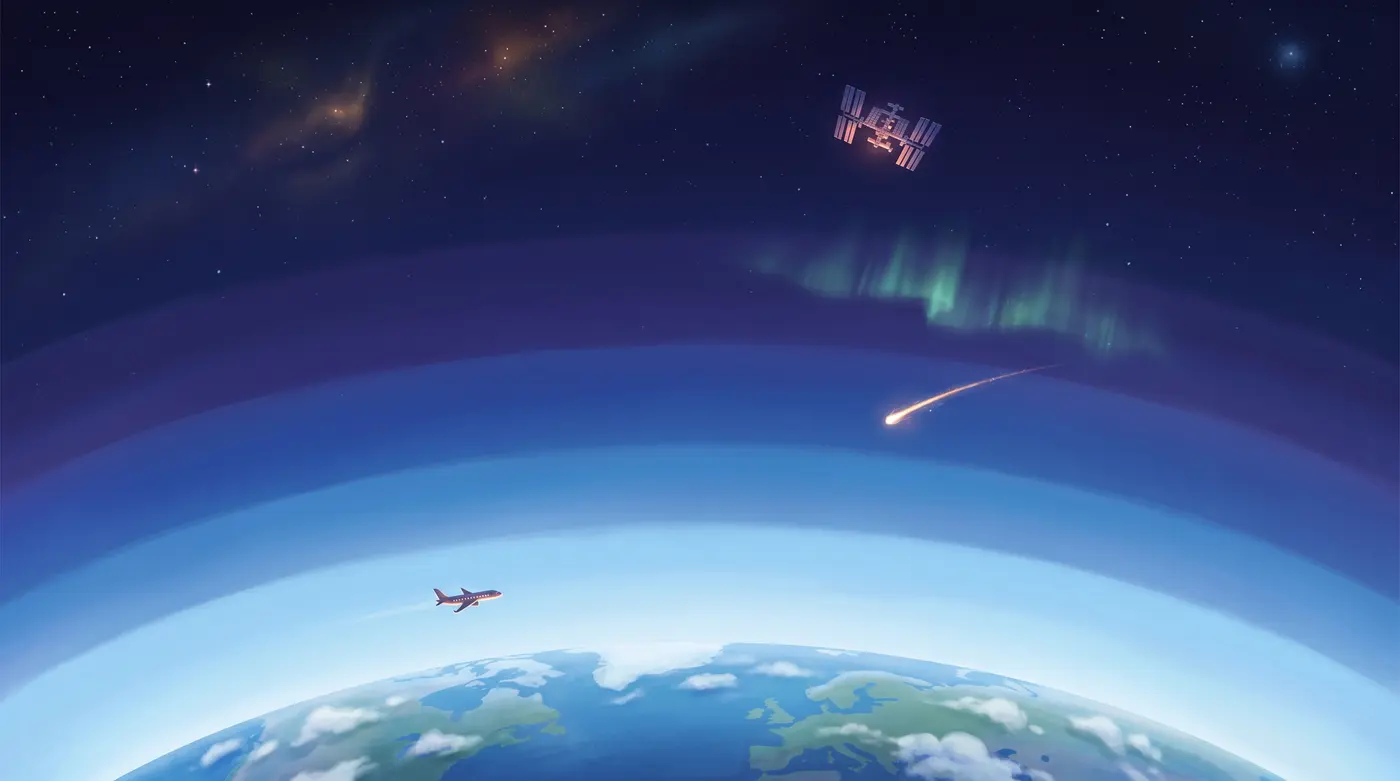
The first layer, where the clouds, the rain and almost all the air are. It ends just above airliner height.
The stratosphere
Clear, almost still air. Here is the ozone, which absorbs the Sun's most dangerous ultraviolet light.
The mesosphere
The air gets thin and freezing cold. This is where meteors light up and become shooting stars.
The thermosphere
Almost no air, but the few particles left are very hot. Space stations fly here and auroras light up.
The exosphere
The last layer does not end: it fades. The air thins out more and more until only empty space is left.
To get an idea
The air pressing on us at sea level weighs as much as a column of water about thirty-four feet tall.
The atmosphere has no edge: the blue fades into black with no line to cross.
Fun facts
These are not in the book: there was no room on paper.
The layers are told apart by whether the temperature rises or falls as you go up.
The border between one layer and the next always has a name ending in pause, like tropopause.
Shooting stars light up in the mesosphere, much higher than any airplane.
In the thermosphere there is almost no air, and yet the few particles there are very hot.
Auroras light up in the high layers, where the Sun's particles meet the air.
The ozone in the stratosphere protects us from the most harmful ultraviolet light coming from the Sun.
Test yourself
The first question is the one printed under the QR code, with the answer the book did not give. The other four only exist here.
Question 1 of 5★ is the one from your book
Where is most of the Earth's air?
Question 2 of 5
How many layers does the atmosphere have?
Question 3 of 5
Why is the daytime sky blue?
Question 4 of 5
In which layer do shooting stars light up?
Question 5 of 5
Where does the atmosphere end?
Riddles
I am as thin as a peel and yet without me nobody could breathe. I am held in place by a force that pulls down and by an invisible shield that defends me from the wind of the fire. What am I?
I have five floors and no roof: the top one does not end, it just thins out. On my third floor, the pebbles that fall from the sky burn up. What am I?
I take white light and scatter only part of it, the coolest part, in every direction. That is why during the day there is no black above you. What am I?
Try it yourself
At sunset, watch how the sky goes from orange to light blue and then dark blue: you are seeing light crossing different depths of air.
Put a drop of milk in a glass of water and shine a flashlight on it from the side: the water looks bluish. It is the same effect as the sky.
The words
- ozone
- A gas in the stratosphere that stops the most harmful ultraviolet light.
Sources: Wikidata (Q3230), Wikipedia (Atmosfera terrestre).