
Space · Galaxies and the universe
The expanding universe
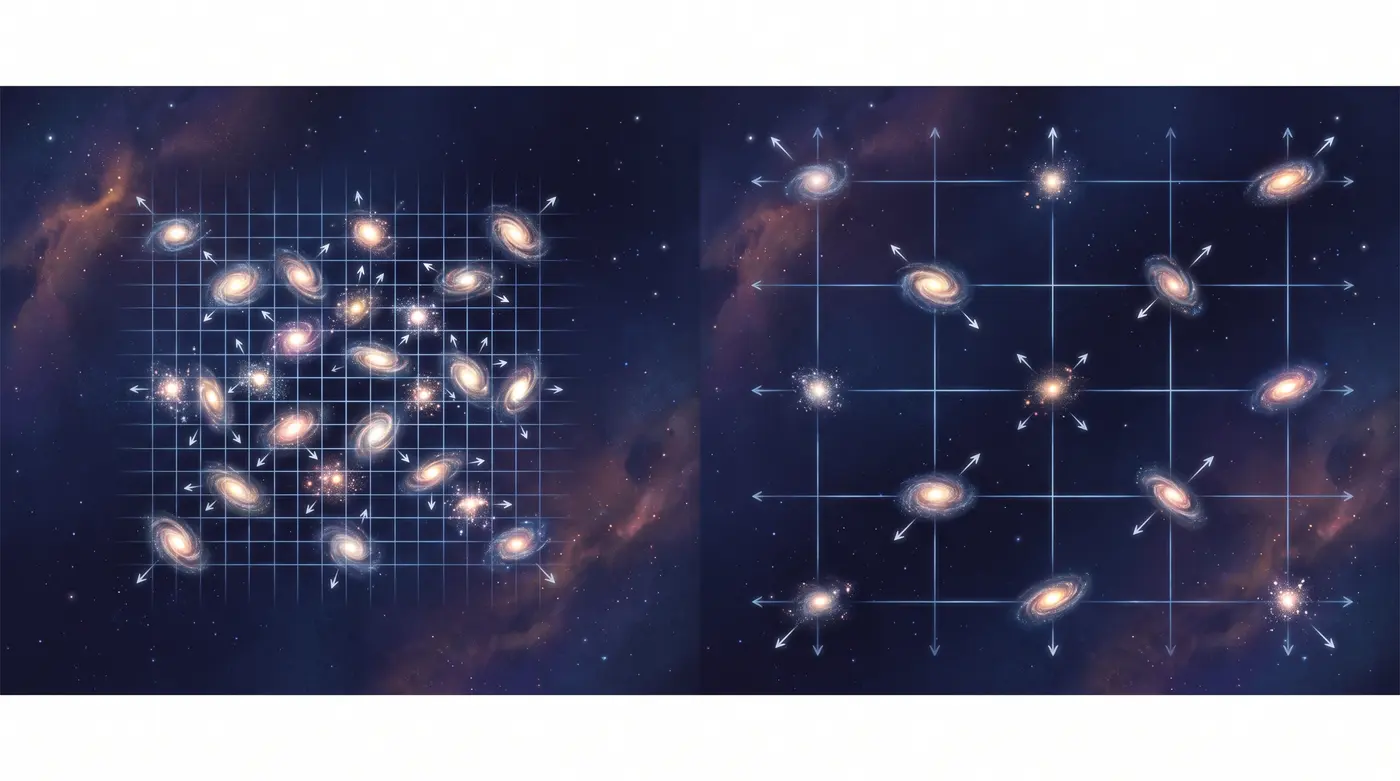
They are not moving away: space is growing
Only spacecraft can see it
The numbers
- What is expanding
- The space between galaxiesNot the galaxies themselves
- How it is measured
- From light stretched toward red
- How fast
- About 74 km per second per megaparsecThe farther it is, the faster it goes
How it happens, step by step
Draw the dots
Picture a deflated balloon with dots drawn on it: each of those dots is a galaxy.
Blow up the balloon
As the rubber stretches, all the dots move apart from one another, while staying right where they were.
Nobody is central
From whatever dot you look, it seems all the others are fleeing from you. Nobody holds the center.
Far ones go faster
Two dots far apart separate faster than two close ones, because there is more rubber stretching between them.
Light tells us
The light of distant galaxies arrives stretched toward red, and how much it is stretched measures their escape.
To get an idea
On a balloon being blown up, every dot sees the others fleeing, but none of them has moved on the rubber.
The farther a galaxy is, the faster it moves away: between us and it there is more space stretching.
Fun facts
These are not in the book: there was no room on paper.
A single megaparsec is a distance of about three million three hundred thousand light-years.
The measurements are made by watching pulsing stars called Cepheids, which act as yardsticks.
The Hubble Space Telescope has watched seventy of them in the Large Magellanic Cloud.
Red giant stars are also used as another way to make the same measurement.
The light of distant galaxies arrives stretched toward red, and that stretch can be measured.
The expansion concerns the space between galaxies, not the galaxies or the atoms they are made of.
Test yourself
The first question is the one printed under the QR code, with the answer the book did not give. The other four only exist here.
Question 1 of 5★ is the one from your book
What is expanding?
Question 2 of 5
Where is the center of the expansion?
Question 3 of 5
Which galaxies move away fastest?
Question 4 of 5
How is the expansion measured?
Question 5 of 5
What does the balloon help explain?
Riddles
Everyone believes the star cities are running away, but none of them really moves: it is I who grow bigger between one and the next. What am I?
If you stand on any dot it will seem that all the others are fleeing from you, and it will be true for whoever stands on any other dot. Nobody is right, or everybody is. What am I?
To measure me you look at the color the light arrives in: if it is redder than it should be, you know how hard I am working. What am I?
Try it yourself
With a ruler, measure two pairs of dots, one close and one far, before and after blowing up: the far pair has moved apart much more.
Try pointing to the dot at the center of the expansion: there is none, and that is exactly the point.
The words
- Cepheid
- A star that pulses regularly and is used to measure distances.
Sources: Wikidata (Q273508), Wikipedia (Espansione metrica dello spazio).