
The numbers
- What it was
- The first artificial satellite
- How big it was
- 23in(58 cm)A metal ball
- When it was launched
- October 4, 1957
How it happens, step by step
A simple ball
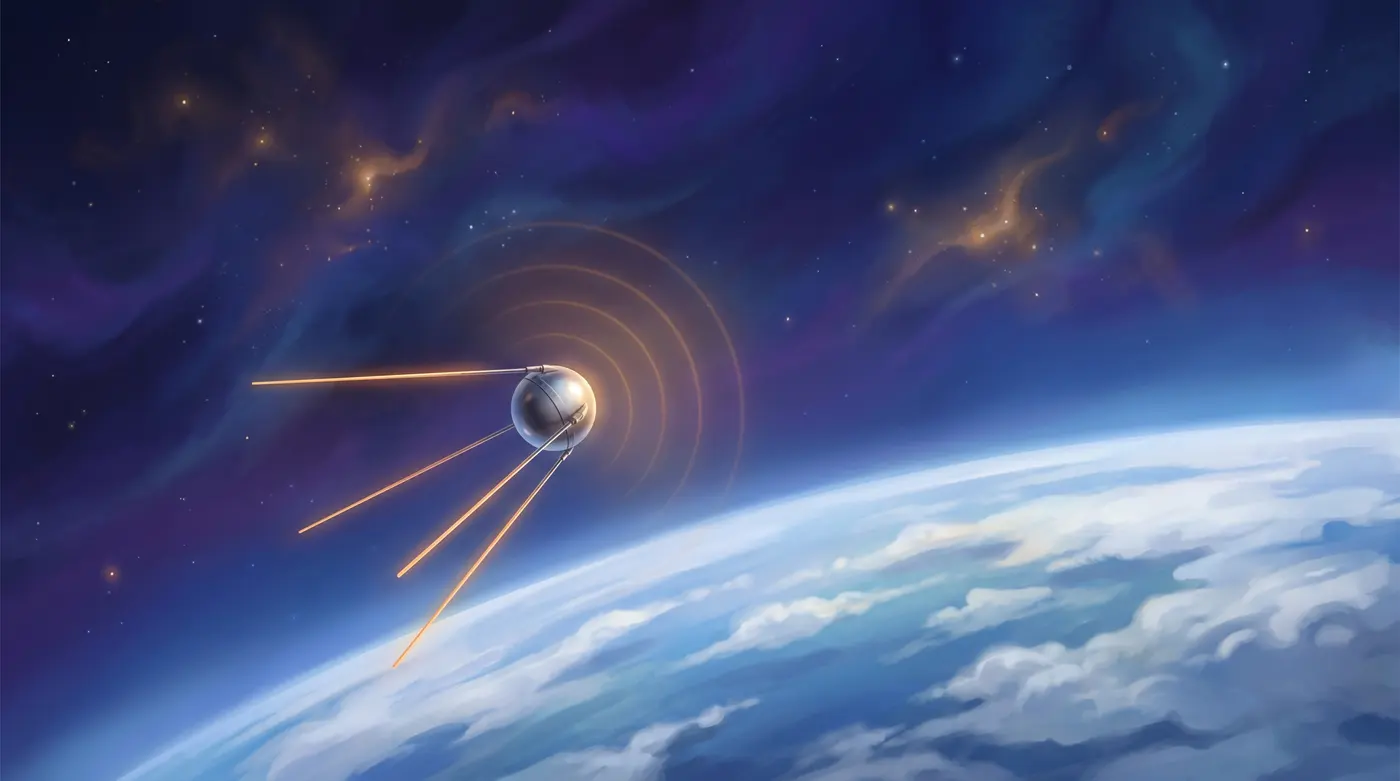
A shiny metal ball with four long antennas, with batteries inside and a small radio transmitter.
The launch
In the fall of 1957 a Soviet rocket carries it up there, into low orbit around the Earth.
The beep
It sends out a repeating radio signal that anyone, even ham radio operators at home, can pick up.
The batteries die
After three weeks it falls silent. It keeps circling for a couple of months, then comes back and burns up.
The race begins
That surprise success starts a race between the great powers of the time, one that will lead to the Moon.
To get an idea
All it could do was send out a radio beep, and its batteries lasted three weeks.
Little more than ten years passed between that beep and the first walk on the Moon.
Fun facts
These are not in the book: there was no room on paper.
Its orbit took it over practically all the inhabited parts of the Earth.
Its batteries lasted three weeks, and then the satellite kept circling in silence.
After a couple of months it came back into the Earth's atmosphere and burned up.
In the United States the news set off what came to be called the Sputnik crisis.
That launch started the space race, during the years of the Cold War.
The launch had deep effects on politics, on technology and on science.
Test yourself
The first question is the one printed under the QR code, with the answer the book did not give. The other four only exist here.
Question 1 of 5★ is the one from your book
What was Sputnik?
Question 2 of 5
What could it do?
Question 3 of 5
How long did its batteries last?
Question 4 of 5
How big was it?
Question 5 of 5
What did that launch set off?
Riddles
When I stopped talking I kept circling in silence for a couple more months, and then I burned up coming back. Nobody ever saw me again. What am I?
My name, in the language of those who built me, means traveling companion. I was the earliest human object to go all the way around your world. What am I?
Try it yourself
Take a beach ball: the first satellite in history was about that size, not counting the antennas.
Watch a satellite pass in the evening, a dot gliding among the stars without blinking: today there are thousands, back then there was one.
The words
- low orbit
- An orbit close to the Earth, a few hundred miles above us.
Sources: Wikidata (Q22701), Wikipedia (Sputnik 1).