
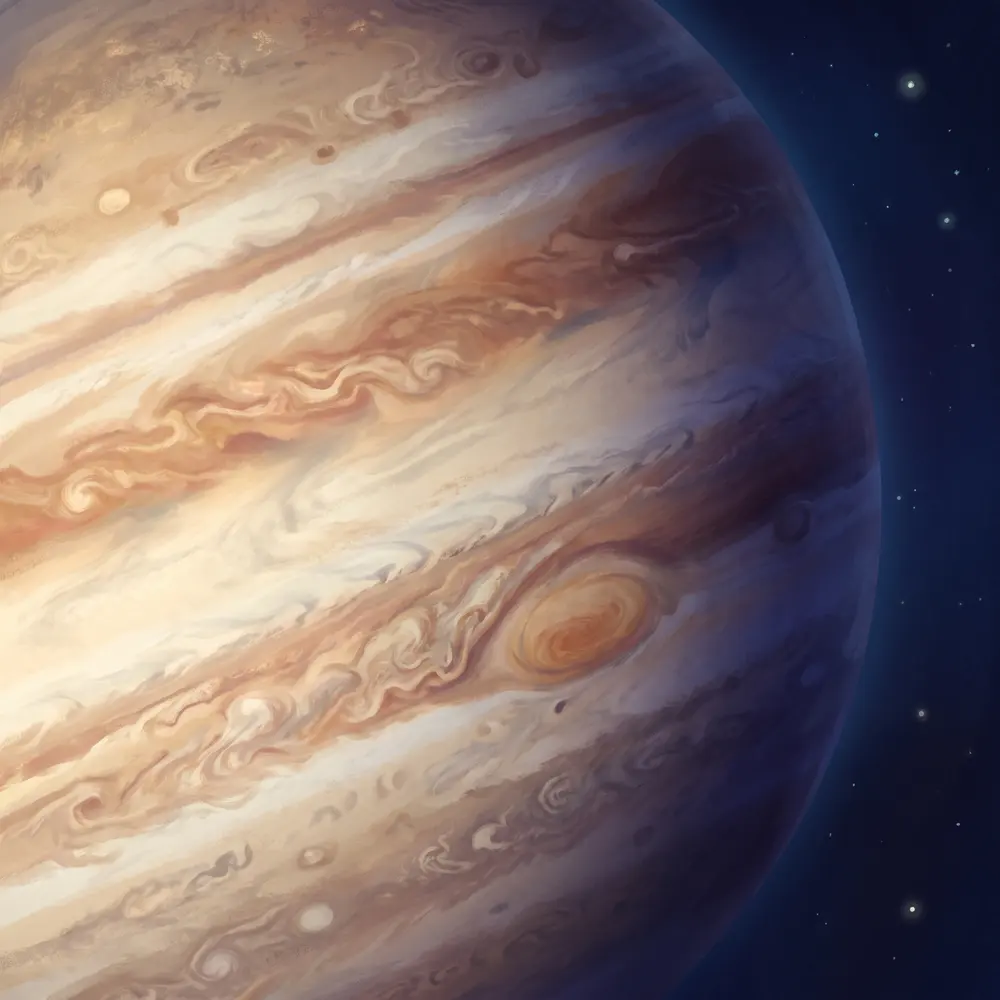
The numbers
- Diameter
- 88,846mi(142,984 km)
- Length of a day
- 9.9hours
- Length of a year
- 4,331days
- Average temperature
- -170°F(-110 °C)
- Known moons
- More than ninetytoday: 95source: NASANew ones are still being found
To get an idea
Jupiter weighs two and a half times as much as all the other planets of the Solar System put together.
A day on Jupiter lasts less than ten hours, the shortest of all, even though it is the biggest planet.
Its year lasts twelve Earth years: someone who is twelve years old has had just one birthday on Jupiter.
Fun facts
These are not in the book: there was no room on paper.
The four biggest moons were seen by Galileo in 1610, and they carry his name.
Ganymede, the biggest of its moons, is even bigger than the planet Mercury.
Jupiter has rings, but they are thin and dark and cannot be seen with an ordinary telescope.
Its gravity pulls many comets off course, which is why some people call it the guardian of the Solar System.
You can see it with your own eyes as a very bright dot that does not twinkle the way stars do.
Test yourself
The first question is the one printed under the QR code, with the answer the book did not give. The other four only exist here.
Question 1 of 5★ is the one from your book
Which is the biggest planet in the Solar System?
Question 2 of 5
What is Jupiter mostly made of?
Question 3 of 5
How long is a day on Jupiter?
Question 4 of 5
Can you land on Jupiter?
Question 5 of 5
What are Jupiter's bands?
Riddles
I weigh more than twice as much as all my brothers put together, but I spin faster than anyone: less than ten hours is enough for me. I spin so fast that I have even flattened at the ends. What am I?
I wear stripes that flow at different speeds, and where they rub against each other huge storms are born. Four small companions circle me in a row. What am I?
Try it yourself
Look at it with binoculars held still against a wall: next to the little disk you will see up to four dots in a row. They are Galileo's moons.
Look at them again the next evening: they will be arranged differently, because in the meantime they have traveled part of their orbit.
The words
- band
- A stripe of clouds parallel to the equator of a gas planet.
Sources: Wikidata (Q319), Wikipedia (Giove (astronomia)) and NASA.