
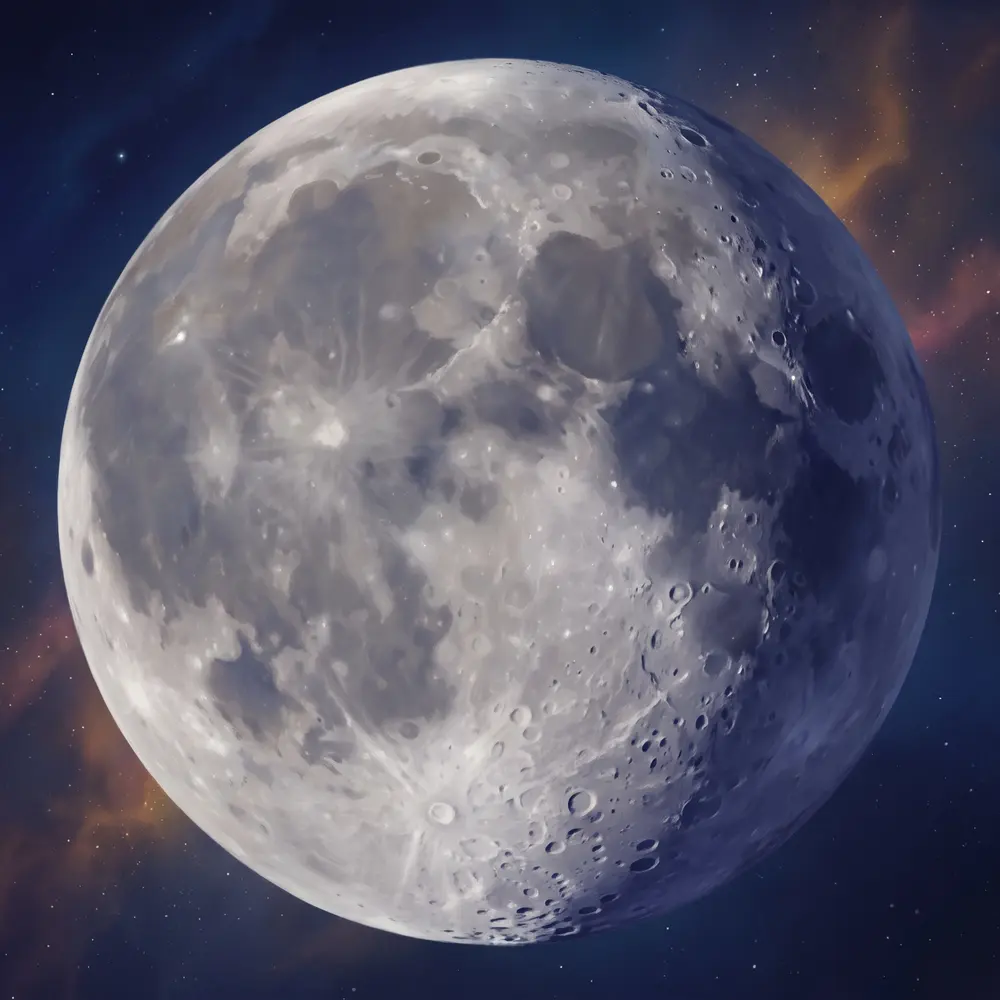
The numbers
- Diameter
- 2,159mi(3,475 km)
- Distance from the Earth
- 239,000mi(384,000 km)226,000 to 252,000 mi (363,000 to 406,000 km)
- Gravity
- 0.17Earth gravitiesOne sixth of Earth's
- One trip around the Earth
- 27.3days
- Air
- None
To get an idea
On the Moon you would not hear a single sound, because without air noise cannot travel.
The astronauts' footprints will last for millions of years: there is no wind to wipe them away.
The Moon turns on itself in the same time it takes to go around us, and that is why it always shows us the same face.
Fun facts
These are not in the book: there was no room on paper.
The Moon turns on itself in exactly the time it takes to go around us.
Its distance from us changes along its orbit by tens of thousands of miles.
Compared with the planet it circles, it is bigger than almost any other known moon.
By day the rocks get extremely hot and by night extremely cold, because there is no air.
It moves away from us by a little over an inch every year, and it will keep doing so.
Test yourself
The first question is the one printed under the QR code, with the answer the book did not give. The other four only exist here.
Question 1 of 5★ is the one from your book
What color is the surface of the Moon really?
Question 2 of 5
What are the seas of the Moon?
Question 3 of 5
Why would you hear nothing on the Moon?
Question 4 of 5
Why do we always see the same face?
Question 5 of 5
How much do you weigh on the Moon compared with Earth?
Riddles
I have seas that never held a drop of water: they are lakes of melted stone that cooled long ago. From far away I look white, up close I am as gray as a road. What am I?
Those who came to visit me left footprints, and those footprints are still here and will be here a million years from now. No wind ever blows on me. What am I?
Try it yourself
With binoculars resting on a wall, look at the edge between the lit part and the dark part: that is where shadows are long and craters are easiest to see.
Do not look at it when it is full if you want details: with the light shining straight on, the shadows vanish and the surface looks flat.
The words
- synchronous rotation
- When a body spins on itself in the same time it takes to orbit.
Sources: Wikidata (Q405), Wikipedia (Luna) and NASA.