
Ursa Minor and the North Star
The spot in the sky that stays still
You can see it with your eyes
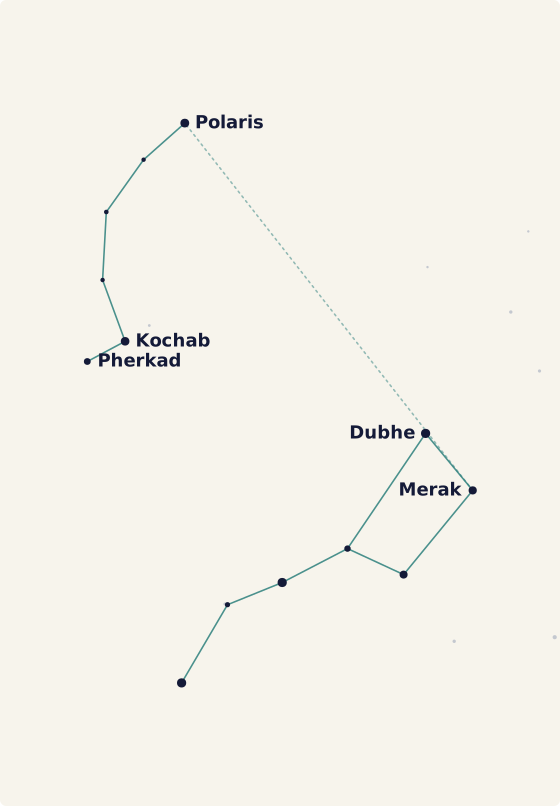
Finding it in the sky
When to look
Every night of the year, always in exactly the same spot, looking north. It is the only star that does not change place with the hours of the night or with the seasons.
How to recognize it
You do not search for it on its own. Find the Big Dipper, take the two stars on the side of the bowl away from the handle and stretch that line five times: the first bright star you meet is this one.
The main stars
- PolarisAlfa Ursae Minoris
- KochabBeta Ursae Minoris
- PherkadGamma Ursae Minoris
- DubheAlfa Ursae Majoris
- MerakBeta Ursae Majoris
To get an idea
How high the North Star is above the horizon tells you how far you are from the equator.
In one night all the other stars travel a full circle around it, and it stays where it is.
Fun facts
These are not in the book: there was no room on paper.
The Earth's axis wobbles and makes a full circle in about twenty-six thousand years.
Thousands of years ago the north of the sky was marked by other stars, including Vega and Thuban.
In the southern half of the world there is no bright star above the pole: people find their way with the Southern Cross.
Seen from the Moon, the star at the pole is not the same as ours: every world has its own.
In Indian myth this star is called Dhruva and holds the highest place in the sky.
A camera left open for a long time shows all the stars circling around it.
Test yourself
The first question is the one printed under the QR code, with the answer the book did not give. The other four only exist here.
Question 1 of 5★ is the one from your book
Why does the North Star seem to stand still?
Question 2 of 5
Is it the brightest star in the sky?
Question 3 of 5
How do you find the North Star?
Question 4 of 5
What constellation is it in?
Question 5 of 5
Will it always be the one pointing north?
Riddles
I sit at the end of a dipper much smaller and fainter than the famous one. To find me you first have to find the big one, and then stretch a line five times. What am I?
Many thousands of years from now I will no longer be the one doing this job, because the world that looks at me wobbles slowly like a tired spinning top. What am I?
Try it yourself
Look at it again two hours later. All the stars around it will have moved, and it will not: it is the simplest way to be convinced.
Stretch out your arm and count how many fists fit between the horizon and the North Star. That number changes if you travel far north or far south.
The words
- latitude
- How far a place is from the equator, to the north or to the south.
- precession
- The slow wobble of the Earth's axis, one full circle every twenty-six thousand years.
Sources: Wikidata (Q662656), Wikipedia (Stella polare).