
The numbers
- How far away it is
- 1light-years0.3 to 1.5 light-years
- Compared with Pluto
- 2,400timesfarther from the Sun
- What shape it has
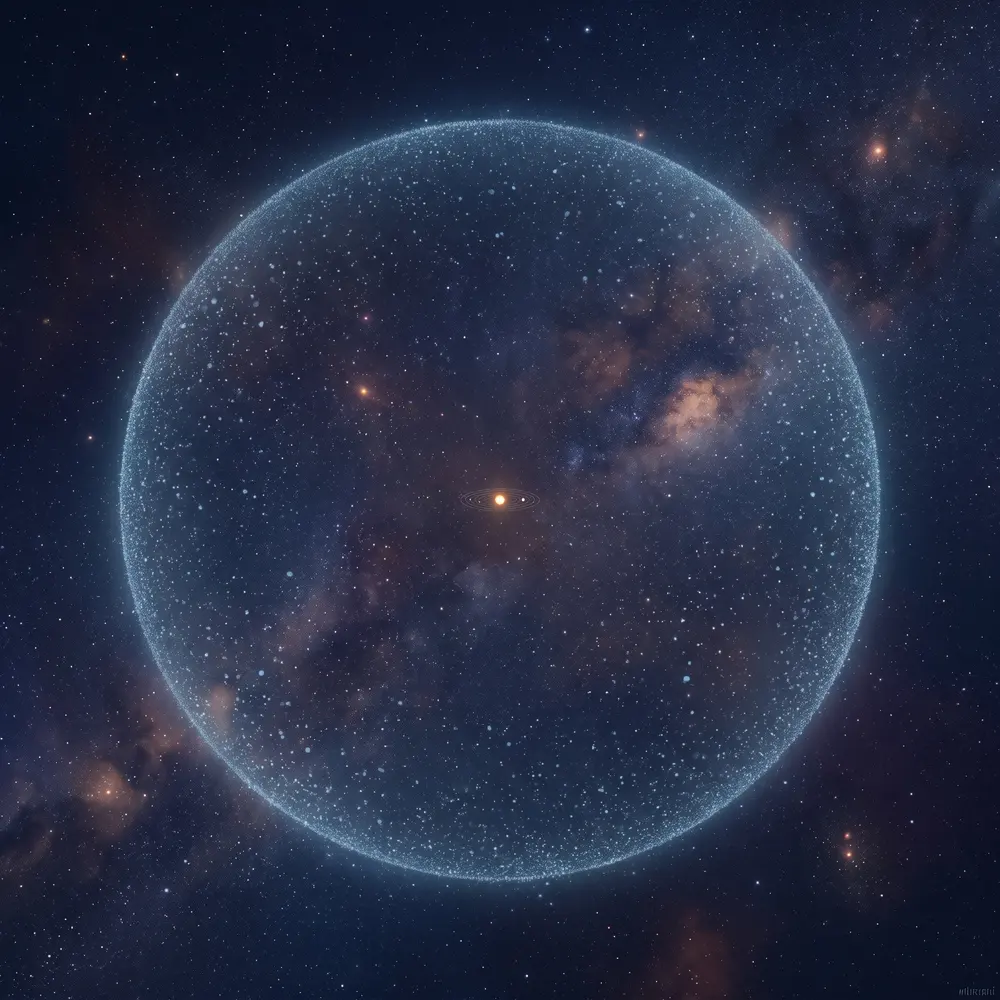
- A round shell around the Sun
- What it holds
- Millions of comet nuclei
To get an idea
It is not a ring but a shell: comets arrive from every direction, even from above and below.
If all comets were original, they would have worn away long ago: something must be restocking them.
Fun facts
These are not in the book: there was no room on paper.
Famous comets like Hale-Bopp and Hyakutake come from this very distant region.
It would be a leftover of the same cloud from which the Sun and the planets formed.
It is bound to the Sun so weakly that a passing star can tear pieces away from it.
Other stars are thought to have their own cloud of comets around them too.
The outer edges of the clouds of two nearby stars might even overlap.
Test yourself
The first question is the one printed under the QR code, with the answer the book did not give. The other four only exist here.
Question 1 of 5★ is the one from your book
Has anyone ever seen the Oort Cloud?
Question 2 of 5
What reasoning led to the idea?
Question 3 of 5
What shape does it have?
Question 4 of 5
Why do its nuclei stay untouched?
Question 5 of 5
What is it made of?
Riddles
Nobody has ever seen me and probably nobody ever will, and yet astronomers are almost sure I exist. They found me by reasoning, not by looking. What am I?
I am not a ring but a shell, and you can tell from how my visitors arrive: from every direction, even from above and below. What am I?
For billions of years I have kept millions of balls of ice, untouched because my Sun is too far away to spoil them. Every now and then I lend one out. What am I?
Try it yourself
Try Oort's reasoning on something else: if you always find new candy in a bowl, someone is refilling it. You have not seen it, but you know it.
Follow the next bright comet announced by the observatories. If its trip takes thousands of years, it is a visitor coming from out there.
The words
- astronomical unit
- The average Earth to Sun distance, the yardstick of the Solar System.
- comet nucleus
- The solid, icy heart of a comet, before it warms up.
Sources: Wikidata (Q13181), Wikipedia (Nube di Oort).