
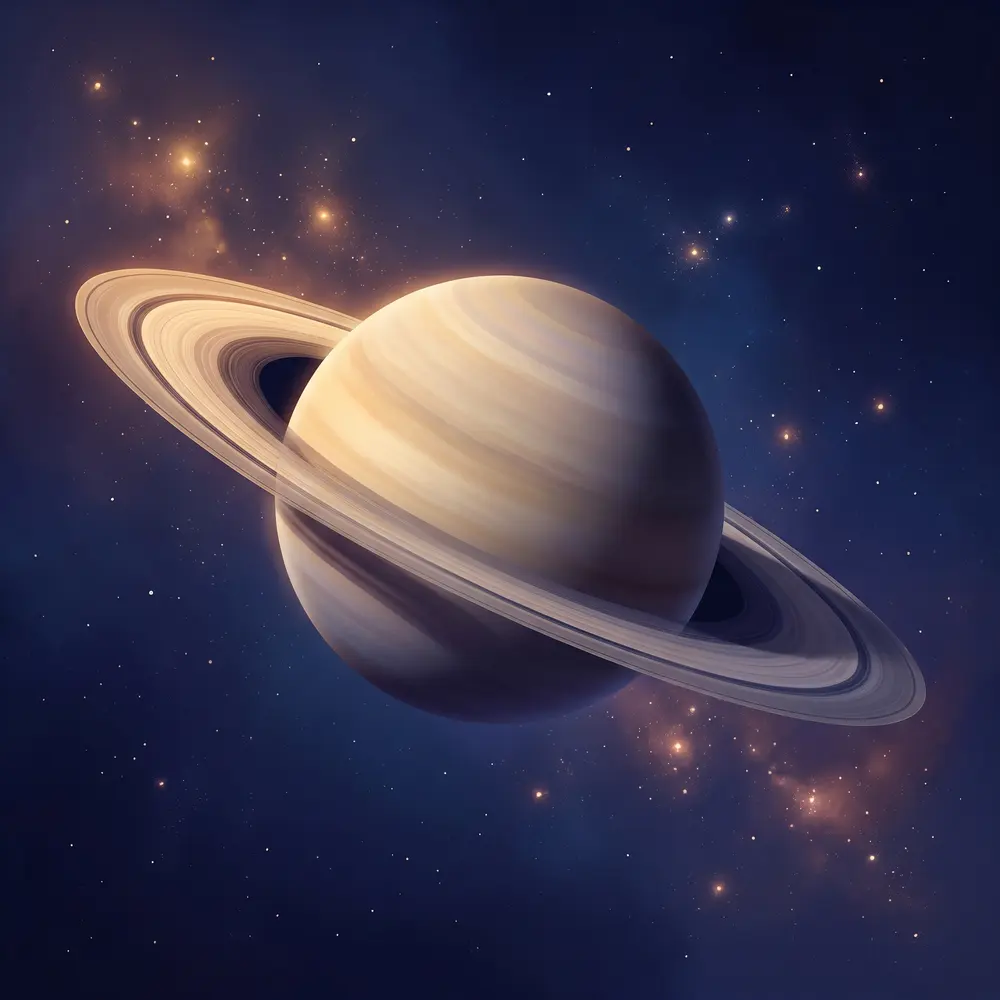
The numbers
- Diameter
- 74,898mi(120,536 km)
- Density
- 687kg per cubic meterLess than water: it would float
- Length of a year
- 10,747days
- Average temperature
- -220°F(-140 °C)
- Known moons
- More than two hundred fiftytoday: 274source: NASAThe count is still going up
To get an idea
It has more moons than any other planet in the Solar System: more than two hundred fifty.
Titan, its biggest moon, is bigger than the planet Mercury.
A year on Saturn lasts almost thirty Earth years.
Fun facts
These are not in the book: there was no room on paper.
Under the atmosphere there is a thick layer of metallic hydrogen and then a core of rock and ice.
A year on Saturn lasts almost thirty Earth years, so its seasons are very long.
Saturn is squashed at the poles too, because it spins fast and is made of gas.
At its north pole there is a storm shaped like an almost perfect hexagon.
You can see it with your eyes as a steady, yellowish star, but for the rings you need instruments.
Test yourself
The first question is the one printed under the QR code, with the answer the book did not give. The other four only exist here.
Question 1 of 5★ is the one from your book
Why do people say Saturn would float?
Question 2 of 5
Which planet has the most moons of all?
Question 3 of 5
What is special about Titan?
Question 4 of 5
How long is a year on Saturn?
Question 5 of 5
Can you land on Saturn?
Riddles
I have more companions than anyone else around here, more than two hundred fifty, and they keep finding more. The biggest of them even beats a planet in size. What am I?
To go just once around the fire I need almost thirty of your years. Someone who watches me as a child and then as a grandparent sees me come back only twice. What am I?
Try it yourself
Look at it again with a small telescope: the little disk will not be round but will have two bumps on the sides, or a thin ring all around.
Put a cork and a stone in a bowl of water. Saturn would behave like the cork, even though it is enormous.
The words
- hydrogen
- The lightest gas there is, and the most common in the whole universe.
Sources: Wikidata (Q193), Wikipedia (Saturno (astronomia)) and NASA.