
Space · Living in space and watching the sky
Searching for life in the universe
A science about something never found
Only spacecraft can see it
The numbers
- What science it is
- AstrobiologyIt studies where life begins and spreads
- What a planet needs
- Many conditions, and rare ones
- Where things stand
- No life found, for nowBeyond the Earth
How it happens, step by step
Look at home
Start from the only example of life we know, ours, and study what it has needed.
Make a list
Water in liquid form, certain chemical elements, a steady source of energy and a great deal of time.
Find the places
Check which worlds have those conditions: Europa, Enceladus, Mars and some planets around other stars.
Look for traces
Not an animal but a sign: molecules, gases in the air or structures that only life could make.
Wait
So far no trace has held up when checked. The question stays open, and that is an answer too.
To get an idea
You need liquid water, certain chemical elements, a source of energy and a lot of time.
To this day no life has been found anywhere beyond the Earth, not even a bacterium.
Fun facts
These are not in the book: there was no room on paper.
Time is needed too: life does not appear in a week, but over very long stretches of time.
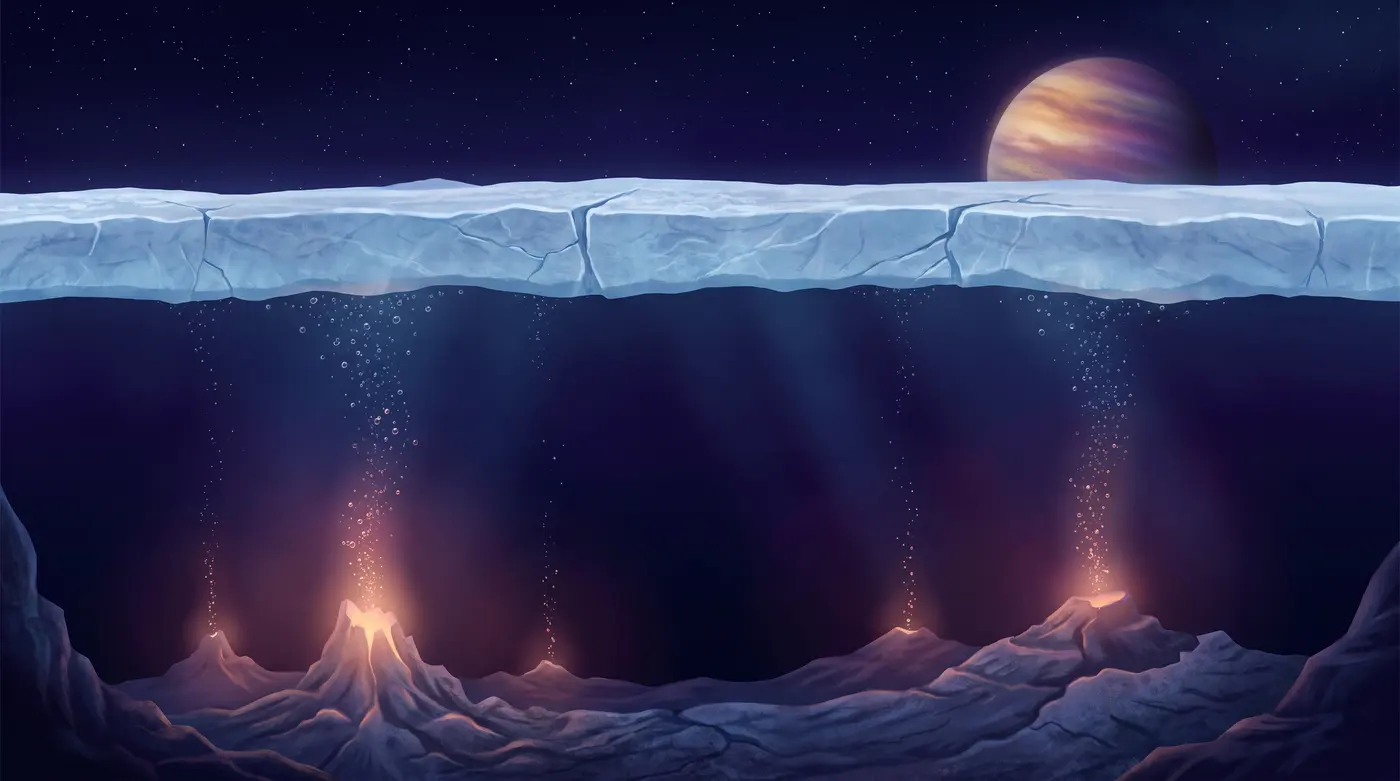
Europa and Enceladus draw a lot of interest because they hide liquid water under their ice.
Mars is interesting because it once had rivers, even though today its surface is a desert.
On Earth there are creatures that live in boiling, freezing or oxygen-free places.
Those creatures stretch the list of places where it makes sense to go looking.
So far no life has been found beyond the Earth, not even in the form of a bacterium.
Test yourself
The first question is the one printed under the QR code, with the answer the book did not give. The other four only exist here.
Question 1 of 5★ is the one from your book
What does astrobiology study?
Question 2 of 5
What is the first ingredient on the list?
Question 3 of 5
Why are Europa and Enceladus interesting?
Question 4 of 5
Has life been found beyond the Earth?
Question 5 of 5
What is needed besides the right ingredients?
Riddles
I am a science that studies something nobody has ever found, and it is not a contradiction: I study the conditions, not the creatures. What am I?
Little green men do not interest me: I want to know whether somewhere there is liquid water, certain chemical elements, a source of energy and enough time. What am I?
So far my answer has always been the same: nothing, nowhere, not even a bacterium. And yet I have no intention of stopping. What am I?
Try it yourself
Look up where the creatures called extremophiles live: boiling springs, permanent ice, seabeds with no light. They are the places that changed the search.
Try answering the question yourself: if tomorrow they found a bacterium on another moon, what would change? There is no wrong answer.
The words
- extremophile
- A living thing that thrives in conditions that would kill almost anything else.
Sources: Wikidata (Q189962), Wikipedia (Astrobiologia).