
Taurus and the Pleiades
The V with the orange eye
You can see it with your eyes
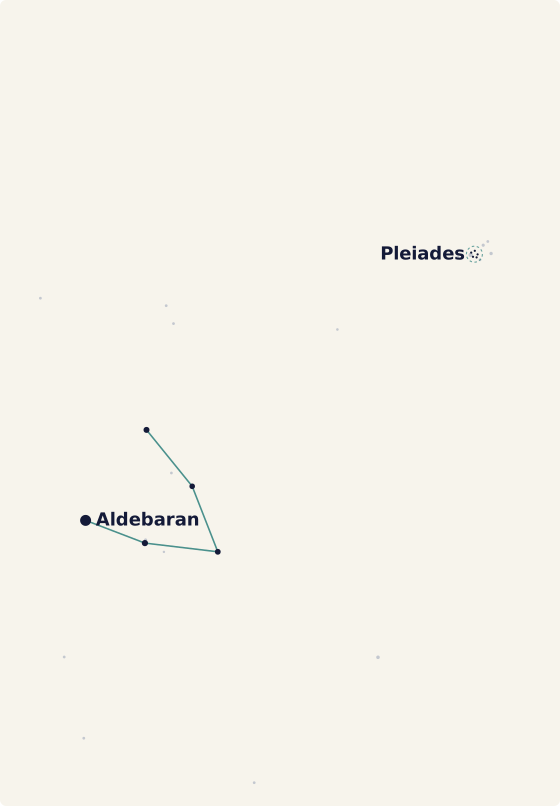
Finding it in the sky
When to look
Winter evenings, from November to March, looking south and rather high. The Pleiades rise first, then Taurus follows and finally Orion, lower down.
How to recognize it
Start from Orion's Belt and stretch its line upward: you reach a V of stars with an orange tip. A little farther on, in the same direction, is the small smudge of the Pleiades.
The main stars
- AldebaranAlfa Tauri
- PleiadesM45
To get an idea
In a city you count four or five Pleiades, from a dark place as many as twelve: the number measures the sky, not the eyes.
The Pleiades are very young for stars, and that is exactly why they are blue and very hot.
Fun facts
These are not in the book: there was no room on paper.
Many ancient peoples used the Pleiades as an eye test, counting how many they could make out.
In Japan the Pleiades are called Subaru, and six of them appear in the logo of a car company.
For the Maori of New Zealand they are called Matariki, and their rising marks the start of the year.
The Nebra sky disk, made of bronze and more than three thousand years old, shows the Pleiades next to the Sun and Moon.
Around the stars of the Pleiades there is a veil of dust that reflects their blue light.
In a few hundred million years the cluster will drift apart, because its stars are too far from each other.
Test yourself
The first question is the one printed under the QR code, with the answer the book did not give. The other four only exist here.
Question 1 of 5★ is the one from your book
What are the Pleiades?
Question 2 of 5
What does the orange star Aldebaran mark?
Question 3 of 5
How many Pleiades can you see with the naked eye?
Question 4 of 5
Why are the Pleiades blue?
Question 5 of 5
What are the Pleiades called in Japan?
Riddles
We are a small group of sisters who look from far away like a breath on a window. Whoever has good eyes and a dark sky counts us all; whoever is in a city sees only four. Who are we?
I have a V-shaped face and just one eye, big and orange. My horns are so long that they never fit on a small map. What am I?
We are not close together for pretend like almost all the figures in the sky: we were born together and we travel together, blue and very young. Who are we?
Try it yourself
Try looking at it not straight on but a little to the side, out of the corner of your eye. Many people see one or two more appear that way.
Point binoculars at the smudge. The few stars become dozens, and you can see right away that they are all the same bluish color.
The words
- light-year
- The distance light travels in one whole year.
- reflection nebula
- Dust that does not shine by itself but sends back the light of nearby stars.
Sources: Wikidata (Q13024), Wikipedia (Pleiadi (astronomia)).