
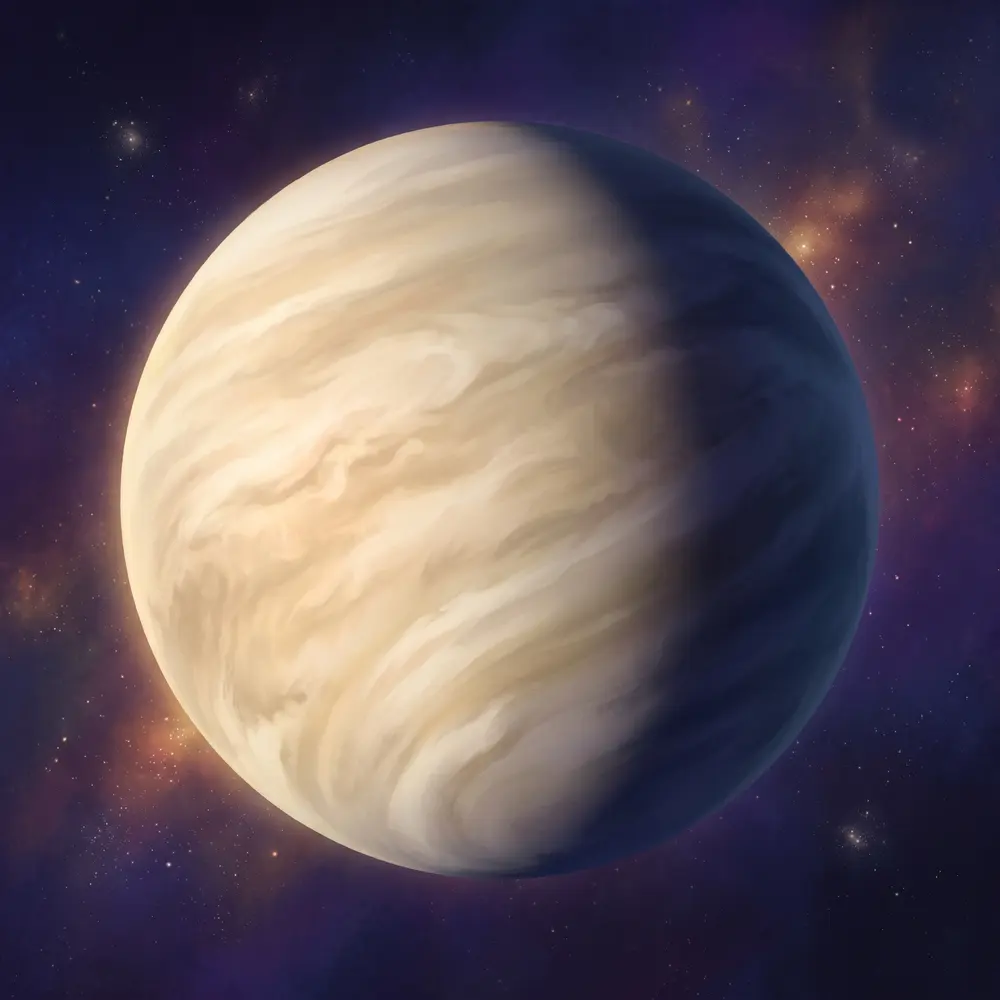
The numbers
- Diameter
- 7,521mi(12,104 km)
- Average temperature
- 867°F(464 °C)
- Air pressure
- 92times Earth's
- Length of a day
- 2,802hours
- Length of a year
- 224.7days
To get an idea
The air on its surface presses as hard as water at the bottom of a sea more than half a mile deep.
It is hotter than Mercury, which is much closer to the Sun.
Fun facts
These are not in the book: there was no room on paper.
There are more volcanoes on its surface than on any other planet in the Solar System.
No probe that landed down there survived more than a couple of hours: heat and pressure destroy them.
It has no magnetic field like the Earth's to protect it from the solar wind.
Its surface does not show up in ordinary photographs: it was mapped with radar.
Its day is longer than its year: it spins more slowly than it travels around the Sun.
Test yourself
The first question is the one printed under the QR code, with the answer the book did not give. The other four only exist here.
Question 1 of 5★ is the one from your book
Which is the hottest planet in the Solar System?
Question 2 of 5
What are the clouds of Venus made of?
Question 3 of 5
Which way does Venus spin?
Question 4 of 5
Why does Venus look so bright?
Question 5 of 5
How was the surface of Venus mapped?
Riddles
I am the brightest thing in the night after the Moon, and that is why I was given two names: one for dawn and one for evening. And yet I am not a star. What am I?
I spin the opposite way from all my brothers, and so slowly that my day is longer than my year. If I could look out, I would see the Sun rise on the wrong side. What am I?
Try it yourself
Look at it the same evening with binoculars: you will see a small disk, not a dot, and sometimes a crescent shape like the Moon's.
Take two identical balls, wrap one in a thick scarf and leave them in the sun: the covered one heats up more and does not cool down.
The words
- radar
- A tool that sees through clouds by bouncing waves off the ground.
Sources: Wikidata (Q313), Wikipedia (Venere (astronomia)) and NASA.