
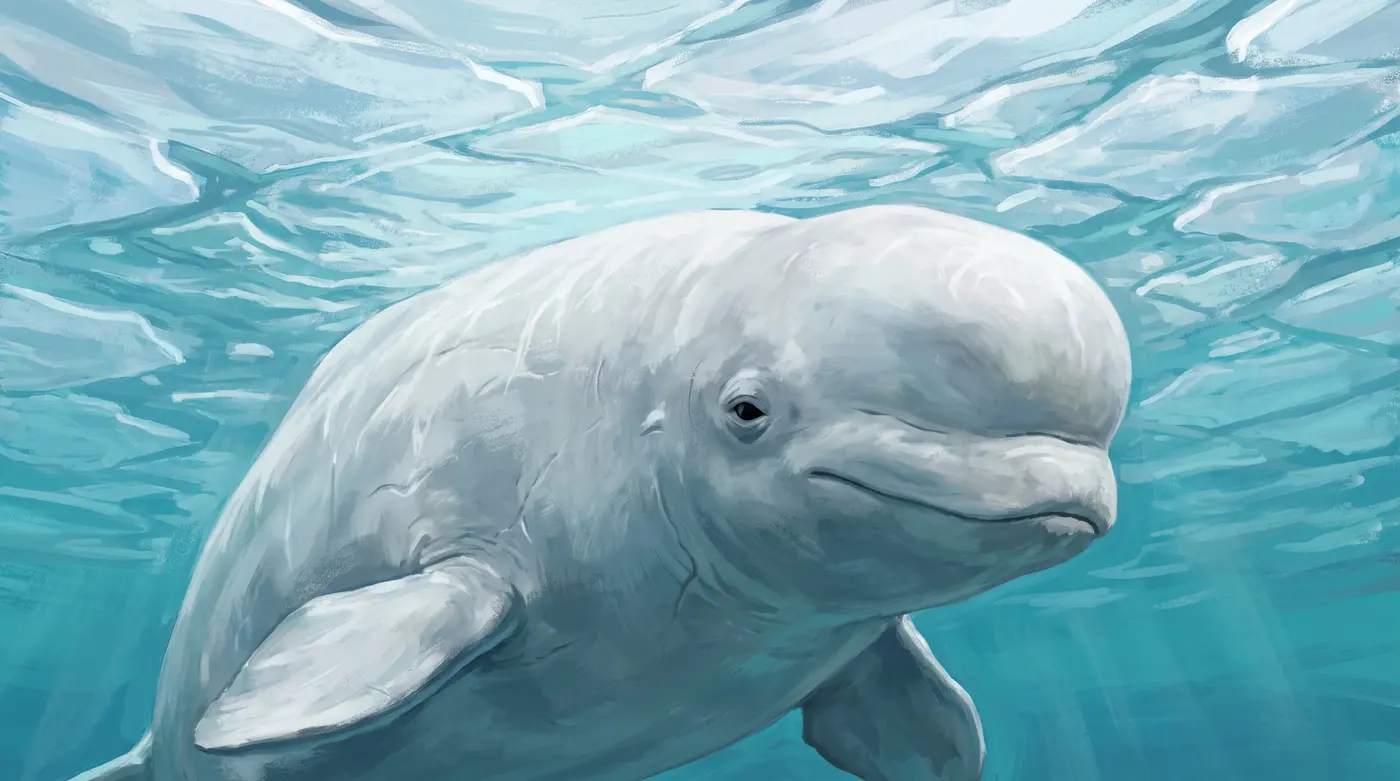
- Status: Safe
- Arctic seas and estuaries of Alaska, Canada, Greenland, and Russia
Numbers
- Weight
- 2600 lbfemales 1,500 to 2,600 lb, males 2,400 to 3,500 lb
- Length
- 18 ftmales up to 18 ft, females 13 ft
- Lifespan
- 50 yearsmaximum reported lifespan
- Depth
- 2000 fttypically hunts at 1,000 feet, can dive twice as deep
- Breath-hold
- 20 minutestypical dive lasts 3 to 5 minutes
- Documented calls
- 11 different callswhistles, squeaks, chirps, trills, and bell-like tones
Ten fun facts
the name comes from the Russian word beloye, meaning white, but calves are born gray or dark brown and lighten over time.
its neck vertebrae are not fused together, so the beluga can turn its head sideways and even change facial expressions.
its thyroid gland is proportionally three times larger than that of a horse, supporting a very fast metabolism in cold waters.
unlike most other whales, the beluga is able to swim backward easily without needing to turn its body around first.
a beluga has between thirty-four and forty teeth inside its mouth, with eight to ten on each side of every jaw.
it sometimes spits water at people and animals, which is likely the same behavior it uses to uncover prey in seafloor sand.
its tail fin never stops growing throughout its life and becomes increasingly curved as the animal gets older over the years.
beluga bones discovered in Vermont in 1849, over one hundred miles inland, are now the official state fossil of Vermont.
the navies of both the United States and Russia have trained belugas to assist in underwater mine clearance in Arctic seas.
scientists estimate about one hundred thousand belugas live in the wild, with around forty thousand in the Beaufort Sea alone.
The quiz answers
The first one is the question printed in your book: here is the answer. The other four are extra.
Question 1 of 5★ this one is in your book
What color is a newborn beluga?
Question 2 of 5
What does the beluga lack compared to other whales?
Question 3 of 5
Why is it called the canary of the sea?
Question 4 of 5
At what depth does it usually search for food?
Question 5 of 5
How many years can a beluga live?
Try it yourself
Measure eighteen feet on the floor using a tape measure to match the length of an adult male. Compare that length to your bedroom.
Hold your breath while counting the seconds, stopping as soon as you feel uncomfortable, and compare your time with twenty minutes underwater.
Find the Beaufort Sea, Hudson Bay, and the Saint Lawrence estuary on a map to see where three different populations of this whale live.
Data from Wikidata (Q132072) and Wikipedia (Beluga whale).