
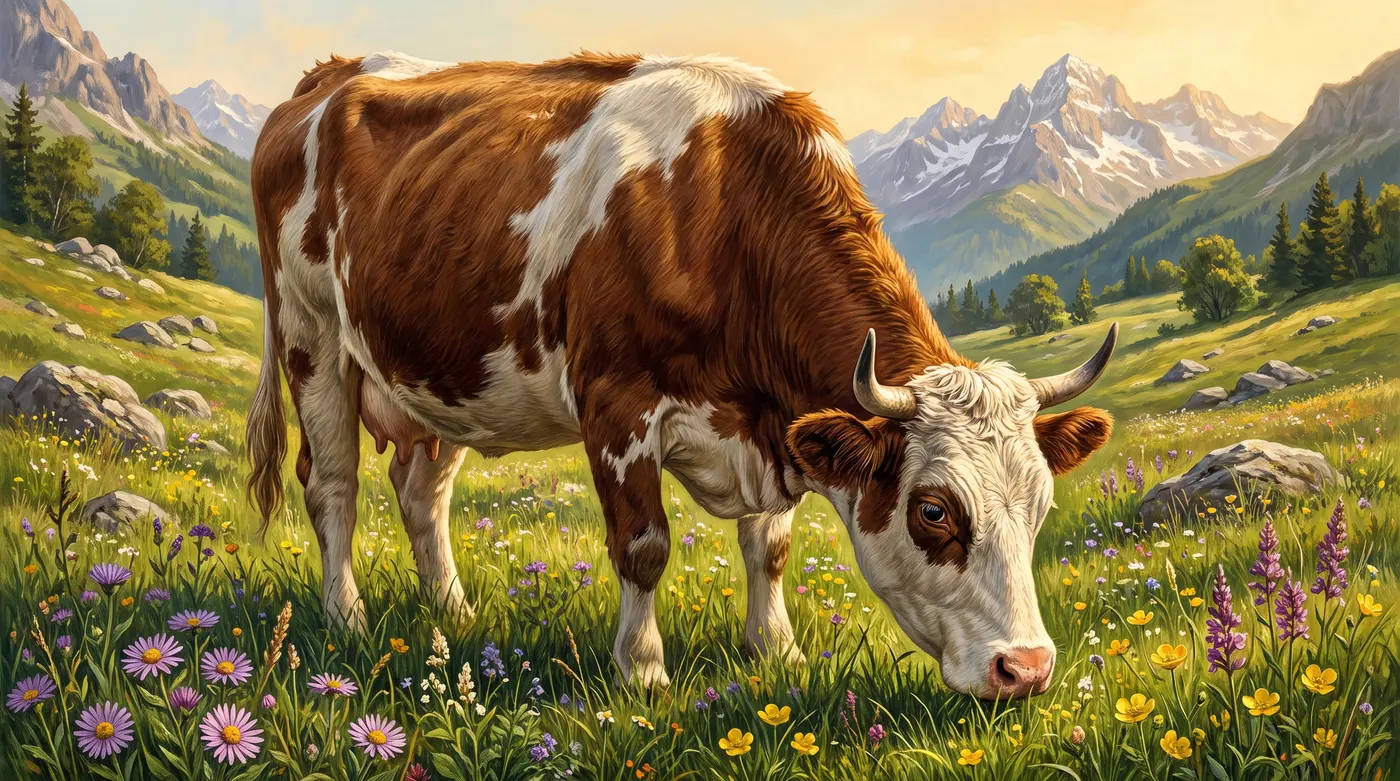
- Status: Safe
- Pastures and barns worldwide, raised by humans
Numbers
- Weight
- 1650 lbfrom 1,100 to 2,400 lb depending on breed
- Length
- 8,5 ftfrom 8 to 9 ft
- Height
- 4,5 ftfrom 4 to 5 ft
- Lifespan
- 15 yearsfrom 15 to 20 years
- Daily milk yield
- 18 gallonsvalue for champion dairy cows, far above average
- Stomachs
- 4 stomachsthree prestomachs plus the abomasum, the glandular stomach
- Colostrum at birth
- 1,3 gallonsto drink in the calf's first 24 to 36 hours of life
Ten fun facts
lacks incisors in its upper jaw, having instead a tough pad called a dental pad to press grass against.
has four stomach compartments where the rumen, reticulum, and omasum process food before the abomasum actually digests it.
has a rib cage formed by thirteen pairs of ribs, which is one pair fewer than the bison has.
has four toes on each foot, but only two touch the ground while two point back for extra stability.
can distinguish the color red, but it is not the cape color that makes a bull aggressive in the ring.
descends from the wild aurochs, an ancient wild bovine species that survived in Poland until the seventeenth century.
got its alternative Italian name mucca in eighteenth-century Tuscany to describe dark cows imported from Switzerland.
needs a newborn calf to drink over a gallon of nutrient-rich colostrum to gain essential protective antibodies.
grows hollow horns made of a bony core covered in keratin, present in both male and female cows.
is raised in many traditional breeds across Italy, including the Holstein Friesian, Brown Swiss, and Chianina.
The quiz answers
The first one is the question printed in your book: here is the answer. The other four are extra.
Question 1 of 5★ this one is in your book
How many stomach compartments does a domestic cow have?
Question 2 of 5
Which teeth are completely missing in a cow?
Question 3 of 5
Which wild animal is the ancestor of all domestic cows?
Question 4 of 5
Can cows see the color red?
Question 5 of 5
How many pairs of ribs does a domestic cow have?
Try it yourself
Count your upper front teeth and notice that a cow has none. Instead, it features a hard pad against which it presses its lower teeth.
Line up five one-quart bottles to see how much colostrum a newborn calf must drink during its very first hours of life.
Draw the outline of a cow with thirteen pairs of ribs, then draw a bison with fourteen pairs to compare their rib structure.
Data from Wikidata (Q830) and Wikipedia (Cattle).