
- Status: Unknown
- Gardens and open woodlands of the Holarctic region
Numbers
- Weight
- 0,04 ozfrom 0.02 to 0.05 oz (females)
- Length
- 0,8 inadult female, from 0.25 to 0.8 in; the male ranges from 0.2 to 0.5 in
- Lifespan
- 2 yearsfrom 1 to 2 years; females die shortly after laying eggs
- Eggs per cocoon
- 500 laid in a single cocoon at the end of summer
- Incubation
- 9 monthsthe eggs spend the entire winter enclosed in the cocoon
- Sexual maturity
- 4 monthsout of a total lifespan of one or two years
Ten fun facts
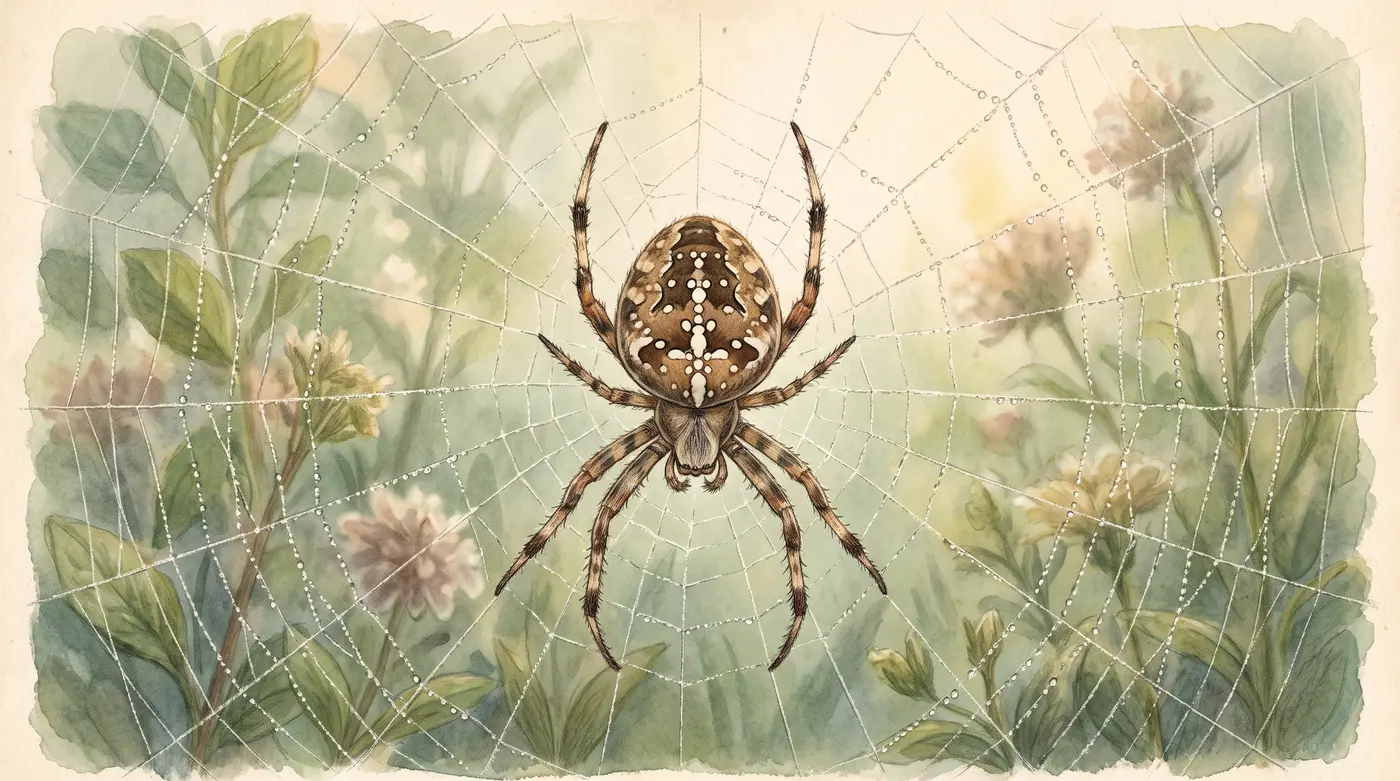
the white cross on its back is made of cells filled with guanine, a waste product of protein metabolism.
the female reaches four fifths of an inch while the male reaches only half an inch, a difference that matters during courtship.
it lays about five hundred eggs in a single silk cocoon at the end of summer, then dies shortly afterward.
the eggs hatch nine months later, which means no female spider ever sees the offspring that she laid.
it reaches sexual maturity at four months old, but its entire life lasts for only one or two years.
its bite has no serious consequences for humans, causing only a very mild sting that feels like a slight pinch.
when disturbed, it almost always flees instead of attacking, even when sitting right at the center of its web.
it is not at the top of the food chain, as birds, amphibians, and lizards regularly catch and eat it.
it catches medium-sized flying insects, such as bees, flies, wasps, and butterflies that get trapped in silk threads.
there are four recognized subspecies, with one living only in Iceland and another living only in Corsica.
The quiz answers
Five questions about this animal. Pick an answer and find out if it is the right one.
Question 1 of 5
How long does a cross spider live on average?
Question 2 of 5
What forms the white cross on its back?
Question 3 of 5
How many eggs does the female lay in a cocoon?
Question 4 of 5
Is its bite dangerous to humans?
Question 5 of 5
What does it eat?
Try it yourself
Measure four fifths of an inch on a ruler to see the maximum length of an adult female, then compare it to your thumbnail.
Count out loud up to five hundred and time how long it takes, which is how many eggs a female lays in a cocoon.
Look for a web in a garden early in the morning when the dew makes it visible, and count how many rays start from center.
Data from Wikidata (Q337509) and Wikipedia (Araneus diadematus).