
- Status: Unknown
- Warm open lands frequented by large herbivores
Numbers
- Weight
- 0,05 ozfrom 0.04 to 0.07 oz
- Length
- 1,3 inmidpoint of the reported range, from 1 to 1.5 in
- Lifespan
- 3 yearsup to 3 years in the wild
- Head projections
- 6 toothed projections on the clypeus, the front part of the head, used for digging and shaping
- Maximum length
- 1,5 inupper end of the known range
- Egg per ball
- 1 laid in the apical cavity of a pear-shaped sphere
Ten fun facts
the term dung beetle can refer strictly to another species, Geotrupes stercorarius, rather than the sacred scarab beetle.
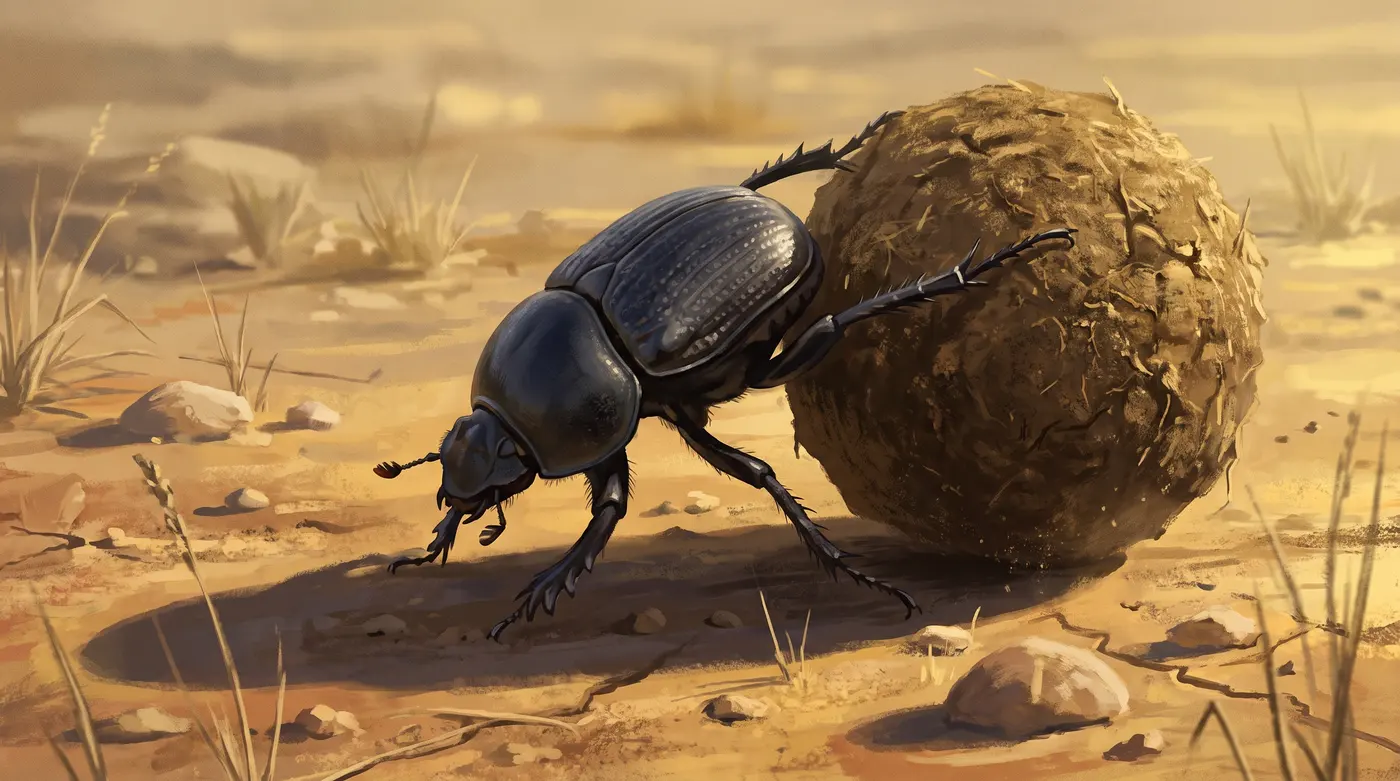
this insect pushes its dung ball while walking backward, keeping its front legs on the ground and using hind legs as levers.
at night this dung beetle navigates using the light of the Milky Way, making it the only known insect to do so.
during daytime it navigates using the polarization of sunlight, a light signal that human eyes are completely unable to detect.
the front legs of this beetle lack tarsi, which are insect feet segments, turning the limbs into specialized digging shovels.
the clypeus, which is the front section of the head, features six toothed points arranged like spokes on a wheel.
these beetles make two kinds of balls: food balls for eating and nuptial balls prepared by males to attract females.
the female lays just one single egg inside each dung ball, placing it in a small cavity at the top.
ancient Egyptians mistakenly believed that the male reproduced entirely on its own by injecting seed directly into the dung ball.
this insect was the very first species that sparked the interest of naturalist William Sharp Macleay, inspiring his entomology career.
The quiz answers
The first one is the question printed in your book: here is the answer. The other four are extra.
Question 1 of 5★ this one is in your book
How does it transport the dung ball?
Question 2 of 5
What does it use to navigate at night?
Question 3 of 5
How many eggs does the female lay in each ball?
Question 4 of 5
How long is the body of an adult?
Question 5 of 5
Why did ancient Egyptians consider it sacred?
Try it yourself
Take a ball of modeling clay, get down on all fours, and try pushing it backward using your feet to move like a dung beetle.
On a clear night far from city lights, look up to find the Milky Way, because that faint band of stars is the dung beetle compass.
Measure one and a half inches on a ruler to see the maximum adult length, then compare that measurement to the width of your thumb.
Data from Wikidata (Q1750802) and Wikipedia (Scarabaeus sacer).