
Animals · Farm and household friends
Dog
Canis lupus familiaris
The first animal domesticated by humans
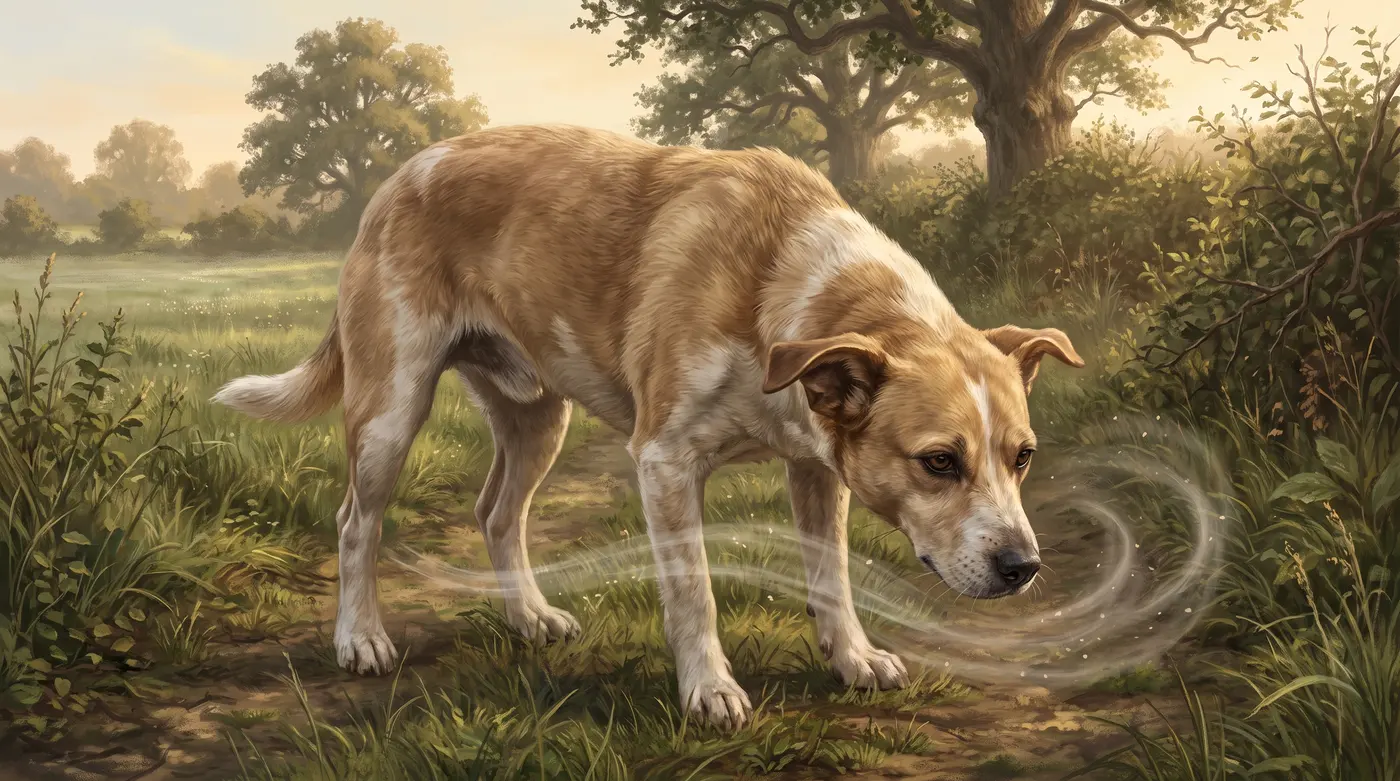
- Status: Safe
- Homes, farms, and villages all over the world, alongside humans
Numbers
- Weight
- 55 lbrepresentative value for a medium-large dog; the species ranges from 1 lb for a Chihuahua to 300 lb for a Saint Bernard
- Length
- 35 infrom 14 in (Chihuahua) to 55 in (Great Dane)
- Height
- 20 infrom 6 in (Chihuahua) to over 32 in (Great Dane)
- Lifespan
- 9 yearsWikidata entry, unconfirmed by descriptive text; small breeds generally live longer
- Words understood
- 165 wordsup to 250 in the most gifted individuals, around a thousand in exceptional cases, according to Stanley Coren
- Domestication
- 32100 years agogenetic estimate, in a range between 18,800 and 32,100 years ago
- Maximum weight
- 300 lbSaint Bernard, compared to 1 lb for a Chihuahua
Ten fun facts
is the first domesticated animal, with traces of early proto-dogs dating back more than thirty-six thousand years ago.
puppies double their weight by their sixth day of life and triple it around their thirtieth day.
a twelve-thousand-year-old grave at Ein Mallaha in Israel shows an elderly human with an arm resting on a puppy.
adult weight ranges from one pound in a Chihuahua to over three hundred pounds in a Saint Bernard.
the print of the ridges on its nose is unique to each individual, just like human fingerprints.
has sweat glands only on its nose and paw pads, so temperatures as low as seventy-seven degrees Fahrenheit can cause permanent damage.
its snout has cold receptors that sense evaporation, indicating exactly which direction a scent is coming from.
Japanese researchers proved in 2010 that its scent detection can identify patients suffering from colon cancer.
its liver cannot produce enzymes to process theobromine, making cocoa and chocolate toxic or even lethal in high amounts.
it has genetic adaptations to digest starch compared to wolves, allowing it to thrive on a diet rich in grains.
The quiz answers
Five questions about this animal. Pick an answer and find out if it is the right one.
Question 1 of 5
Which animal is the ancestor of the domestic dog?
Question 2 of 5
How long is the gestation period of a female dog?
Question 3 of 5
Why is chocolate dangerous for dogs?
Question 4 of 5
What makes every dog's snout unique?
Question 5 of 5
At what temperature does a dog start suffering from the heat?
Try it yourself
Weigh one pound of flour and imagine an adult Chihuahua. Then weigh your backpack. How many times could a three-hundred-pound Saint Bernard fit inside it?
List the commands a dog knows at your house. A well-trained one can understand one hundred sixty-five words, similar to a two-year-old child.
Blindfold yourself and try to identify three spices using only your nose. Then remember that a dog can spot a single molecule among millions.
Data from Wikidata (Q144) and Wikipedia (Dog).