
Animals · Deserts and drylands
Dromedary
Camelus dromedarius
Twenty-six gallons of water in ten minutes
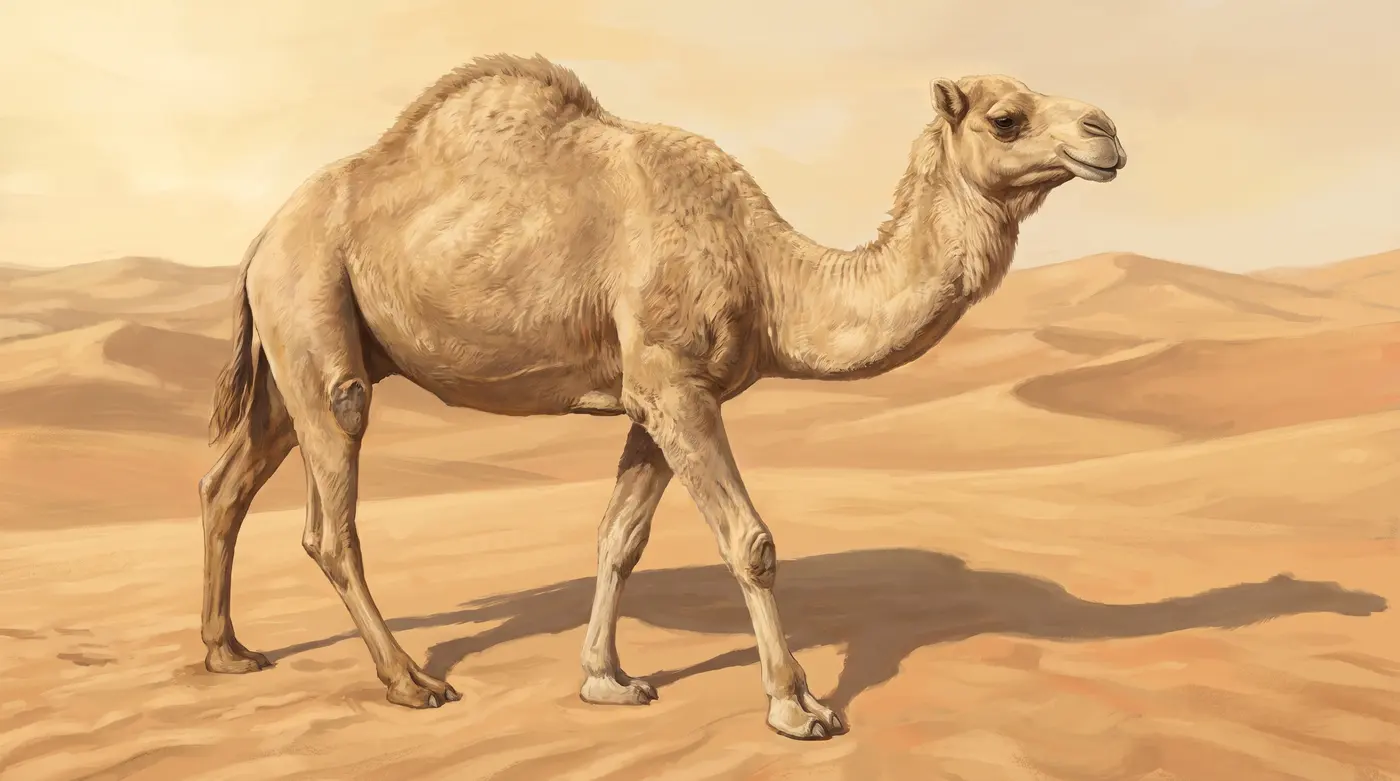
- Status: Safe
- Deserts and steppes of Northern Africa, Arabia, Asia, and Australia
Numbers
- Weight
- 1100 lbWikidata value for adults; Wikipedia text does not list weight
- Length
- 10 ftfrom 7 to 11 ft
- Height
- 6,5 ftfrom 6 to 7 ft
- Lifespan
- 45 yearsfrom 40 to 50 years
- Resistance to thirst
- 8 daysplus another 4 to 5 days with very salty plants
- Distance in a day
- 90 miin 15 to 20 hours, with a load of 330 to 440 lb
- Water consumed
- 26 galabout twenty-six gallons, in ten minutes
Ten fun facts
its name comes from the Greek word dromas, meaning fast, and served to distinguish it from the two-humped camel.
it actually has two humps, but the front one is almost completely underdeveloped and cannot be seen from the outside.
when it uses up fat, its hump shrinks in size instead of flopping to the side like a camel's hump.
burning two pounds of hump fat provides about a quart of water, in addition to energy for moving around.
it eats steppe plants so full of salt that they are toxic to humans, giving it four or five extra days without water.
its body temperature can rise by twelve degrees Fahrenheit without causing the animal to lose precious body fluids.
urea produced by the liver does not enter the urine, but returns to the stomach through the bloodstream for reuse.
in the Arabic language, there are about one hundred and sixty different words for it, more than for the horse.
a female can produce half a gallon to three gallons of milk daily, forming the basis of the Bedouin diet.
feral dromedaries in Australian deserts numbered at least six hundred thousand in 2008 and around three hundred thousand in 2013.
The quiz answers
Five questions about this animal. Pick an answer and find out if it is the right one.
Question 1 of 5
What does the hump contain?
Question 2 of 5
How many days can it survive without drinking?
Question 3 of 5
How many humps does the dromedary actually have?
Question 4 of 5
Where do free-roaming herds of dromedaries live today?
Question 5 of 5
How far can it travel in less than twenty hours?
Try it yourself
Fill a quart bottle one hundred times and imagine drinking it all in ten minutes. That is the amount of water a dromedary drinks during a single stop.
Mark eight straight days on a calendar to see how long this animal goes without drinking, then count how many times you drink in one day.
Measure your temperature, add twelve degrees Fahrenheit, and look at the result. For this desert creature that is normal, but for you it would be a dangerous fever.
Data from Wikidata (Q71516) and Wikipedia (Dromedary).