
- Status: Endangered
- Tropical and temperate seas worldwide, never in the Mediterranean
Numbers
- Weight
- 1800 lbon average 1,500 to 1,800 pounds, maximum recorded about 2 tons
- Length
- 22 ftdisc width from tip to tip, the measurement usually used to describe the species
- Lifespan
- 40 yearsup to 40 years
- Disc width
- 22 ftunconfirmed reports reach up to 30 feet
- Maximum weight
- 4400 lbrecord value, adults usually remain around 1,500 to 1,800 pounds
- Filtering gill slits
- 5 slitslocated on the belly, they trap plankton
Ten fun facts
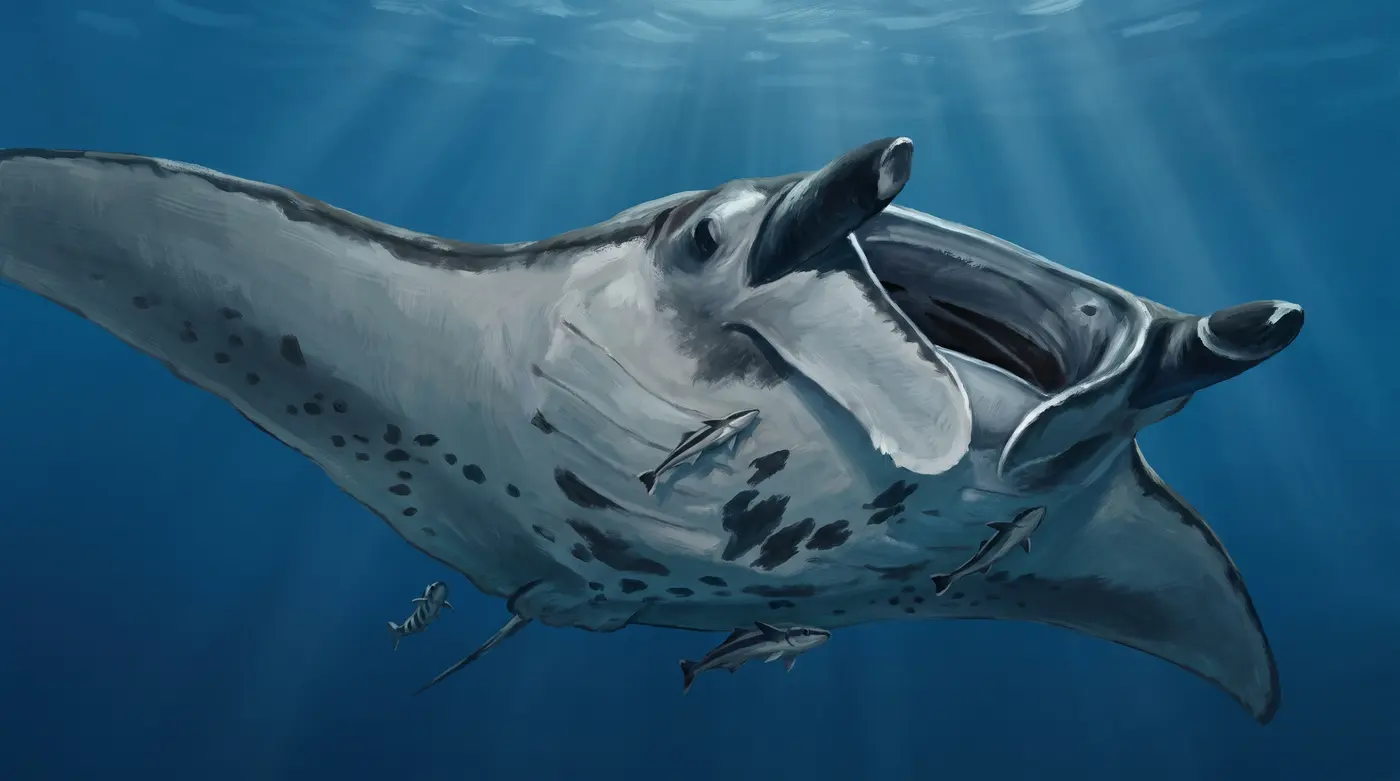
the two flaps beside its mouth roll up during swimming and look like horns, giving origin to its scientific name birostris.
its white belly bears dark spots that are unique on every individual, allowing researchers to recognize each giant manta ray.
its skeleton contains no bone and is made entirely of flexible cartilage, just like the skeleton of a shark.
it performs leaps completely out of the water, probably to rid itself of parasites or attached remora fish.
in the Atlantic Ocean it approaches the Strait of Gibraltar, but it never enters into the Mediterranean Sea.
the diamond shaped disc is about two and a half times wider than its length, with sharp lateral tips.
unlike other rays, it does not stay on the sea floor, but lives in the open ocean far from shore.
usually only one pup is born at a time, hatching from its egg inside the body of the mother.
during courtship, several males chase a single female for a long time until one of them prevails.
the closely related reef manta ray species Manta alfredi was recognized as a distinct species only in 2009.
The quiz answers
The first one is the question printed in your book: here is the answer. The other four are extra.
Question 1 of 5★ this one is in your book
What does the giant manta ray mainly feed on?
Question 2 of 5
What are the two flaps on the sides of its mouth used for?
Question 3 of 5
How wide can the disc reach?
Question 4 of 5
Which sea does it never enter?
Question 5 of 5
How many pups are usually born at one time?
Try it yourself
Measure twenty-two feet on your gymnasium floor with a tape measure to see the full disc width of an adult giant manta ray.
Weigh your full backpack and calculate how many times it goes into eighteen hundred pounds, the average weight of an adult.
Roll two sheets of paper into funnels and hold them beside your mouth to imitate the cephalic fins while eating.
Data from Wikidata (Q321976) and Wikipedia (Giant oceanic manta ray).