
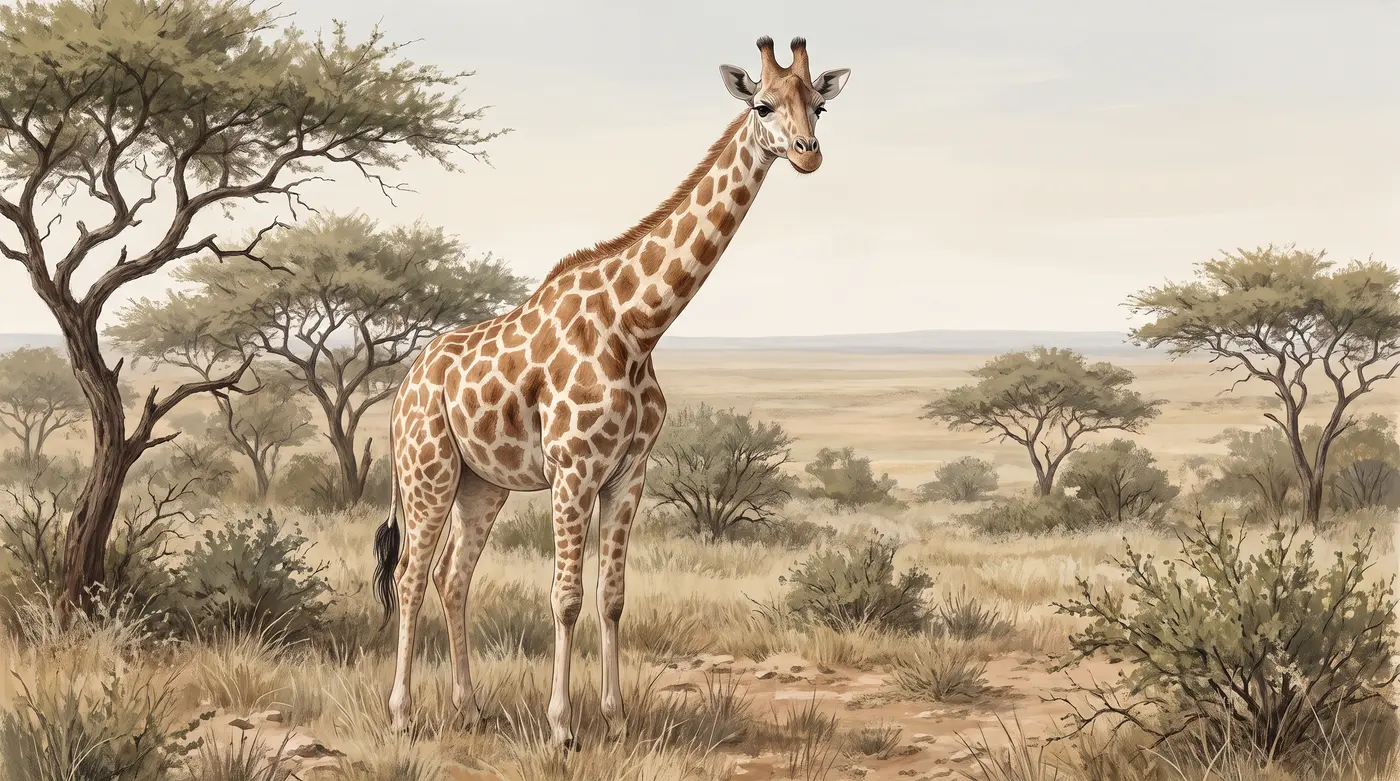
- Status: Threatened
- Savannas and woodlands of Eastern and Central Africa, in isolated populations
Numbers
- Weight
- 2200 lbfrom 1,800 lb (females) to 2,600 lb (males)
- Length
- 14 ftfrom 12 to 15 ft
- Height
- 18 ftWikidata value, not confirmed by reference text
- Lifespan
- 25 yearsfrom 20 to 25 years in the wild
- Height
- 18 ftWikidata value, to be confirmed by external source
- Remaining individuals
- 97000 individuals2016 count, all subspecies
- Male third horn
- 5 infrom 3 to 5 inches, which is about 7.6 to 12.7 centimeters
Ten fun facts
that in the Middle Ages it was called a camelopard, combining the ancient Greek words for camel and leopard?
that almost every African language has a different name for this animal, such as kameelperd in Afrikaans or twiga in Swahili?
that males have a third cylindrical horn in the middle of their forehead that can grow up to five inches long?
that the two bumps on their forehead are called ossicones, and both males and females have them?
that in 2016 only about ninety-seven thousand individuals of all subspecies were counted living in the wild?
that it lived in Morocco until around the year 600, when the dry climate of the Sahara made those lands uninhabitable?
that this species is also extinct in Libya and Egypt, where its range once reached all the way to northern regions?
that it lived in Chad in the late Pliocene, making its history in Africa millions of years long?
that scientists disagree on the number of species, with IUCN recognizing one and other proposals recognizing up to eleven?
that only a few hundred individuals survive confined inside the Dosso Reserve near Kouré in Niger?
The quiz answers
Five questions about this animal. Pick an answer and find out if it is the right one.
Question 1 of 5
What are the bumps on the forehead of the Giraffe called?
Question 2 of 5
Where does the name camelopardalis come from?
Question 3 of 5
How many individuals of all subspecies were counted in the wild in 2016?
Question 4 of 5
How many subspecies does the IUCN taxonomic scheme recognize?
Question 5 of 5
Why did giraffes disappear from Morocco?
Try it yourself
Wikidata lists eighteen feet as the height for this species. Measure the height of your room and calculate how many floors high it would need to be to fit inside.
One inch equals two point five four centimeters. Multiply that by five to find the maximum length of the male third horn, then draw it at full real scale.
On a map of Africa mark Senegal, Mali, Nigeria, and Egypt for its ancient range. Then mark Kenya, Chad, and Niger, and compare how much space is left.
Data from Wikidata (Q15083) and Wikipedia (Northern giraffe).