
Animals · Insects and small creatures
Honey bee
Apis mellifera
A society of one hundred thousand sisters
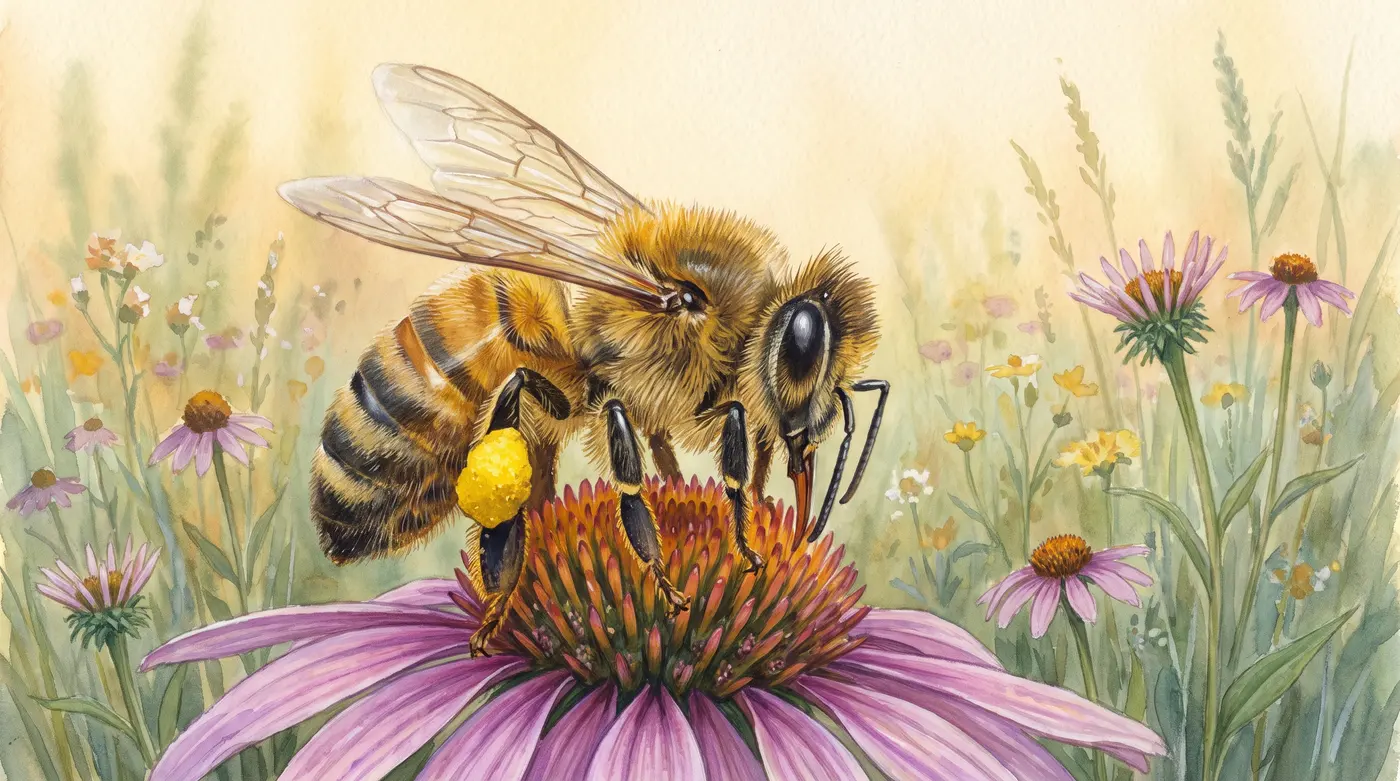
- Status: Unknown
- Every continent except Antarctica, wherever there are flowers
Numbers
- Weight
- 0,0035 ozfrom 0.0035 oz for workers to 0.009 oz for the queen
- Length
- 0,6 infrom 0.5 to 0.6 in
- Lifespan
- 38 daysadult worker, from 30 to 45 days, longer if born in autumn; queen up to 4 or 5 years
- Workers per hive
- 100000 individualsfrom 40,000 to 100,000, all sterile females
- Flight range
- 2 mimaximum estimated distance a worker honey bee searches for food
- Eggs laid in a day
- 3000 eggsfrom 2,000 to 3,000 during abundant harvest periods
Ten fun facts
between forty thousand and one hundred thousand workers live in a beehive, all sterile females and all daughters of the same queen.
worker honey bees change jobs with age, first cleaning cells, then feeding larvae, and finally leaving the hive to forage.
a queen honey bee can lay up to three thousand eggs in a single day during periods of abundant nectar harvest.
foraging honey bees travel up to two miles from the hive and can return home without ever losing their way.
honey bees locate the position of the sun even behind clouds because they can perceive the polarized light of the sky.
honey bees communicate by dancing, and their dance indicates the direction, distance, and quality of the flower patch they found.
unfertilized eggs give rise to male honey bees with sixteen chromosomes, while fertilized eggs produce female honey bees with thirty-two.
the antenna of a worker honey bee contains about two thousand four hundred olfactory pits, compared to one thousand on a male.
a newly emerged queen honey bee produces a territorial piping sound between fifteen hundred and two thousand hertz, audible outside the hive.
the sting is an ovipositor modified into a weapon, which is why male honey bees do not possess one at all.
The quiz answers
Five questions about this animal. Pick an answer and find out if it is the right one.
Question 1 of 5
How many workers normally live in a beehive?
Question 2 of 5
What is the first job of a honey bee right after emerging from its cell?
Question 3 of 5
How far does a honey bee travel to search for food?
Question 4 of 5
How do honey bees find the sun when the sky is cloudy?
Question 5 of 5
What do male honey bees hatch from?
Try it yourself
Take a map of your town and draw a circle with a radius of two miles around your house. That is the area where a honey bee searches for flowers.
Mark forty-five days on a calendar starting from today. That represents the entire adult life of a worker honey bee from emergence to its final flight.
Try showing a friend where a distant location is without speaking or pointing, using only body movements. That is the exact challenge honey bees solve every day.
Data from Wikidata (Q30034) and Wikipedia (Western honey bee).