
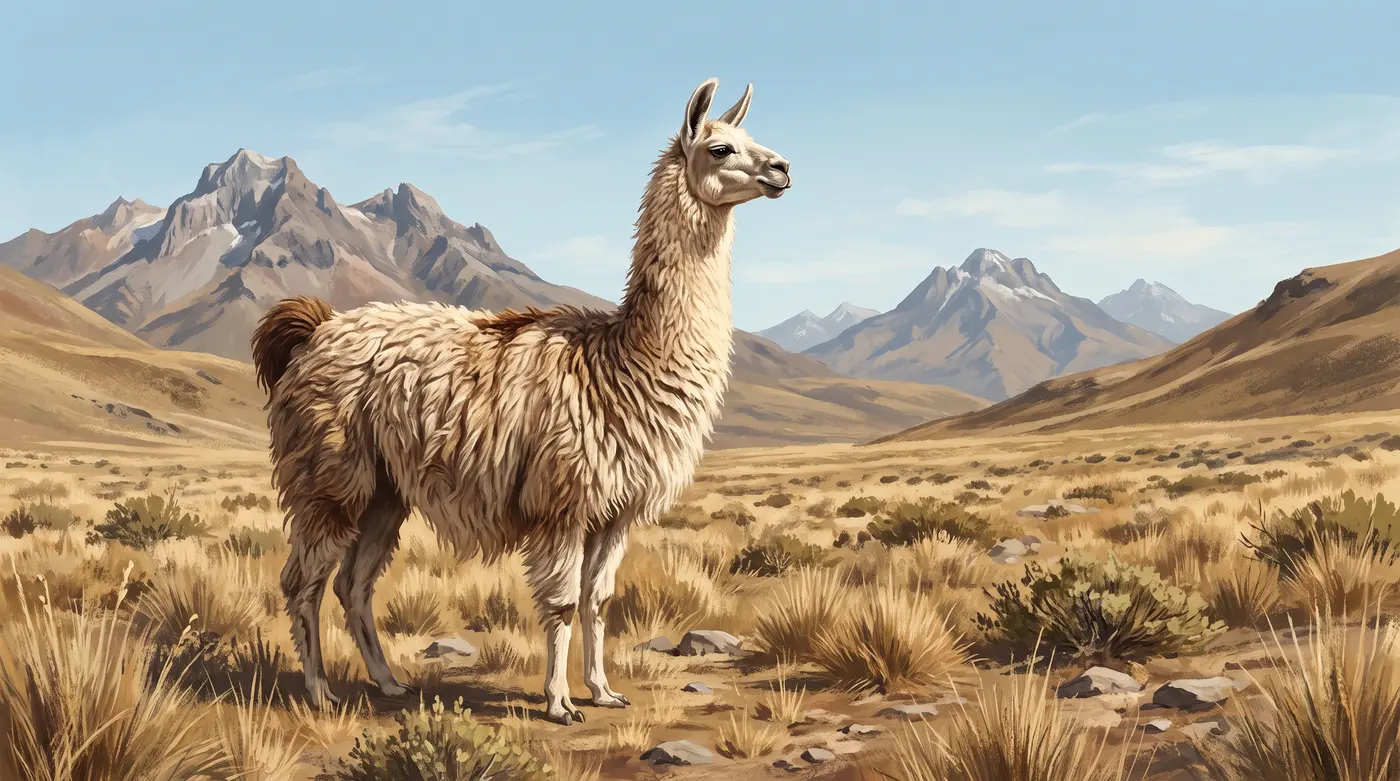
- Status: Safe
- South America: raised by humans, often free-ranging
Numbers
- Weight
- 310 lb290 to 340 lb
- Length
- 4 ft3 to 4 ft body length
- Height
- 4 ft3.5 to 4.5 ft
- Lifespan
- 20 years15 to 25 years
- Humps
- 0 humpsthe most obvious difference compared to camels
- South American camelids
- 4 speciesllama, vicuña, alpaca, and guanaco
- Pack load
- null lbthe material documents its use as a pack animal but does not state how much weight it can carry
Ten fun facts
before the Spanish conquest it was Peru's only domesticated hoofed animal, doing the work of horses, oxen, sheep, and goats.
when threatened it defends itself by spitting stomach acids rather than plain saliva to drive off potential attackers.
farmers in North America raise this animal as a livestock guardian to protect sheep and goats from aggressive coyotes.
it descends from the wild guanaco, a species that it closely resembles in both body shape and social behavior.
the most obvious physical difference compared to its camel relatives is that it has no hump on its back.
there are two main domestic breeds, including a short-haired pack animal and a smaller breed raised for wool.
unlike camels it cannot survive for long periods without water and needs to drink on a regular basis.
the word llama is sometimes used to refer to all four South American camelids, including alpacas, vicuñas, and guanacos.
an old name for this creature translates to camel sheep, describing its appearance as a combination of both animals.
the main character Kuzco is transformed into one of these animals in the animated Disney movie The Emperor's New Groove.
The quiz answers
The first one is the question printed in your book: here is the answer. The other four are extra.
Question 1 of 5★ this one is in your book
Which wild species is the ancestor of the llama?
Question 2 of 5
How does it defend itself when threatened?
Question 3 of 5
What is the most obvious difference between it and a camel?
Question 4 of 5
Why do North American farmers keep llamas?
Question 5 of 5
How many domestic breeds of llama exist?
Try it yourself
Write down horses, oxen, sheep, and goats on paper and cross them out. In ancient Peru, only the llama was available for those jobs.
Find South America on a map and locate Peru. The name llama originates from there and was used long before the arrival of the Spanish.
Compare photographs of a llama and an alpaca side by side. Look for the larger body size and less rounded head of the llama.
Data from Wikidata (Q42569) and Wikipedia (Llama).