
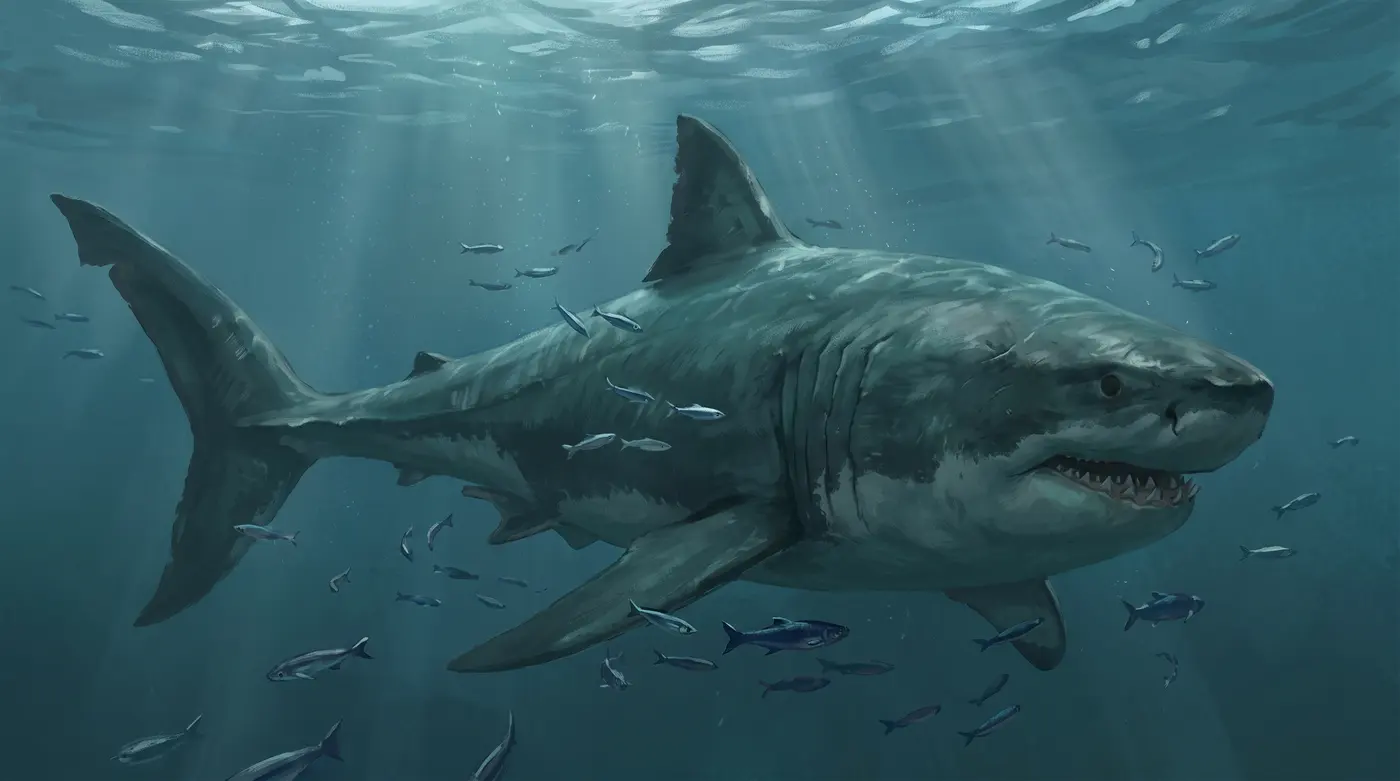
- Status: Extinct
- Fossil teeth in all the world's oceans, including coasts
- Extinct
Numbers
- Weight
- 67,9 tonestimate from a 2022 three-dimensional model for a 52 ft individual; for mature adults, estimates range from 13.9 ton for a small male to 65.5 ton for a large female
- Length
- 34 ftmodal length, the most frequent across 544 examined teeth; the most reliable maximum estimate is 57 ft and various methods yield from 47 to 67 ft. Wikidata lists 82 ft, a value higher than any estimate based on material
- Lifespan
- 23 million years agofrom the early Miocene to the early Pliocene, from about 23 to 3.6 million years ago; however, some remains are dated to the late Oligocene, about 28 million years ago
- Bite force
- 40960 lbupper end of the estimate, which starts at 24,390 lb
- Tooth height
- 6,6 inupper anterior tooth used in 1996 to estimate the animal's length
- Maximum length
- 57 ftmost recent estimate with the smallest margin of error; other methods give from 47 to 67 ft
Ten fun facts
pliny the Elder described its teeth as petrified human tongues and called them glossopetrae, meaning stone tongues.
in the Middle Ages those teeth ended up inside amulets and tableware because people believed they could neutralize poisons.
in 1616 Fabio Colonna burned a sample of glossopetra and used the carbon residue as proof that it was a tooth.
in the Chesapeake Bay area teeth were excavated and traded toward Ohio as early as 430 BC.
it was not a close relative of the great white shark, as the similarity of their teeth is convergent evolution.
a 52-foot individual would have needed almost one hundred thousand calories a day, twenty times more than an adult great white.
a fossil backbone discovered in Belgium belonged to an individual that died at forty-six years of age.
its skin scales are between 0.01 and 0.03 inches wide, suggesting a slow swimmer capable of sudden bursts.
the first jaw reconstruction in 1909 suggested a 100-foot animal, but the size of the jaw had been overestimated.
it faced serious competitors in its oceans, including the predatory whale Livyatan, macroraptorial sperm whales, and ancestors of killer whales.
The quiz answers
The first one is the question printed in your book: here is the answer. The other four are extra.
Question 1 of 5★ this one is in your book
Why do almost only teeth remain from Megalodon?
Question 2 of 5
What is the maximum length estimate with the smallest margin of error?
Question 3 of 5
What did it mainly feed on?
Question 4 of 5
Was it a close relative of the great white shark?
Question 5 of 5
What contributed to its disappearance?
Try it yourself
Cut out a cardboard triangle six and a half inches tall and place it on your palm: this is the size of a real fossil tooth.
Use chalk to draw a thirty-four foot line in the yard, representing the most common length of this shark, then walk along it counting your steps.
Count how many classmates standing in a single line it takes to reach fifty-seven feet, which is the most reliable maximum length estimate for Megalodon.
Data from Wikidata (Q163873) and Wikipedia (Megalodon).