
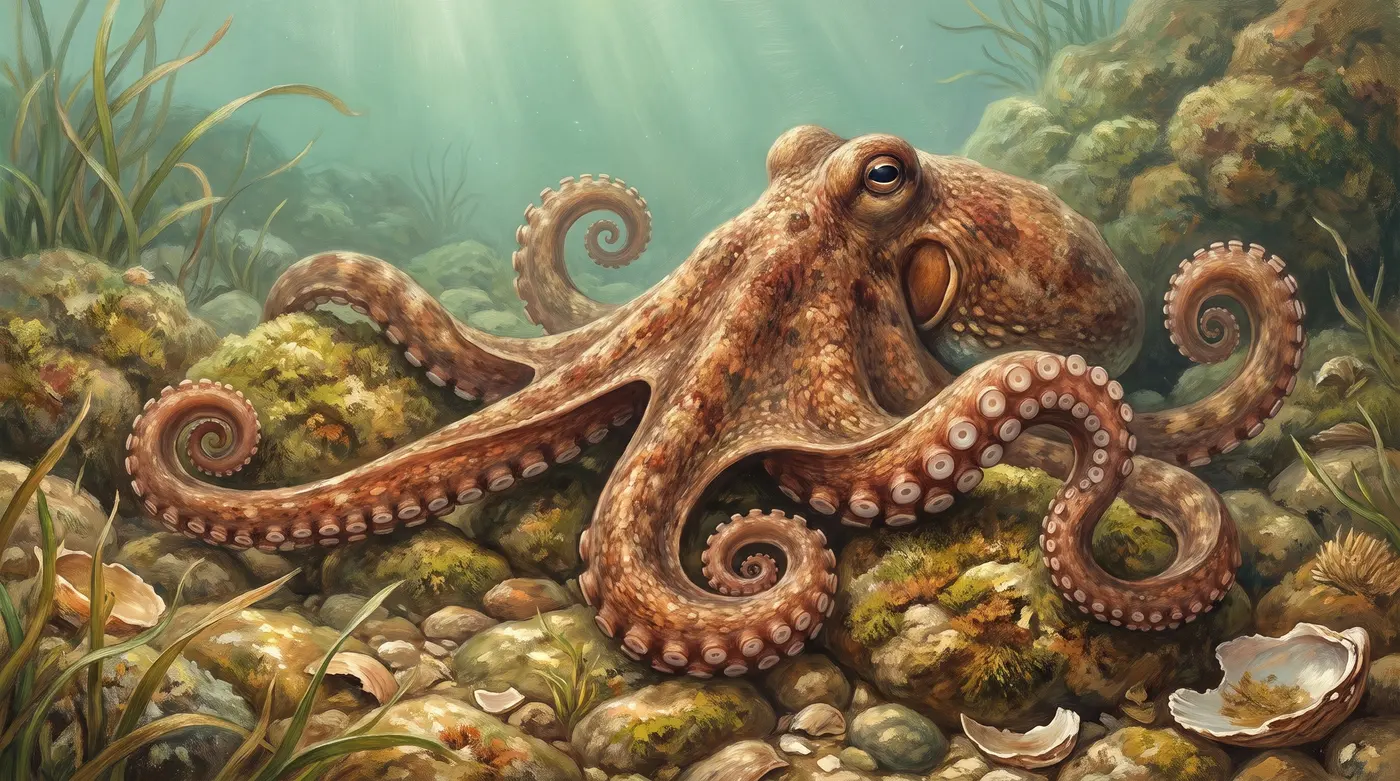
- Status: Safe
- Rocky sea floors in all oceans, within 650 feet
Numbers
- Weight
- 9 lbmidpoint value of the range given in the material, from one pound to sixteen to eighteen pounds in the largest specimens
- Length
- 28 inaverage arm length, from sixteen to forty inches; the mantle alone measures three to ten inches
- Lifespan
- 1 yearsat most one and a half years; the Wikidata value of 1.5 years coincides with the maximum indicated by the material
- Hearts
- 3 heartstwo gill hearts and one systemic heart
- Eggs laid
- 400000 eggsfrom 50,000 to 400,000 in a single laying, guarded for one to two months
- Coding genes
- 33000 genescompared to 25,000 in the human genome
Ten fun facts
it has three hearts: two pump blood to the gills, while the third distributes it to the rest of the body.
its ink is rich in hormones: it not only hides the animal from view, but also confuses a predator's sense of smell.
each arm carries a double row of suckers: the musky octopus, which looks very similar to it, has only a single row.
its genome contains about 33,000 coding genes, compared to 25,000 in the human genome, making it larger than ours.
its nervous network contains six times as many neurons as a mouse, making it the most developed system among all invertebrates.
a severed arm retains cognitive functions and is still capable of recognizing and identifying the rest of the body it came from.
its camouflage relies on proteins called reflectins, which change the way light reflects off the skin of the animal.
it learns by watching others of its species, an ability previously shown only in some mammals, even though it is a solitary animal.
the female does not eat during the entire brooding period, losing much of her weight and dying shortly after the eggs hatch.
the white-spotted octopus, a reddish nocturnal cephalopod with white dots that resembles it, sometimes manages to prey upon the octopus itself.
The quiz answers
The first one is the question printed in your book: here is the answer. The other four are extra.
Question 1 of 5★ this one is in your book
How many hearts does the common octopus have?
Question 2 of 5
What distinguishes the octopus from the musky octopus?
Question 3 of 5
Why is the ink of the octopus so effective?
Question 4 of 5
How long does a common octopus live on average?
Question 5 of 5
What happens to the female after the eggs hatch?
Try it yourself
Try opening a screw-top jar with your eyes closed: it is the task an octopus solves in a laboratory to reach its food.
Count to three beats on your chest: an octopus would have three actual hearts, two for its gills and one for its body.
Draw one hundred dots on a sheet of paper and time yourself: reaching the 400,000 eggs of a female would take weeks.
Data from Wikidata (Q651361) and Wikipedia (Common octopus).