
- Status: Safe
- Forests of India, raised all over the world
Numbers
- Weight
- 10 lbfrom 9 to 13 lb (males), from 6 to 9 lb (females)
- Length
- 40 infrom 37 to 45 inches
- Lifespan
- 15 yearsabout 15 years in the wild, up to 23 in captivity
- Ornamental feathers
- 80 inmaximum length of the upper tail coverts in males
- Eggs per clutch
- 9 eggsfrom 4 to 9 eggs, laid in spring
- Lifespan in captivity
- 23 yearsin the wild the estimate drops to about 15 years
Ten fun facts
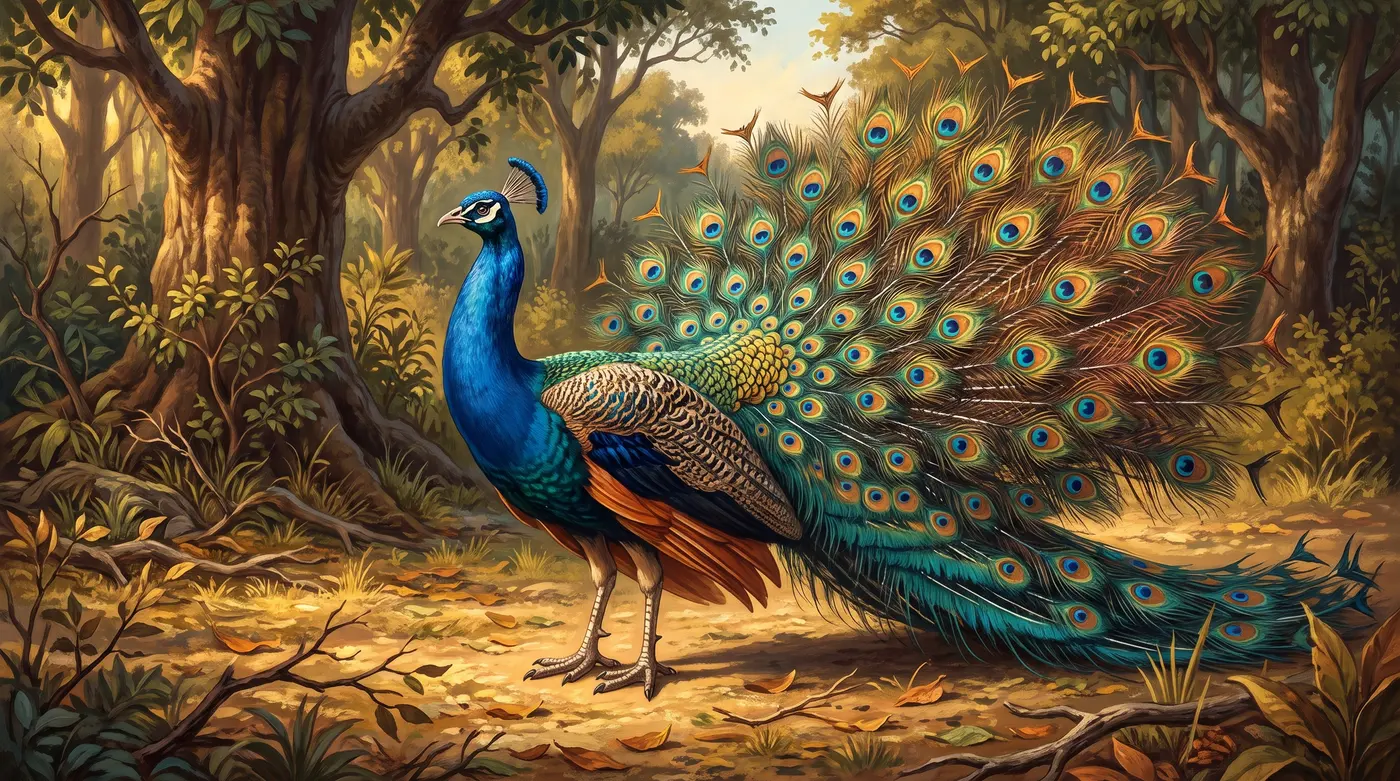
the train feathers are not actual tail feathers, but upper tail coverts that grow up to six feet in length.
the actual tail of the male is short and square, hidden behind the train, and looks like the female tail.
the ornamental train feathers cannot lift themselves, so the short true tail pushes them up from underneath.
each male usually mates with four or five females, a social behavior similar to that of the western capercaillie.
chicks are born ready to walk and immediately follow their mother around to look for food together.
it rarely flies, but a short escape takeoff allows it to easily reach the roof of a three story house.
in captivity it can live up to twenty three years, while wild peacocks usually live for about fifteen years.
the ancient Romans raised peacocks not only for their beautiful colorful feathers, but also for meat and eggs.
a peacock can produce rare hybrid offspring with a guineafowl, crossing two completely different bird species.
in medieval times people believed peacock meat never decayed, making the bird a strong symbol of immortality.
The quiz answers
Five questions about this animal. Pick an answer and find out if it is the right one.
Question 1 of 5
Are the display fan feathers actual tail feathers?
Question 2 of 5
How long can the ornamental train feathers grow?
Question 3 of 5
How many eggs does the female lay in spring?
Question 4 of 5
How long can it live in captivity?
Question 5 of 5
Which Greek deity was associated with the peacock?
Try it yourself
Unroll a tape measure to six feet on the floor. That is the maximum length of a single ornamental feather. Compare that measurement to your own height.
Look at a photograph of the fan display from behind. Find the short, square true tail pushing up all the longer train feathers from below.
Count the eye-shaped spots on a photograph of an open fan display. Then compare that number to the hundred eyes of the mythical giant Argus.
Data from Wikidata (Q61865) and Wikipedia (Indian peafowl).