
The numbers
- How high they light up
- 62mi(100 km)62 to 310 mi (100 to 500 km)
- What makes the color
- Oxygen green and red, nitrogen blue
- How often the Sun gets restless
- 11years
How it happens, step by step
The Sun blows
A steady flow of charged particles leaves the Sun. When the star is restless, the flow becomes thicker and faster.
The shield deflects
Earth's magnetic field sends almost everything off to the side. Only near the poles do its lines open upward.
A crash up high
The particles that come down meet the atoms of the upper atmosphere and hit them, handing over part of their energy.
The atom gives back
An atom full of energy does not hold on to it: it lets it go at once as light, and that light is the aurora.
The gas decides
Oxygen gives off green, and higher up red. Nitrogen gives off blue. The color tells you which gas was hit.
To get an idea
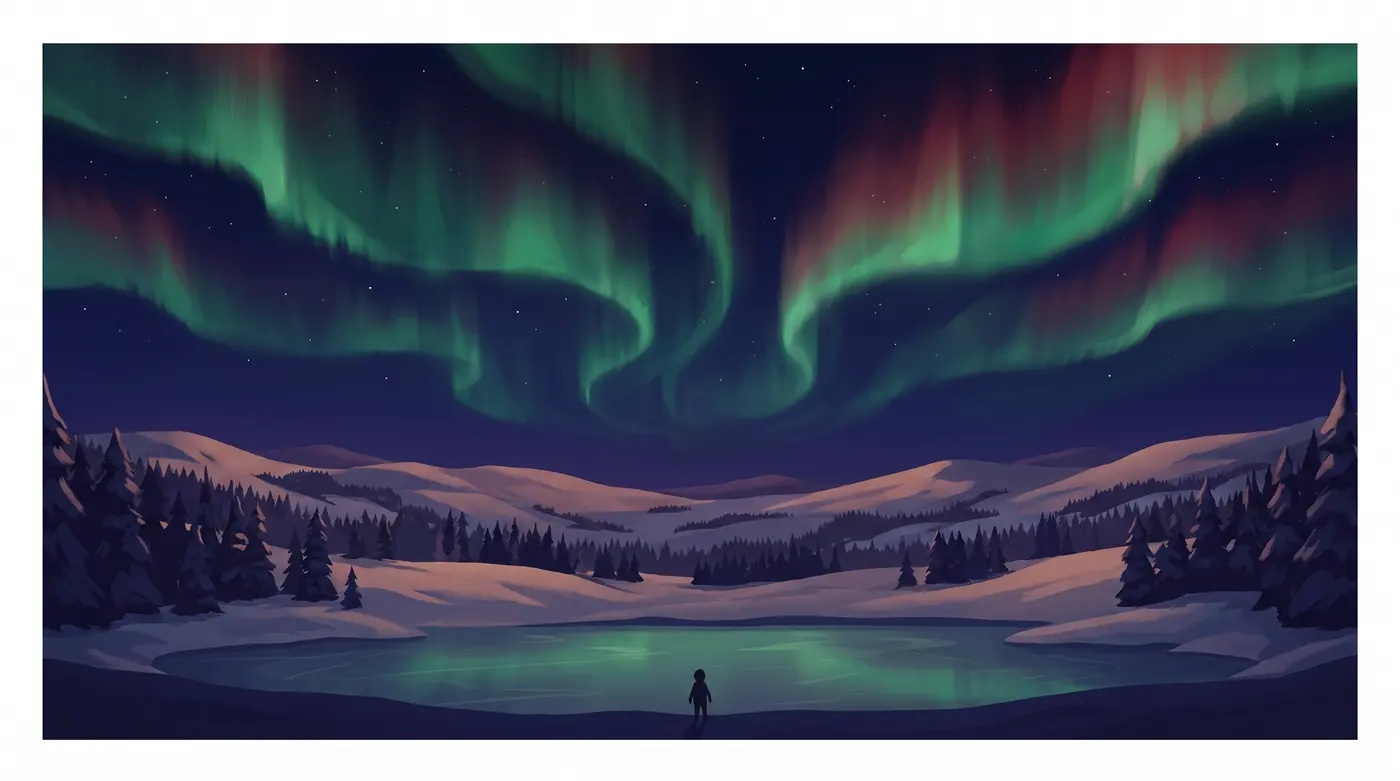
It is not reflected light: it is the air itself glowing, like the gas inside a neon sign.
Green comes from oxygen, blue from nitrogen: the color tells you which gas was hit.
Fun facts
These are not in the book: there was no room on paper.
In 1859 a solar storm threw the telegraphs into chaos and brought auroras very close to the equator.
That event is named after the astronomer who saw the flash leave a group of sunspots.
Storms as strong as that one are thought to happen roughly once every five hundred years.
People used to think auroras were high-altitude lightning or light reflected off icebergs.
A superstorm today would cost as much as a major earthquake, if nobody took precautions.
Other planets with a magnetic field have their own auroras around their poles too.
Test yourself
The first question is the one printed under the QR code, with the answer the book did not give. The other four only exist here.
Question 1 of 5★ is the one from your book
What is an aurora?
Question 2 of 5
Where do the particles come from?
Question 3 of 5
Why are auroras seen near the poles?
Question 4 of 5
What decides the color?
Question 5 of 5
What can a strong solar storm do?
Riddles
Nothing reflects me: I am the air itself lighting up, far higher than airplanes. Near the poles people see me sway like a curtain moved by the wind. What am I?
My color depends on who gets hit: if it is oxygen I turn green, if it is nitrogen I turn blue. I am born from particles that left the Sun days earlier. What am I?
In the 1800s I knocked out the telegraphs across half the world, and the people who saw me thought of a distant fire. I come back mostly when my star is restless. What am I?
Try it yourself
If you are lucky enough to see one, do not photograph it right away: watch it for a few minutes. The shapes keep changing, and a single photo cannot tell that.
Hold a magnet near a small pile of iron filings and look at the lines that form: the particles follow lines like these, and at the poles they point down.
The words
- aurora borealis
- The aurora seen from the northern hemisphere; in the south it is called australis.
- solar storm
- A sudden, strong arrival of particles that left the Sun.
Sources: Wikidata (Q40609), Wikipedia (Aurora polare).