
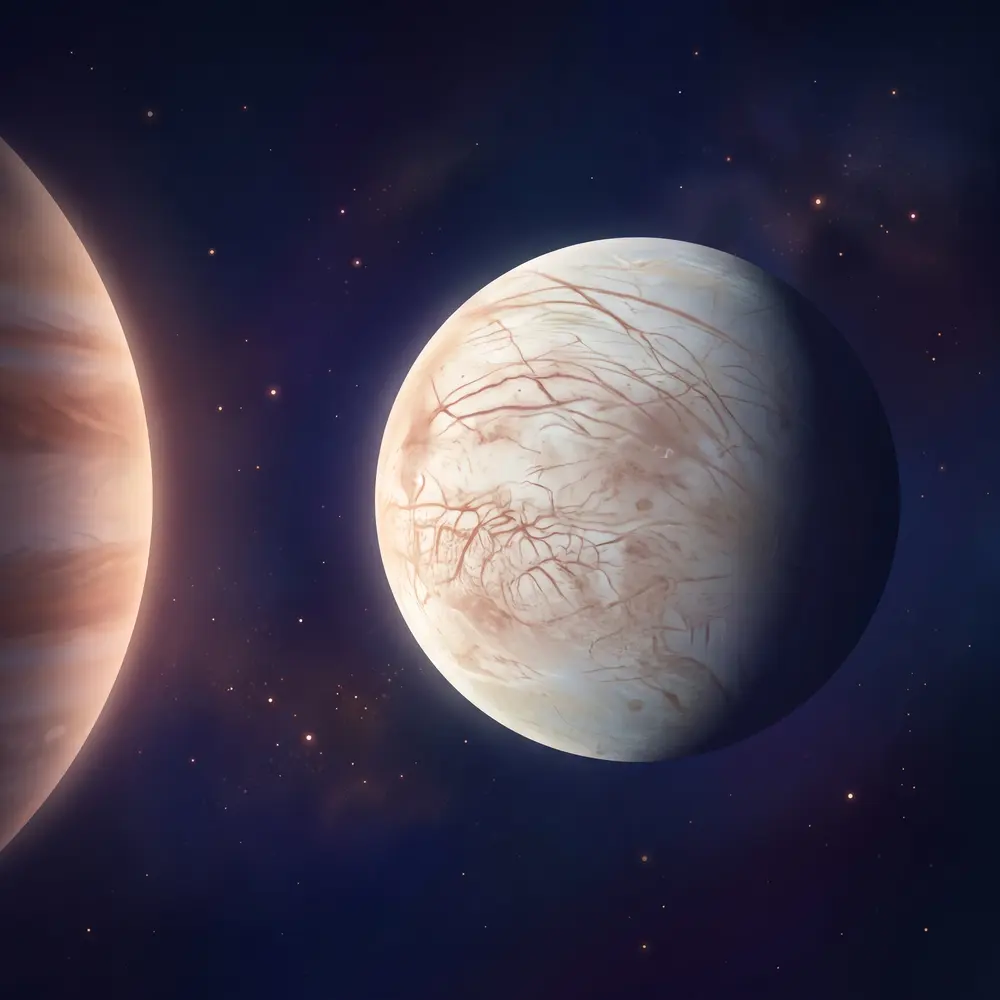
The numbers
- Radius
- 970mi(1,561 km)A little less than our Moon
- Its surface
- The smoothest in the Solar SystemAlmost no craters
- Under the ice
- An ocean of liquid water
- One trip around Jupiter
- 3.55days
- When it was discovered
- In 1610, by Galileo Galilei
To get an idea
Under its crust of ice there would be an ocean of liquid water wrapping around the whole moon.
The water stays liquid thanks to the heat of stretching, not thanks to the Sun, which warms very little out there.
Fun facts
These are not in the book: there was no room on paper.
The long dark streaks on its crust look like the cracks on a frozen lake.
The heat that keeps the water liquid comes from the stretching caused by Jupiter's gravity.
It is one of the most promising places to search for life beyond our planet.
It was discovered by Galileo in 1610, together with Io, Ganymede and Callisto.
It is slightly smaller than our Moon, but it holds much more water than all the seas on Earth.
Test yourself
The first question is the one printed under the QR code, with the answer the book did not give. The other four only exist here.
Question 1 of 5★ is the one from your book
What is under the crust of Europa?
Question 2 of 5
Why does Europa have so few craters?
Question 3 of 5
What keeps that water liquid?
Question 4 of 5
What is the surface of Europa like?
Question 5 of 5
Why are scientists so interested in it?
Riddles
I am smoother than anyone else around here, and that very smoothness gives away my secret: something under me keeps remaking my skin. What am I?
I wear a suit of armor made of ice, but underneath I hide more water than all the seas of your world put together. That is why you come looking for me. What am I?
The fire that keeps my water liquid does not come from the distant star: it comes from the giant that kneads me on every trip around it. What am I?
Try it yourself
Mark the positions of the four dots for three evenings in a row: you will see that each one moves at a different speed, because each has its own orbit.
Lay a thin sheet of ice on a bowl of water and press in the middle: the cracks that form look like the streaks on Europa.
The words
- silicates
- The most common rocks, the ones the rocky planets are made of.
Sources: Wikidata (Q3134), Wikipedia (Europa (astronomia)).