
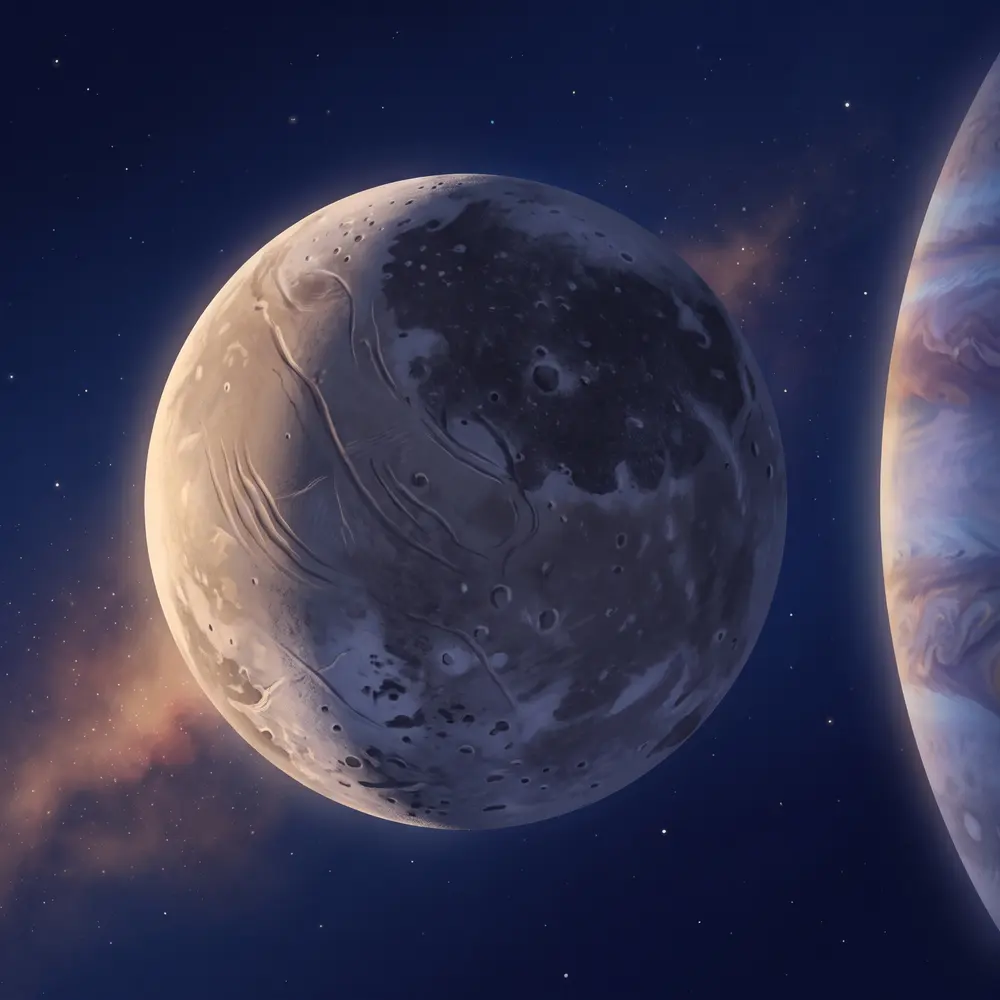
The numbers
- Radius
- 1,635mi(2,631 km)The biggest moon of all
- A record
- Bigger than the planet MercuryBut not heavier
- Under the surface
- A salty ocean between two layers of ice
- One trip around Jupiter
- 7.15days
- When it was discovered
- In 1610, by Galileo Galilei
To get an idea
It is the only known moon with a magnetic field all its own.
For each trip Ganymede makes around Jupiter, Europa makes two and Io four.
Fun facts
These are not in the book: there was no room on paper.
It has a core of molten iron, like the Earth, and that is where its magnetic field comes from.
Its dark, cratered regions are about four billion years old and cover a third of the moon.
The pale areas are younger and carved by long parallel ridges, like the furrows of a plow.
The trips of Ganymede, Europa and Io are locked together in an exact ratio.
It is named after a young man in Greek myth whom Zeus carried up to the sky to be his cupbearer.
Test yourself
The first question is the one printed under the QR code, with the answer the book did not give. The other four only exist here.
Question 1 of 5★ is the one from your book
Which is the biggest moon in the Solar System?
Question 2 of 5
Why does it weigh less than Mercury even though it is bigger?
Question 3 of 5
What is unique about it among the moons?
Question 4 of 5
What would be under its surface?
Question 5 of 5
How are the trips of Ganymede, Europa and Io linked?
Riddles
I am bigger than a real planet, and yet I am not a planet: I go around a giant instead of around the star. In the whole neighborhood nobody of my kind beats me. What am I?
I have a heart of molten iron that makes me an invisible shield: I am the only one of my kind to have one. What am I?
My trip and those of two of my sisters fit together like gears: for each of my trips, one makes two and the other four, without ever making a mistake. What am I?
Try it yourself
Mark the positions for a whole week: Ganymede takes a little over seven days to come back to where you first saw it.
Draw a circle for Mercury and a slightly bigger one next to it: the second one is a moon, and the first one a planet.
The words
- molten core
- The central part of a body in space that is in a liquid state.
Sources: Wikidata (Q3169), Wikipedia (Ganimede (astronomia)).