
The numbers
- Speed on arrival
- 31,000mph(50,000 km/h)25,000 to 37,000 mph (40,000 to 60,000 km/h)
- Big craters every million years
- 21 to 3
- Age of the ocean floors
- 200,000,000years
How it happens, step by step
The arrival
The asteroid crosses the whole atmosphere in a few seconds, dozens of times faster than an airliner.
The crash
On contact all the energy of the motion is released at once. It is not the rock that digs: it is the blast.
Rock flies out
The ground is squeezed and then thrown up and out, falling back all around the spot that was hit.
A round hole
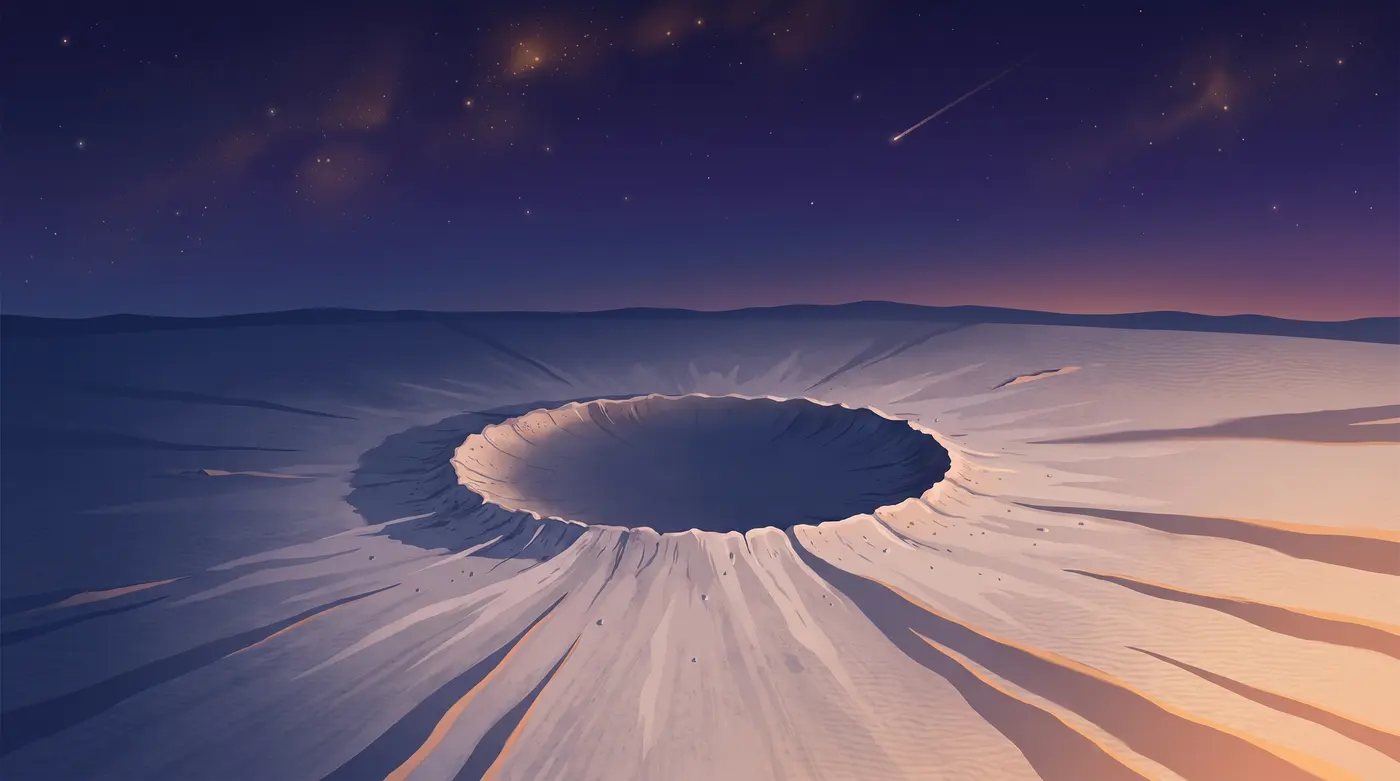
A round crater is left, much wider than the object, with a raised rim and often a little hill in the middle.
Time erases it
On Earth, rain, wind and plants wear it down. On the Moon, with no air, it stays the same for billions of years.
To get an idea
An asteroid arrives at about thirty thousand miles an hour: forty times the speed of an airliner.
Fun facts
These are not in the book: there was no room on paper.
The oldest known craters on the Earth are almost two billion years old.
On the moon Callisto the icy crust is so weak that craters flatten out over time.
Many craters on Earth can be recognized only from above or with instruments: from the ground you do not notice them.
In the biggest craters a small hill is left in the middle, pushed up as the rock bounced back.
On the Moon there is no air or water: a crater stays as it is for billions of years.
Deserts keep craters better than any other place, because it hardly rains there and no plants grow.
Test yourself
The first question is the one printed under the QR code, with the answer the book did not give. The other four only exist here.
Question 1 of 5★ is the one from your book
Why does the Earth have fewer craters than the Moon?
Question 2 of 5
Why is a crater always round?
Question 3 of 5
How fast does an asteroid arrive?
Question 4 of 5
How old are the ocean floors at most?
Question 5 of 5
How big is a crater compared with the object that digs it?
Riddles
I am always round, even when whoever made me came in sideways. On the Moon I stay forever, on the Earth I vanish quickly. What am I?
I was not dug by a rock, but by the energy that rock carried. I am much wider than it was, and I have a raised rim all around. What am I?
Rain wears me down, plants cover me, the sea recycles me. That is why on my planet there are few of us, while on the neighbor we are everywhere. What am I?
Try it yourself
Do it again throwing the marble at a slant instead of from above. The crater will still be round: it is exactly what really happens.
With binoculars resting on a wall, look at the Moon when it is half full and count the craters along the line between light and shadow.
The words
- plate tectonics
- The slow movement of the plates that renews the Earth's surface.
- ejecta
- The material thrown out of the crater during the impact.
Sources: Wikidata (Q55818), Wikipedia (Cratere meteoritico).