
The numbers
- What it is
- A distance, not a time
- What it is for
- Measuring distances between stars
- Another unit
- The parsec, equal to 3.26 light-years
How it happens, step by step
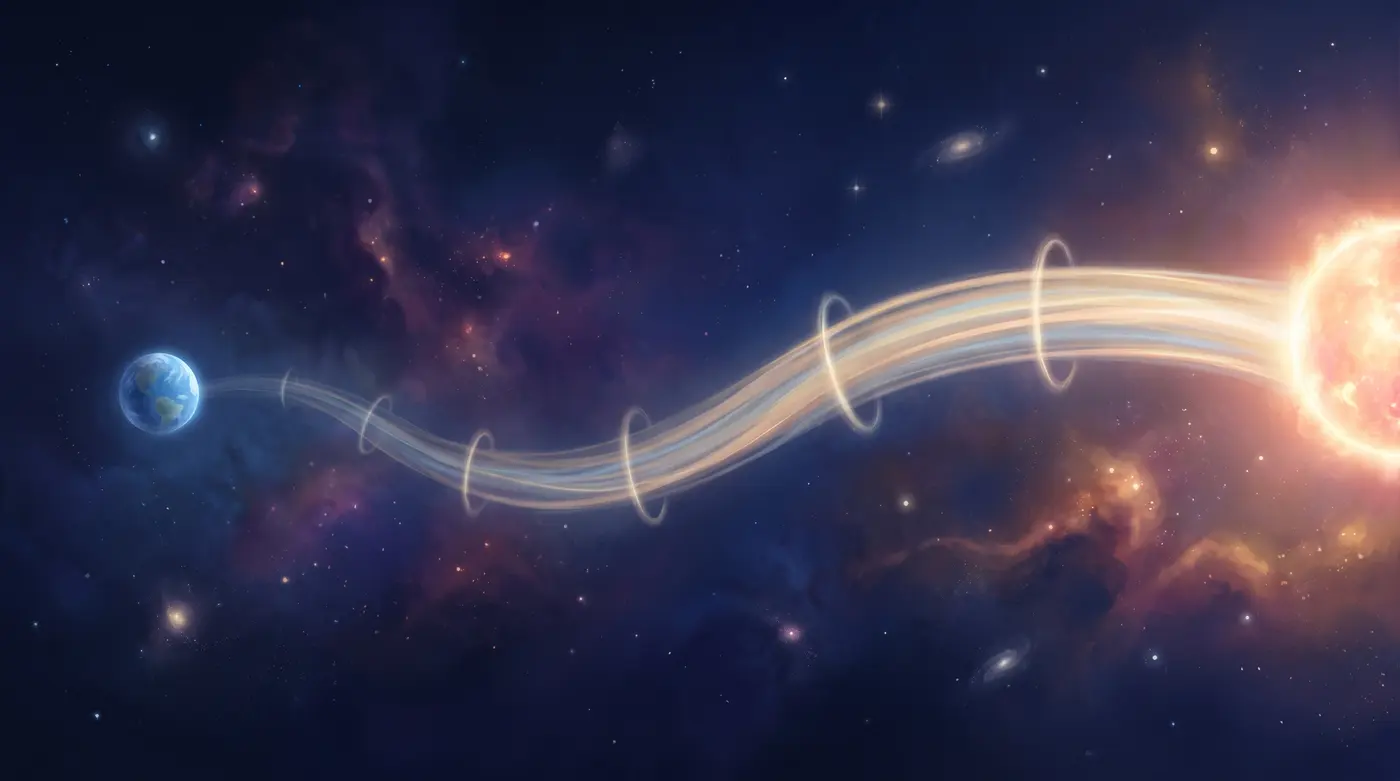
Light travels
Light does not arrive instantly: it moves, extremely fast but not infinitely fast, and it takes time.
A year of travel
The distance it covers in one whole year is taken as a unit of measure, and it is called a light-year.
Made for the stars
Between the stars miles turn into useless rows of zeros, while light-years stay numbers you can grasp.
The light set off
The light reaching your eyes tonight set off as many years ago as the star is light-years away.
You see the past
So you do not see the star as it is now, but as it was when that light set off on its trip.
To get an idea
A star a hundred light-years away is seen as it was a hundred years ago, not as it is now.
The Sun we see is the Sun of a little over eight minutes ago.
Fun facts
These are not in the book: there was no room on paper.
The year used in the definition is the Julian year, three hundred sixty-five and a quarter days long.
Looking at a distant star always means looking at its past, never at its present.
Sunlight takes a little over eight minutes to travel all the way to the Earth.
The farther a telescope looks, the further back in time it can see.
A star we see shining tonight might already have gone out long ago.
The official definition of this unit was set by the International Astronomical Union.
Test yourself
The first question is the one printed under the QR code, with the answer the book did not give. The other four only exist here.
Question 1 of 5★ is the one from your book
What does a light-year measure?
Question 2 of 5
Why is it used instead of miles?
Question 3 of 5
How do we see a star a hundred light-years away?
Question 4 of 5
How long does sunlight take to get here?
Question 5 of 5
What is a parsec?
Riddles
My name says year and everyone thinks of time, but I measure space: I am the distance the fastest thing there is covers in twelve months. What am I?
Thanks to me every telescope becomes a machine that looks back: the farther you reach, the older the scene you see. What am I?
Without me you would have to write rows of zeros to say how far away a star is, and those numbers would mean nothing to anyone. What am I?
Try it yourself
Look up the distance in light-years of a star you know and subtract that number from the current year: that is the year the light you see set off.
Time a distant flash of lightning and the thunder that follows: the light arrives at once, the sound later. It is the same idea, on a tiny scale.
The words
- parsec
- Another unit of distance in astronomy, about 3.26 light-years.
Sources: Wikidata (Q531), Wikipedia (Anno luce).