
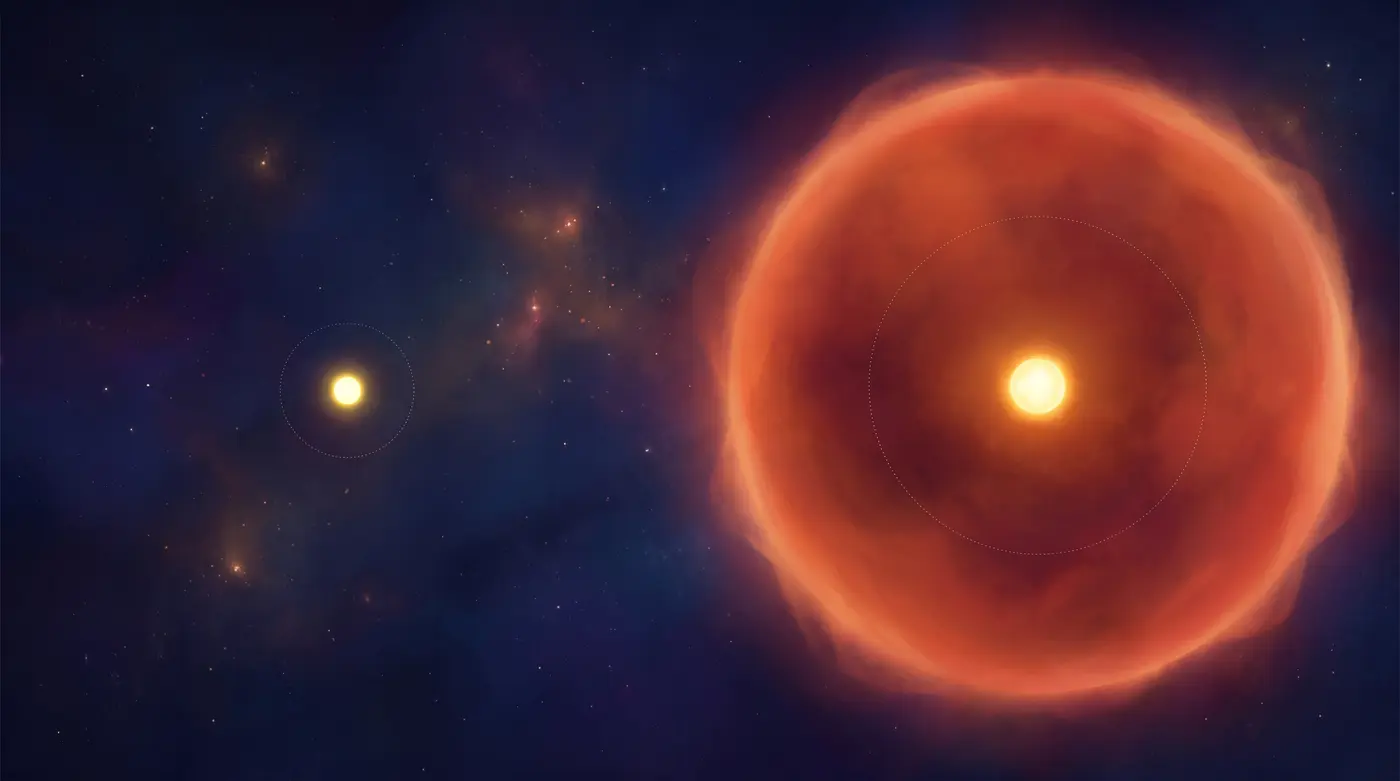
The numbers
- Which stars
- Those of small or medium massFrom a third to eight times the Sun
- Surface temperature
- 8,500°F(4,700 °C)Less than that
- What color they are
- From yellow-orange to red
How it happens, step by step
The fuel runs out
In the star's heart the hydrogen runs out, and with it the push that held its own against gravity.
The center shrinks
Without that push the heart collapses in on itself and, as it collapses, gets even hotter than before.
A shell lights up
That heat lights up the layers just outside the heart, where there is still hydrogen. A new fire is born.
The star swells
The new fire pushes the outer layers away, and they move very far from the center of the star.
It turns red
Far from the center those layers cool down, and a cooler surface glows a redder color.
To get an idea
The surface of a red giant is much cooler than it was before, and that is why it turns red.
The Sun will become a red giant too, and it will swell so much that it swallows the closest planets.
Fun facts
These are not in the book: there was no room on paper.
The color ranges from yellow-orange to red, and it matches the spectral classes called K and M.
A red giant is brighter than before, because the surface giving off light is immense.
The Sun will become a red giant too, but only billions of years from now.
When that happens it will swell so much that it swallows the planets closest to it.
Many orange stars you can see with the naked eye are already in this stage.
Giant stars can also be told apart by where they fall on the Hertzsprung-Russell diagram.
Test yourself
The first question is the one printed under the QR code, with the answer the book did not give. The other four only exist here.
Question 1 of 5★ is the one from your book
What does a star do when the hydrogen in its heart runs out?
Question 2 of 5
Why does the surface get cooler?
Question 3 of 5
Then why does it look brighter?
Question 4 of 5
Which stars become red giants?
Question 5 of 5
What will become of the Sun?
Riddles
When I run out of firewood I do not go out: I swell up. I become enormous, my skin cools down and I change color, and whoever looks at me from afar sees me brighter than before. What am I?
I am cooler on the surface and yet I shine more, and it is no trick: it is that I have become immense. What am I?
Billions of years from now the star that warms you will become like me, and the worlds closest to it will not come out of it well. What am I?
Try it yourself
Compare it with Rigel, Orion's foot, which is blue: you have in front of you two stars at opposite ends of the temperature scale.
Blow up a balloon and hold it against your cheek: the surface is wider but cooler than when it was flat. It is the same idea.
The words
- spectral class
- The group a star is put in according to its color.
Sources: Wikidata (Q744622), Wikipedia (Gigante rossa).