
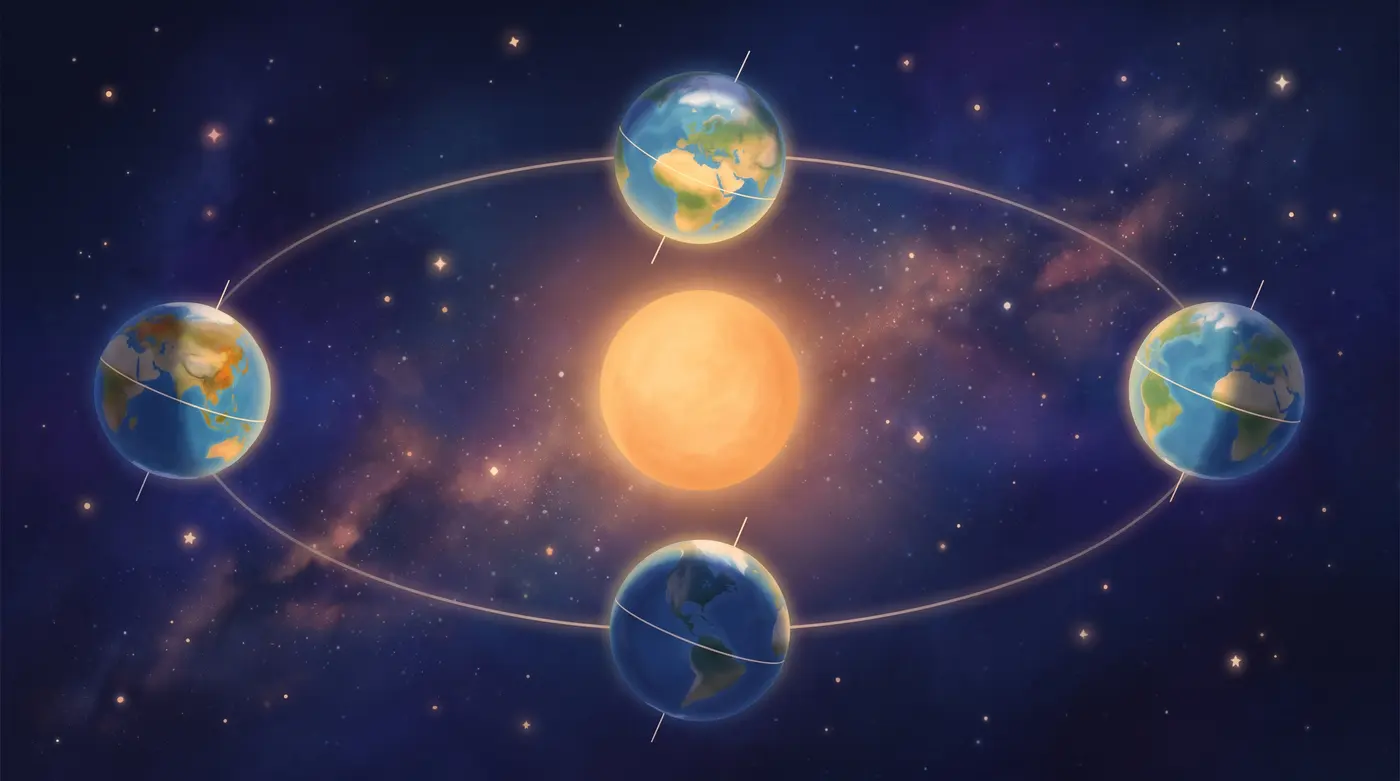
The numbers
- Tilt of the axis
- 23.4°
- Closest distance from the Sun
- 91,400,000mi(147,100,000 km)
- Farthest distance from the Sun
- 94,510,000mi(152,100,000 km)
How it happens, step by step
The axis is tilted
The Earth does not spin upright. Its axis is tilted and always points the same way while the planet goes around the Sun.
One half leans in
For six months the northern half of the world leans toward the Sun. For the other six it leans the other way.
The angle changes
The half leaning toward the Sun gets rays that come down almost straight, packing heat onto a little ground. It is summer.
The hours change
That same half stays in the light longer. More hours of sunshine every day mean more heat stored up.
The other side
At the same time the other half gets slanted rays and short days. When it is summer here, it is winter there.
To get an idea
A slanted ray warms less because it spreads the same light over a much bigger patch of ground.
At the equator you hardly feel the seasons; at the poles they become a night and a day that last for months.
Fun facts
These are not in the book: there was no room on paper.
The astronomical seasons run from an equinox to a solstice and each lasts three months.
The farther you go from the equator, the bigger the difference between summer and winter.
Mars has seasons too, because its axis is tilted almost as much as the Earth's.
The seasons on the calendar and the seasons of the weather almost never line up.
If the axis were upright, the equator would always have the Sun overhead and the poles would always be cold.
Without a tilt, day and night would last the same everywhere, all year long.
Test yourself
The first question is the one printed under the QR code, with the answer the book did not give. The other four only exist here.
Question 1 of 5★ is the one from your book
Why does the Earth have seasons?
Question 2 of 5
When is the Earth closest to the Sun?
Question 3 of 5
What happens when a ray arrives at a slant?
Question 4 of 5
How many seasons are counted in the polar regions?
Question 5 of 5
What if the axis were perfectly upright?
Riddles
I do not depend on distance, even though everyone thinks so. I depend on a tilt that never changes: it is the world moving around the fire, always leaning the same way. What am I?
There are four of us and we always come back in the same order. When two of us are on one side of the world, the other two are exactly on the other side. What are we?
Near the belly of the planet you can hardly feel me, but toward its two ends I turn fierce: there I bring whole months of light or whole months of darkness. What am I?
Try it yourself
Look at where the Sun sets from your window and mark it. Over a few months the spot moves quite a lot along the horizon.
Point a flashlight straight at a sheet of paper and then tilt it. The patch of light gets bigger and dimmer: that is the whole reason for the seasons.
The words
- equinox
- The day when light and dark last the same all over the world.
- solstice
- The longest or shortest day of the year in one half of the world.
Sources: Wikidata (Q10688), Wikipedia (Stagione) and NASA.