
Space · Comets and shooting stars
Shooting stars
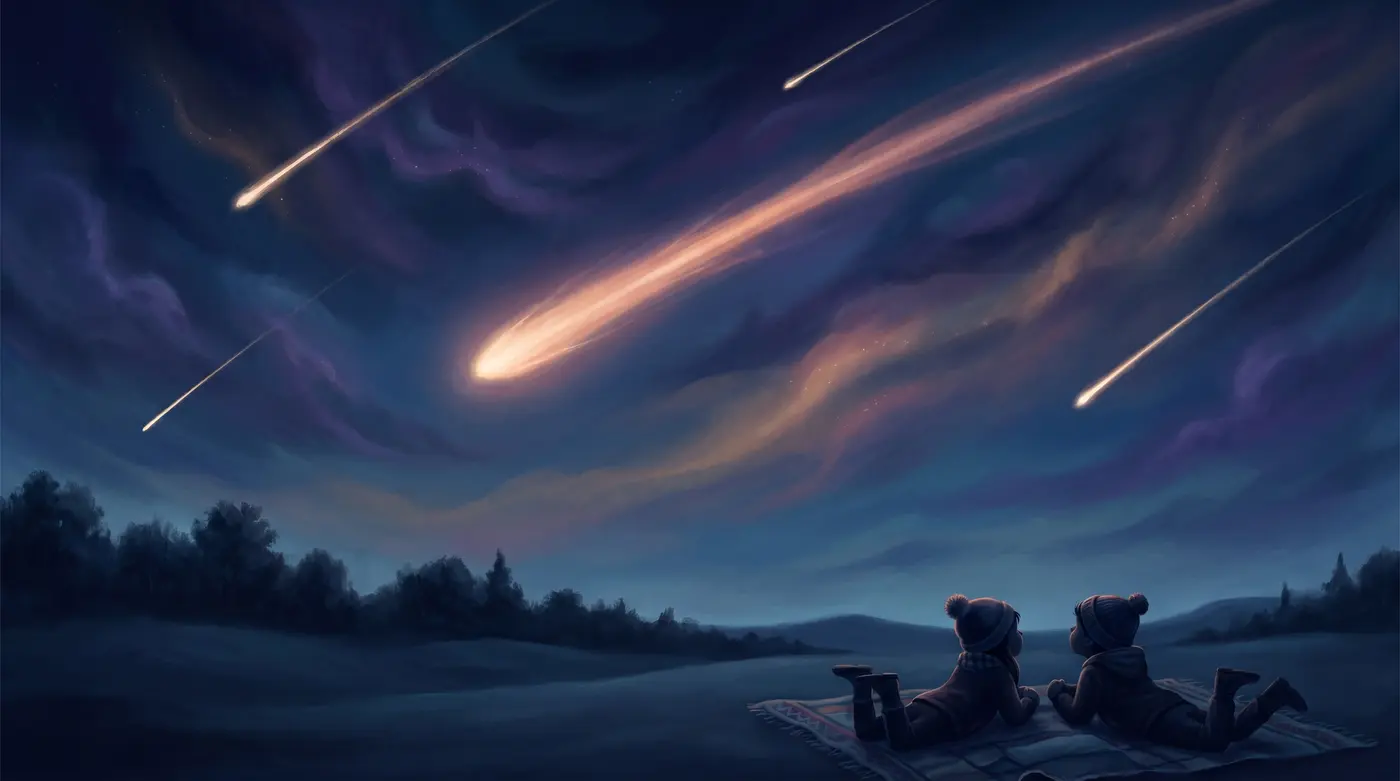
Not stars, and not falling
You can see it with your eyes
The numbers
- How high they light up
- 55mi(88 km)47 to 62 mi (76 to 100 km)
- Speed when they enter
- 26mi/s(42 km/s)6.96 to 45.2 mi/s (11.2 to 72.8 km/s)
- Temperature reached
- 4,041°F(2,227 °C)
How it happens, step by step
A grain in space
A bit of rock, often smaller than a grain of rice, travels along its orbit around the Sun.
It meets the Earth
The Earth comes toward it. The grain enters the atmosphere at seven to forty-five miles per second.
The air is squeezed
At that speed the air in front of the grain has no time to move aside: it gets crushed and heats up hugely.
It falls apart
At about fifty miles up the rock reaches about 4,500 degrees and loses material. That light is the streak.
It fades, or lands
Almost always it burns up in a few seconds. If something is left and reaches the ground, it becomes a meteorite.
To get an idea
Shooting stars light up eight times higher than airliners fly.
Fun facts
These are not in the book: there was no room on paper.
Ninety percent of the light comes from the material that breaks off the little rock.
A meteor has two parts: the head, which is the grain, and the streak it leaves behind.
Some meteors are not natural: they are pieces of rockets and satellites falling back down.
The entry speed also depends on the fact that the Earth races along at about eighteen miles per second.
After midnight you see more of them, because you are on the side of the Earth that is moving forward.
You do not need any instrument to see them: binoculars make your view too narrow.
Test yourself
The first question is the one printed under the QR code, with the answer the book did not give. The other four only exist here.
Question 1 of 5★ is the one from your book
What is a shooting star really?
Question 2 of 5
How high do they usually light up?
Question 3 of 5
How fast do they go?
Question 4 of 5
What is a very bright meteor called?
Question 5 of 5
What do you need to see them?
Riddles
They call me a star, but I am not one. They say I fall, but I do not. I am smaller than a grain of rice, and for a few seconds everyone looks at me. What am I?
I am born fifty miles above the ground, I live three seconds and I almost never leave anything behind. Whoever sees me makes a wish. What am I?
I do not burn because I rub, but because the air in front of me has no time to move aside. I reach forty-five hundred degrees and I fall apart. What am I?
Try it yourself
Try blowing hard against your hand: you feel the air being squeezed. At a meteor's speed that heat becomes thousands of degrees.
Keep a notebook of shooting stars: date, time and how many you saw. After a year you will have a little record of your own.
The words
- fireball
- A very bright meteor, with a wide streak that lingers.
- mesosphere
- The layer of the atmosphere from about thirty to fifty-five miles up.
Sources: Wikidata (Q131136), Wikipedia (Meteora).