
Space · Living in space and watching the sky
Stargazing with the naked eye
The first instrument is your eyes
You can see it with your eyes
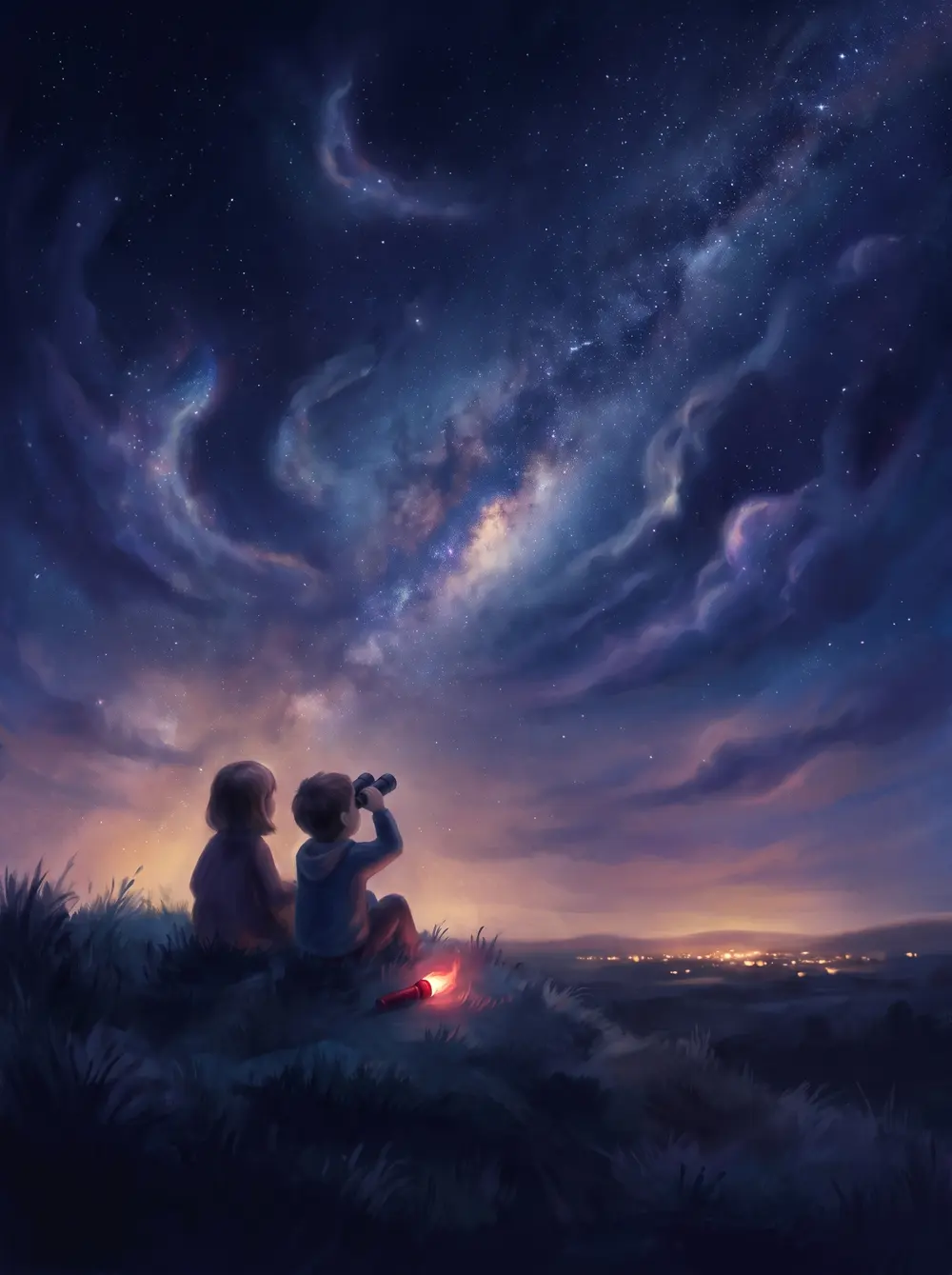
Finding it in the sky
When to look
In any season, as long as the sky is clear and the Moon is not full. The best nights are the ones with no Moon, because its light wipes out everything else, just as a streetlight would.
How to recognize it
Start from a figure you already know, like the Big Dipper or the three stars in a row of Orion's Belt, and from there hop from star to star toward what you are looking for.
To get an idea
Your eyes take about twenty minutes to adjust to the dark, and a phone screen resets everything.
Ordinary binoculars held steady show more than a cheap telescope that wobbles.
Fun facts
These are not in the book: there was no room on paper.
The best nights are the ones with no Moon, because its light wipes out faint objects.
Binoculars held steady against a wall show more than a cheap telescope that wobbles.
Planets can be told from stars because their light almost never twinkles.
Amateur astronomers still sometimes discover comets and supernovae before the professionals do.
The sky changes with the seasons: the winter constellations are not the summer ones.
Even from a balcony at home you can see the Moon, the main planets and the brightest stars.
Test yourself
The first question is the one printed under the QR code, with the answer the book did not give. The other four only exist here.
Question 1 of 5★ is the one from your book
What is the first instrument for looking at the sky?
Question 2 of 5
How long do your eyes take to adjust to the dark?
Question 3 of 5
Why do people use red flashlights?
Question 4 of 5
How do you look at faint objects?
Question 5 of 5
Better binoculars or a cheap telescope?
Riddles
I cost nothing and you cannot buy me in any store: all it takes is your eyes, a bit of patience and a place far from streetlights. After twenty minutes I really start to work. What am I?
One flash of white light is enough to make me start over, and that is why those who know me use red flashlights. Whoever is in a hurry never gets me. What am I?
If you stare straight at me you almost cannot see me, but if you look at me out of the corner of your eye I appear at once. I am the most surprising advice a stargazer can get. What am I?
Try it yourself
Find a figure you already know and use it as a starting point: from there hop from star to star until you find a new one.
Cover a flashlight with red paper: you will see where you step without losing the adjustment to the dark you have just gained.
The words
- averted vision
- Looking at a faint object from the side to see it better.
Sources: Wikidata (Q327223), Wikipedia (Astronomia amatoriale).