
Space · Living in space and watching the sky
Telescopes
They collect light, they do not just magnify
You can see it with your eyes
The numbers
- What it is really for
- Collecting lightMore than magnifying
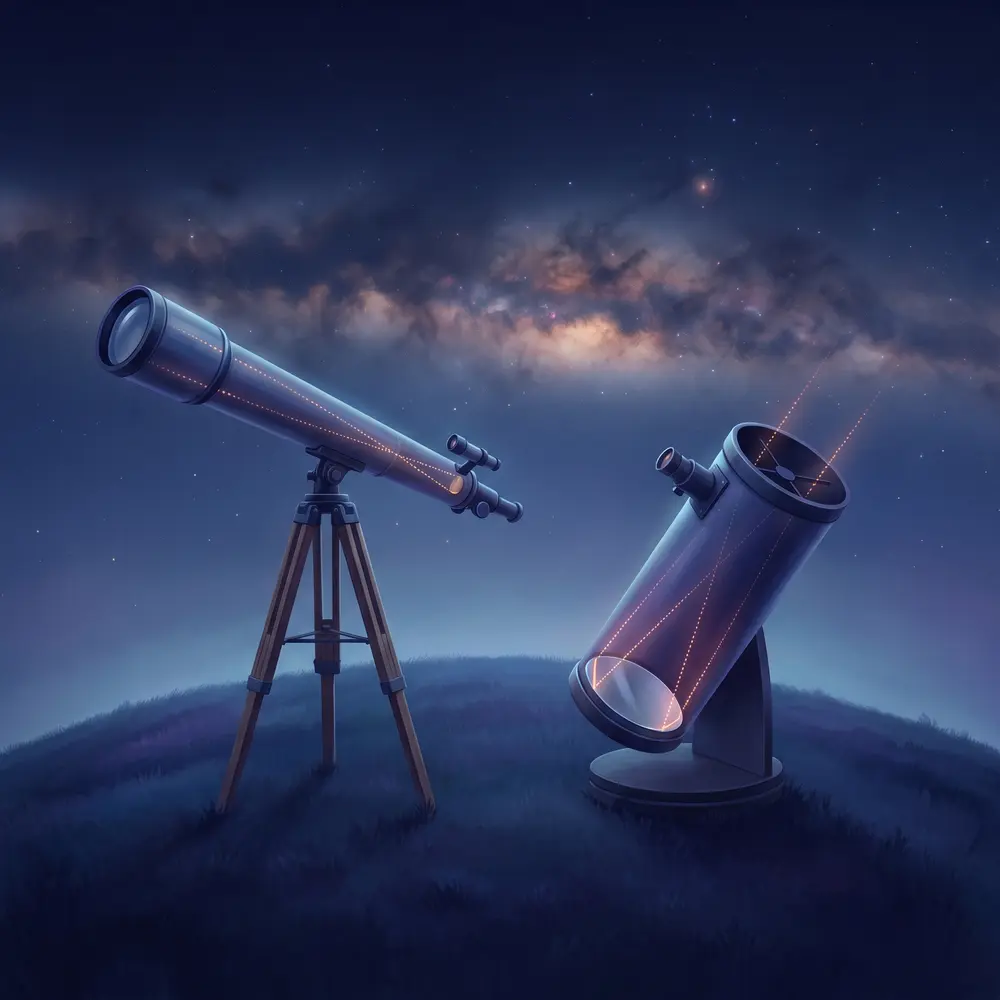
- The two kinds
- With lenses or with a mirrorRefractors and reflectors
- The biggest
- All use mirrorsWider than about three feet
- When it was born
- In the 1600s, with the first lenses
To get an idea
A big lens sags under its own weight; a mirror can be held up from behind.
Every instrument with an opening wider than about three feet is a reflector, with no exceptions.
Fun facts
These are not in the book: there was no room on paper.
A big lens can be held only by its edge, and it sags under its own weight.
A mirror, instead, can be supported from behind across its whole surface.
Every instrument with an opening wider than about three feet is a reflector, with no exception.
There are also mixed designs, which use a main mirror plus correcting lenses.
When choosing an instrument, the opening matters more than the magnification on the label.
Test yourself
The first question is the one printed under the QR code, with the answer the book did not give. The other four only exist here.
Question 1 of 5★ is the one from your book
What is the main job of a telescope?
Question 2 of 5
What are telescopes with lenses called?
Question 3 of 5
Why do big telescopes use mirrors?
Question 4 of 5
Above about three feet of opening, what instruments are used?
Question 5 of 5
What matters most when choosing an instrument?
Riddles
Everyone thinks my job is to make things look bigger, but my real work is to collect more light than can get into an eye. What am I?
There are two families of us: one works with glass that bends light, the other with a curved surface that sends it back. Above a certain size the second always wins. What am I?
If you choose me by the magnification printed on the box, you will almost surely make a bad buy. Look instead at how wide I am in front. What am I?
Try it yourself
Look at the numbers written on a pair of binoculars, for example seven by fifty: the second number is the width of the lenses in millimeters, and it matters most.
Cover half of a binocular lens with a finger and look again: faint stars disappear, because you have halved the light collected.
The words
- aperture
- The width of the lens or mirror: it decides how much light gets in.
Sources: Wikidata (Q4213), Wikipedia (Telescopio).