
The summer Milky Way
Our galaxy seen from inside
You can see it with your eyes
Finding it in the sky
When to look
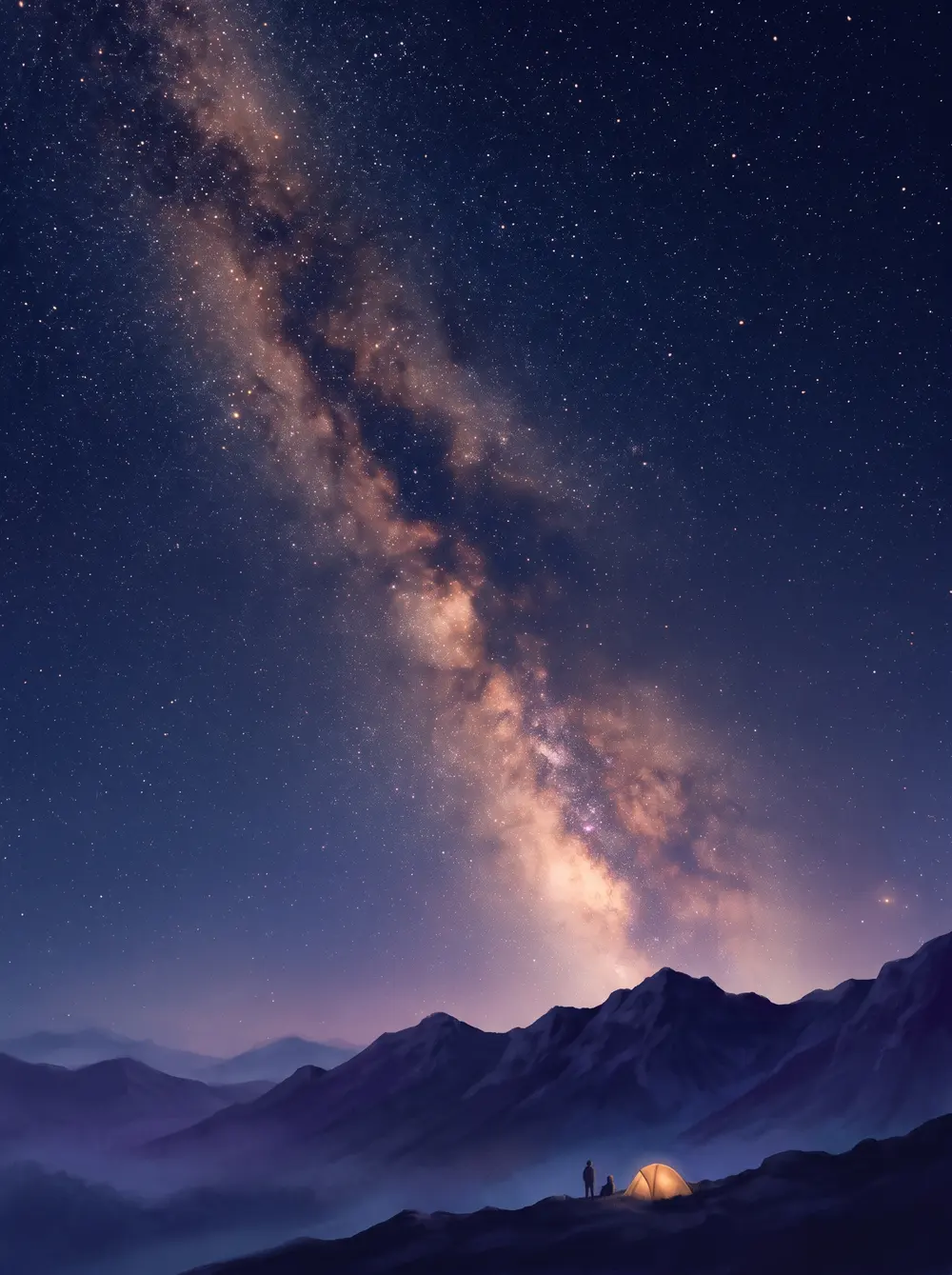
Summer nights, from a dark place and on an evening with no Moon. The richest part is low toward the south, while the band climbs upward and carries on to the opposite horizon.
How to recognize it
Start from the Summer Triangle, high overhead: the pale band passes right between its three points. From there follow it down toward the south, where it gets wider and brighter.
The main stars
- SagittariusSagittarius
- ScorpiusScorpius
- AquilaAquila
- CygnusCygnus
- CassiopeiaCassiopeia
To get an idea
The dark patches inside the band are not holes: they are clouds of dust covering the more distant stars.
From a city the Milky Way cannot be seen at all, while from a dark place it fills half the sky: the place changes, not your eyesight.
Fun facts
These are not in the book: there was no room on paper.
A long dark streak, more than forty degrees wide, splits the band in two: it is the Cygnus Rift.
The name comes from Greek and means circle of milk: the word galaxy comes from there too.
For the ancient Egyptians it was a heavenly Nile, a pale river flowing across the sky.
In China and Japan it is called the Silver River, and in India the Ganges of the sky.
In Spain it is called the Way of Saint James, because it guided the pilgrims heading there.
Our galaxy holds several hundred billion stars, and one of them is the Sun.
Test yourself
The first question is the one printed under the QR code, with the answer the book did not give. The other four only exist here.
Question 1 of 5★ is the one from your book
What is the pale band of the Milky Way?
Question 2 of 5
Who discovered what it is made of?
Question 3 of 5
Why is it easier to see in summer?
Question 4 of 5
What are the dark patches in the band?
Question 5 of 5
What do you need to see it?
Riddles
I am not a figure and I have no shape to learn: either you see me whole, from one horizon to the other, or you do not see me at all. Streetlights erase me. What am I?
I look like mist, but a man with a telescope discovered in 1610 that I am made of stars, so many and so faint that no eye can separate them. What am I?
The Egyptians called me the river of the sky, the Chinese the silver river, the Spanish the pilgrims' road. I am your home seen from inside. What am I?
Try it yourself
If you see it, follow it with your eyes from one horizon to the other and look for the dark patches inside: they are clouds of dust, not empty spaces.
Point binoculars at any stretch of the band, without looking for anything in particular. Instead of mist, dozens of separate stars will appear.
The words
- galactic disk
- The flat, wide part of the galaxy, where the Sun is too.
- light pollution
- Artificial light that brightens the sky and hides the faint stars.
Sources: Wikidata (Q321), Wikipedia (Via Lattea).