
Animals · Woods and fields of North America
American robin
Turdus migratorius
The bird that listens for worms
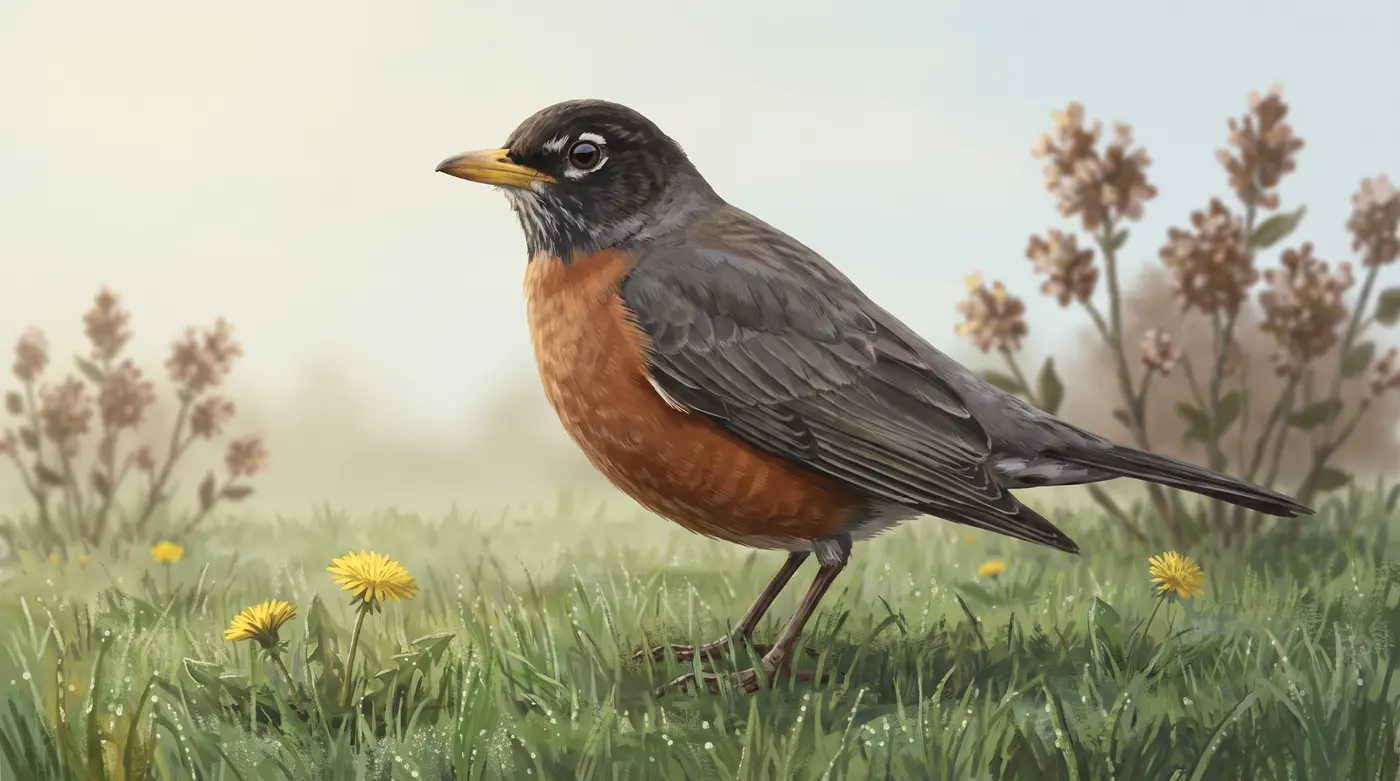
- Status: Safe
- Lawns, woods and gardens across North America, wintering in the south
Numbers
- Weight
- 2.7 oz (77 g)from 2.1 to 3.3 oz
- Length
- 10 in (25 cm)from 9 to 11 in
- Lifespan
- 2 yearson average; the record in the wild is 14
- Population
- 370 millionthe most of any land bird in North America
- Wingspan
- 16 in (41 cm)from 12 to 16 in
- Broods a year
- 3 broodstwo or three, from April to July
Ten fun facts
About three hundred seventy million American robins live in North America, more than any other land bird there.
Experiments show a robin can find earthworms hidden underground by listening for them, not only by looking.
Settlers named it after the European robin, but the American robin is a thrush and only a distant relative.
Its eggs are such a bright blue that the color has its own name: robin's egg blue.
Robins that eat too many fermented berries have been seen stumbling and falling over as they walk.
It is among the first songbirds to start singing at dawn, often before the sun comes up.
A robin builds a brand-new nest for every brood, lining it with smeared mud and soft grass.
When a cowbird sneaks an egg into its nest, the robin usually recognizes it and throws it out.
Robins tagged in Alaska travel up to three and a half times farther each year than robins tagged in Massachusetts.
The oldest known wild American robin lived fourteen years, although most robins live only about two years.
The quiz answers
The first one is the question printed in your book: here is the answer. The other four are extra.
Question 1 of 5★ this one is in your book
How does a robin find earthworms underground?
Question 2 of 5
What color are a robin's eggs?
Question 3 of 5
Which bird is the American robin named after?
Question 4 of 5
How many families can a robin pair raise in one season?
Question 5 of 5
What makes up most of a robin's food?
Try it yourself
Lie on the grass and listen closely with one ear to the ground for a minute. A robin hunts earthworms partly by hearing them.
Mix blue and a little green paint until you match a robin's egg. The color is so well known it has its own name.
Count the days on a calendar: fourteen for the eggs to hatch, fourteen more to leave the nest. That is a robin's first month.
Data from Wikidata (Q460967) and Wikipedia (American robin).