
Animals · Woods and fields of North America
Great horned owl
Bubo virginianus
The owl that hunts skunks
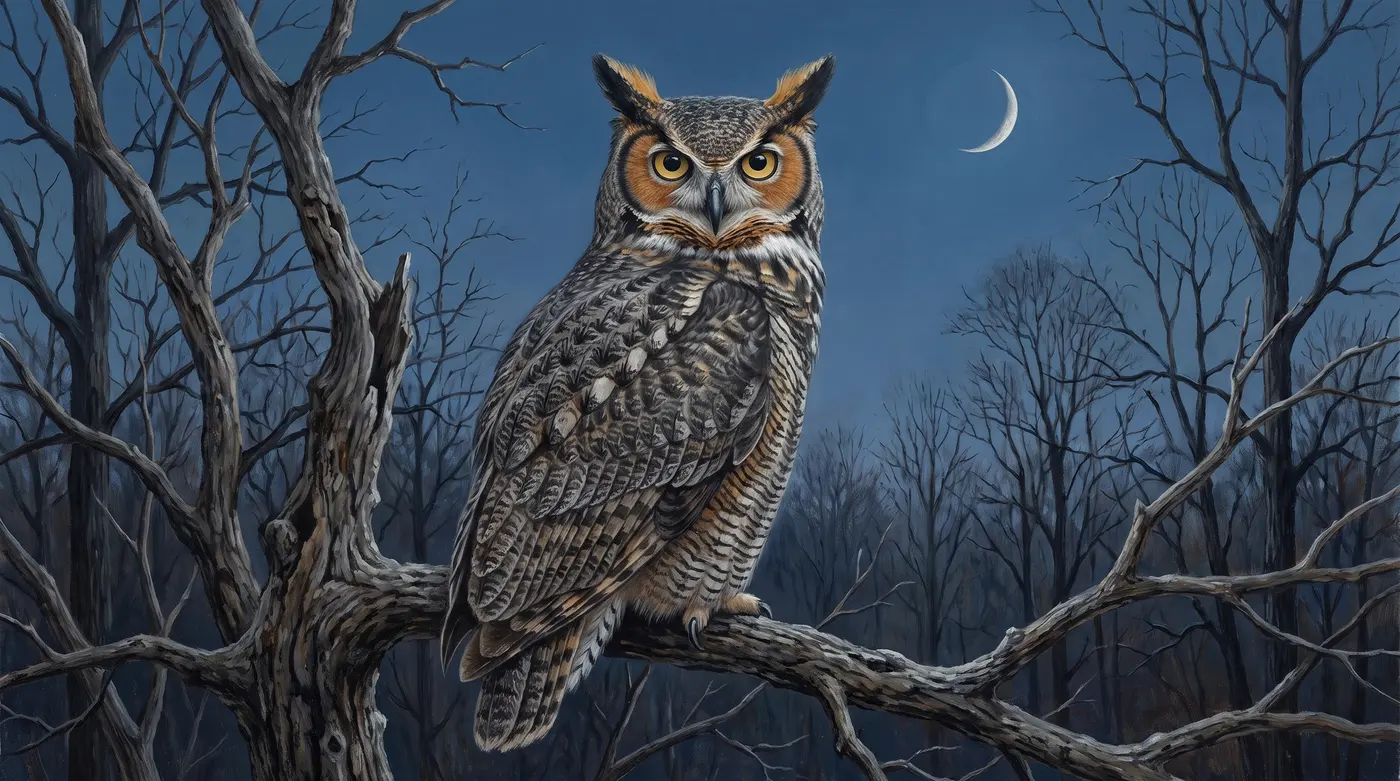
- Status: Safe
- Forests, deserts, farmland and cities across the Americas
Numbers
- Weight
- 3 lb (1.4 kg)females about 3.5 lb, males about 2.7 lb
- Length
- 22 in (56 cm)from beak to tail, from 17 to 25 in
- Lifespan
- 13 yearsa typical long life; the record is almost 29
- Talon grip
- 300 psi (21 bar)stronger than a human hand
- Wingspan
- 4 ft (1.2 m)from 3 to 5 ft
- Head turn
- 270 degreesits eyes cannot move
Ten fun facts
The horns of the great horned owl are only tufts of feathers, and they play no part in its hearing.
Its ear openings sit at slightly different heights, which lets it find prey hidden under snow by sound alone.
Its eyes are almost as big as a human's and shaped like tubes, working like a telephoto lens.
It cannot move its eyes, so it turns its whole head, as far as two hundred seventy degrees.
Fringed edges on its wing feathers break up the air, so it flies in almost total silence.
It is one of the few predators that regularly eat skunks, because its sense of smell is poor.
In a single great horned owl nest, researchers once found the remains of fifty-seven striped skunks.
Its talons squeeze with at least three hundred pounds per square inch, far more than a human hand.
It is one of the earliest birds in North America to nest, laying eggs weeks or months before other raptors.
The oldest great horned owl on record in North America lived to almost twenty-nine years.
The quiz answers
Five questions about this animal. Pick an answer and find out if it is the right one.
Question 1 of 5
What are the horns of a great horned owl?
Question 2 of 5
How far can a great horned owl turn its head?
Question 3 of 5
Why can a great horned owl hunt skunks?
Question 4 of 5
How does it fly so quietly?
Question 5 of 5
When does a great horned owl usually lay its eggs?
Try it yourself
Sit still and turn your head as far as you can to each side. A great horned owl can turn its head two hundred seventy degrees.
Close your eyes while a friend drops a coin somewhere in the room, then point to it. The owl finds mice under snow by sound.
Squeeze a tennis ball as hard as you can with one hand. An owl's talons press much harder, at three hundred pounds per square inch.
Data from Wikidata (Q81515) and Wikipedia (Great horned owl).