
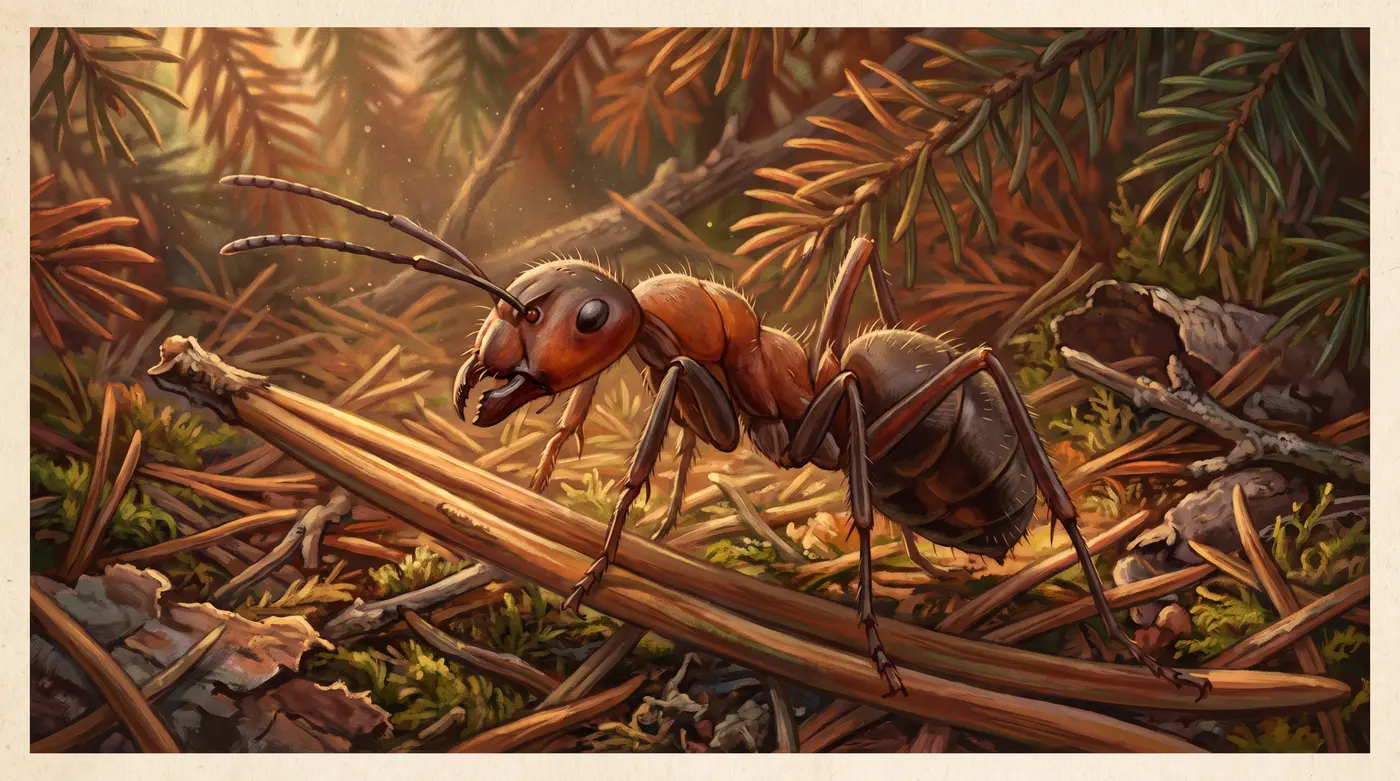
- Status: Threatened
- Coniferous forests of the Northern Hemisphere, especially firs and larches
Numbers
- Weight
- 0,0001 ozfrom 0.00003 to 0.00018 oz
- Length
- 0,4 inworker, from 0.3 to 0.4 in
- Formic acid spray
- 12 inabout thirty times its body length
- Nest height
- 6,5 ftbuilt by insects less than half an inch long
- Insects eliminated in a season
- 5000000 insectsfrom a single nest, many of them harmful caterpillars
Ten fun facts
has no sting: it defends itself by spraying formic acid up to twelve inches away, thirty times its body length.
its nests can reach up to seven feet in height and hide a dense network of tunnels inside them.
in a single season, the inhabitants of a single nest can destroy five million insects, many of them harmful caterpillars.
entire nests are moved to different forests to fight harmful insects without using any chemical products.
more than a hundred fertilized females can live together in older nests, making this species polygynous with many queens.
a fertilized queen cannot survive alone, which is why she is often welcomed back into the colony where she was born.
new colonies are formed through division into secondary swarms, tertiary swarms, and very rarely even quaternary swarms.
spring nuptial flights often coincide with battles between neighboring colonies to redraw the boundaries of their territory.
some queens establish their nest inside colonies of other species, usually of the Formica fusca group, exploiting their workers.
nests are almost always located in open areas of the forest, where sunlight can reach all the way to the ground.
The quiz answers
The first one is the question printed in your book: here is the answer. The other four are extra.
Question 1 of 5★ this one is in your book
How does the Ant defend itself without a sting?
Question 2 of 5
How tall can an Ant nest be?
Question 3 of 5
How many insects can a single nest eliminate in a season?
Question 4 of 5
What does it mean that the Ant is polygynous?
Question 5 of 5
How does a new Ant colony usually start?
Try it yourself
Measure twelve inches with a ruler and place a grain of rice next to it to see the distance of the formic acid spray.
Use a tape measure to mark seven feet on a wall to see the maximum height of a nest built by tiny insects.
Watch a nest in the woods without touching it, count how many ants enter and leave in one minute, then multiply by sixty.
Data from Wikidata (Q148769) and Wikipedia (Formica rufa).