
Animals · Reptiles and amphibians
Axolotl
Ambystoma mexicanum
The salamander that stays a larva forever
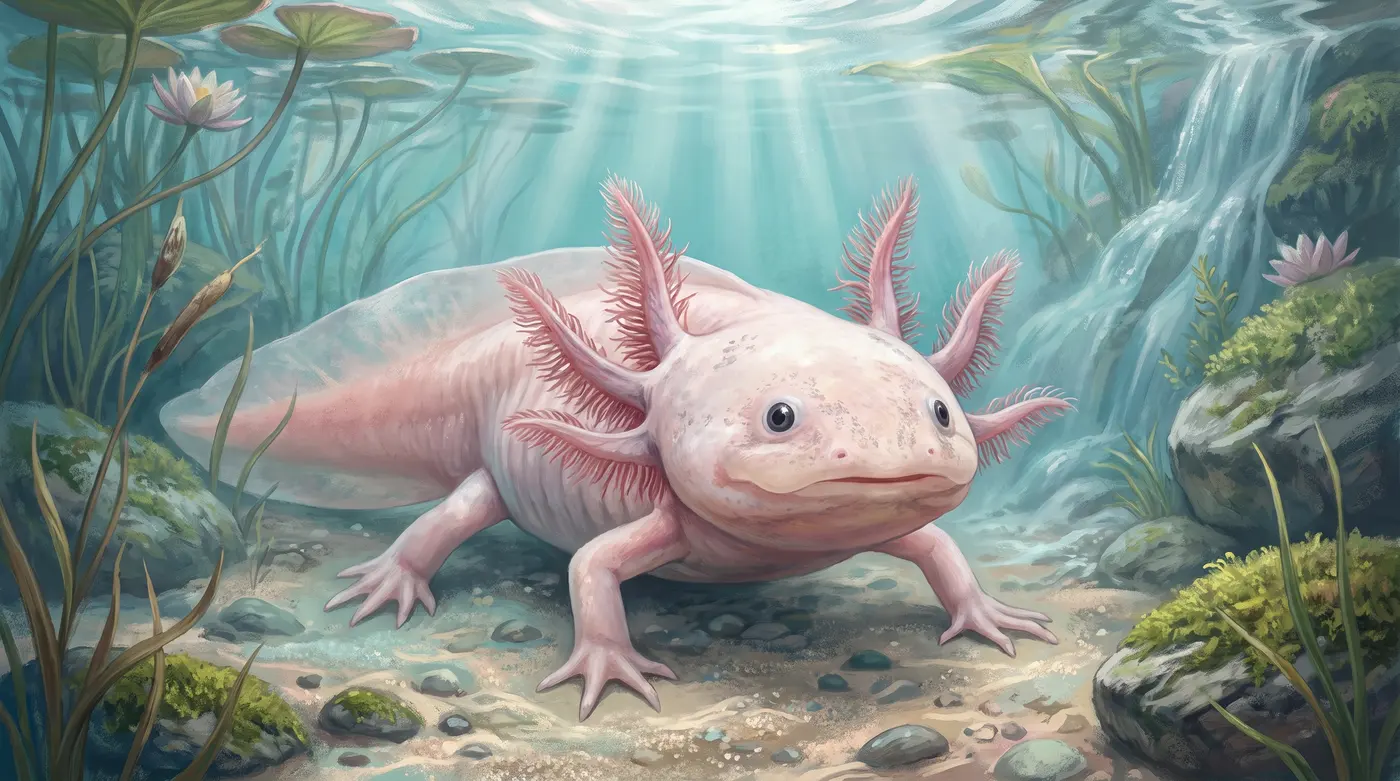
- Status: Endangered
- Lake Xochimilco, on the outskirts of Mexico City
Numbers
- Weight
- 3 ozfrom 2 to 4 oz
- Length
- 10 infrom 6 to 10 in; over 12 in is rare. Wikidata indicates 18 inches, about 46 cm, in contrast with the material
- Lifespan
- 15 yearsthe material places the mature adult between 10 and 15 years of life, but the sentence is ambiguous
- Days to grow four legs
- 72 daysstarting from egg hatching
- Exceptional size
- 12 inbeyond this size specimens are rare
- Pairs of gills
- 3 pairsplus four external gills hidden in the back
Ten fun facts
it never completes metamorphosis: it stays in the larval stage all its life, a phenomenon called neoteny.
it can regenerate limbs, lungs, the spinal cord, and even parts of the brain without leaving a single scar.
its ability to regenerate seems to depend on cells very similar to the adult stem cells found in mammals.
it has three pairs of gills behind its head, plus four external gills hidden in the back part.
it does not chew: its teeth are rudimentary and food is sucked in with water using its front gills.
it can breathe through its rear gills or swallow air directly by swimming up to the surface of the water.
if a larva absorbs enough iodine, it begins metamorphosis and transforms into a land salamander.
its eggs are transparent, so the development of the embryo can be followed from the outside day by day.
larvae take about seventy-two days to grow all four legs after hatching from their eggs.
it was added to Minecraft due to extinction risks, but two of the five game variants do not exist in nature.
The quiz answers
The first one is the question printed in your book: here is the answer. The other four are extra.
Question 1 of 5★ this one is in your book
What does it mean that the Axolotl is neotenic?
Question 2 of 5
Which body part can it NOT regenerate?
Question 3 of 5
Where did the Axolotl live in the wild?
Question 4 of 5
How does the Axolotl eat?
Question 5 of 5
What triggers a larva to complete metamorphosis?
Try it yourself
Measure ten inches with a ruler and compare it with your open hand: that is the total length of an adult Axolotl.
Mark seventy-two days on a calendar starting from today: that is the time a larva needs to grow all four of its legs.
Look up Lake Xochimilco on an atlas near Mexico City: that single body of water is the entire natural range of this species.
Data from Wikidata (Q22718) and Wikipedia (Axolotl).