
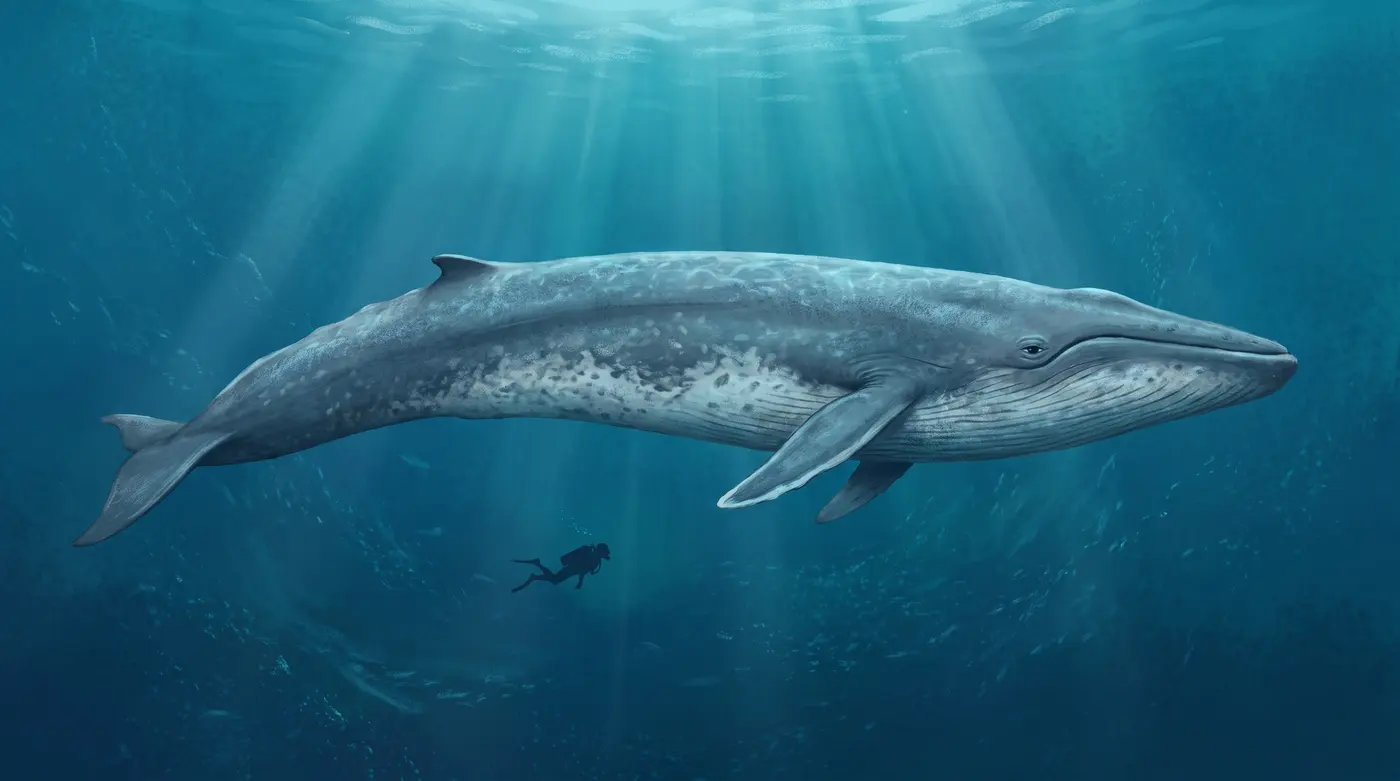
- Status: Endangered
- All the world's oceans, from Antarctica to temperate waters
Numbers
- Weight
- 330000 lbestimate for a 90-foot specimen, between 330,000 and 370,000 lb; the heaviest accurately measured reached 390,000 lb
- Length
- 90 ftadults measure from 80 to 110 feet; the two longest ever measured were females of 110 and 109 feet; the Wikidata value of 89 feet is consistent with the material
- Lifespan
- 80 yearsunconfirmed hypothesis: the longest-tracked specimen was studied for 34 years
- Resting heart rate
- 5 beats per minutefrom 5 to 10 at rest, down to 2 during deep dives
- Top speed
- 30 mphonly over short distances; typical speed is 12 mph and drops to 3 mph while feeding
- Heart weight
- 400 lbthe largest heart of any known animal
Ten fun facts
its heart weighs four hundred pounds and is the largest of any animal, with an aorta nine inches in diameter.
at rest its heart beats five to ten times per minute, and during deep dives it can drop to two.
a newborn calf weighs about six thousand pounds, as much as an adult hippopotamus, and drinks up to one hundred gallons of milk daily.
in its first months of life the calf can gain two hundred pounds a day and doubles its length in six months.
its lungs have a capacity of thirteen hundred gallons and the spout it exhales can rise up to forty feet high.
its vocalizations reach one hundred eighty-eight decibels and drop to ten hertz, below the threshold that the human ear can hear.
its only natural predator is the orca, and more than twenty-five percent of adults bear scars left by these attacks.
the scientific name musculus means muscular, but also tiny mouse, so Linnaeus might have chosen it as a joke.
between nineteen thirty and nineteen thirty-one, whalers killed twenty-nine thousand four hundred of them in Antarctic waters alone.
there are at least eleven documented adult hybrids between blue whales and fin whales, two genetically distant species.
The quiz answers
Five questions about this animal. Pick an answer and find out if it is the right one.
Question 1 of 5
What does the blue whale feed on almost exclusively?
Question 2 of 5
How much does the heart of a blue whale weigh?
Question 3 of 5
What prevents the blue whale from swallowing large prey?
Question 4 of 5
How much does a blue whale calf weigh at birth?
Question 5 of 5
What is the only natural predator of the blue whale?
Try it yourself
Measure nine inches on a ruler: that is the diameter of a blue whale's aorta. Try fitting your arm through a circle of that size.
Count your pulse at your wrist for one minute, then compare it with the five to ten beats per minute of a resting blue whale's heart.
Use tape and chalk in the yard to draw a line ninety feet long: that is the length of an adult blue whale.
Data from Wikidata (Q42196) and Wikipedia (Blue whale).