
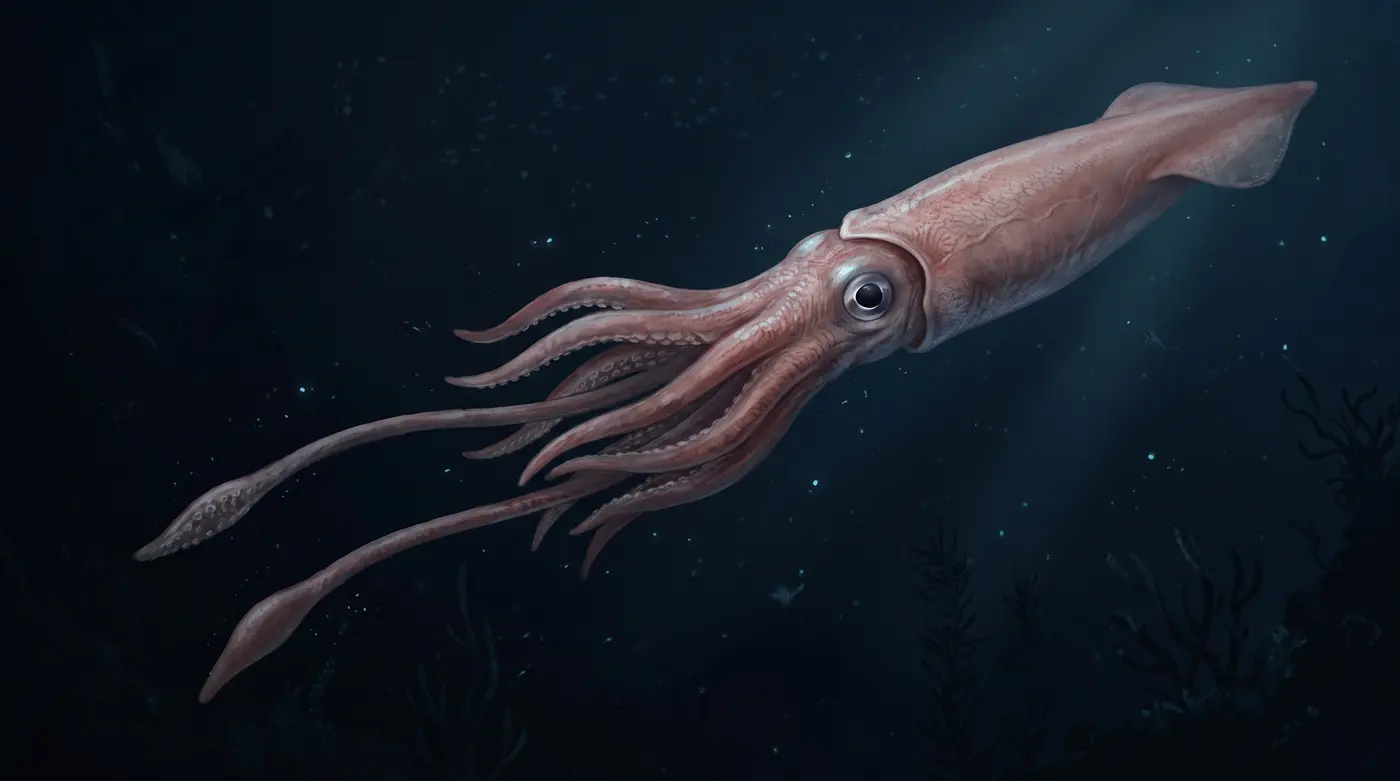
- Status: Safe
- Deep waters of all oceans, from 650 to 3,300 feet deep
Numbers
- Weight
- 600 lbestimate: 600 lb for males, 330 lb for females
- Length
- 43 ftestimated total length including tentacles; the mantle alone does not exceed 7.5 feet
- Lifespan
- 14 yearsestimated maximum value, not directly measured
- Depth
- 3300 ftrange from 650 to 3,300 ft, most common between 1,300 and 2,000 ft
- Eggs laid
- 1000000 eggsover one million, corresponding to more than 11 lb
- Growth
- 3 yearstime needed to reach adult size
Ten fun facts
that calling this animal an octopus is wrong because it has ten arms and a long body instead of eight arms?
that the first images of a live giant squid were taken on September 30, 2004, after nearly two years of attempts?
that the first video of a live adult was filmed on December 4, 2006, showing an eleven foot female?
that this creature lacks light organs and sucker hooks, but it still possesses an ink sac like other cephalopods?
that a twenty-eight foot specimen caught near the Falkland Islands in 2006 was sent to the Natural History Museum in London?
that a specimen washed ashore in Newfoundland in 1878 had a thirty-five foot tentacle and weighed over two tons?
that researcher Frederick Aldrich calculated that mass strandings happen every ninety years and accurately predicted the events of the 1960s?
that its flesh contains ammonium ions that help it stay buoyant, making the meat completely inedible for human beings?
that one specimen attacked a Greenpeace submarine in the Bering Sea in 2007 and sprayed ink at the vessel?
that its main predators are sperm whales and Greenland sharks, while young squids are eaten by many types of fish?
The quiz answers
The first one is the question printed in your book: here is the answer. The other four are extra.
Question 1 of 5★ this one is in your book
Who is the main predator of the giant squid?
Question 2 of 5
In what year was a live giant squid photographed for the first time?
Question 3 of 5
What is the maximum length of the mantle, the body without the arms?
Question 4 of 5
Why is its meat not eaten by humans?
Question 5 of 5
Which legendary monster was likely inspired by this animal?
Try it yourself
Unroll a tape measure to seven and a half feet. That is the maximum known length of the mantle, which is the main body without arms.
Pick up a grain of sand or salt and look at it closely. An egg of this ocean creature is only a fraction of an inch wide.
Close the door of a pitch-black room and try to recognize an object by touch alone. No sunlight reaches two thousand feet below the surface.
Data from Wikidata (Q13537131) and Wikipedia (Giant squid).