
- Status: Safe
- Raised worldwide, from mountains to Mediterranean islands
Numbers
- Weight
- 100 lbfrom 45 lb for dwarf breeds to over 220 lb for large males
- Length
- 53 infrom 47 to 59 in
- Height
- 24 infrom 16 to 39 in
- Lifespan
- 15 yearsWikidata entry, not confirmed by the main text
- Milk per day
- 2,6 quartsfor 305 days of lactation; reaching over 7.4 quarts in exceptional cases
- Domesticated since
- 10000 BCin the Zagros Mountains of Iran; preceded only by the dog
- Kids in one birth
- 6 kidsa very rare case; usually twins are born
Ten fun facts
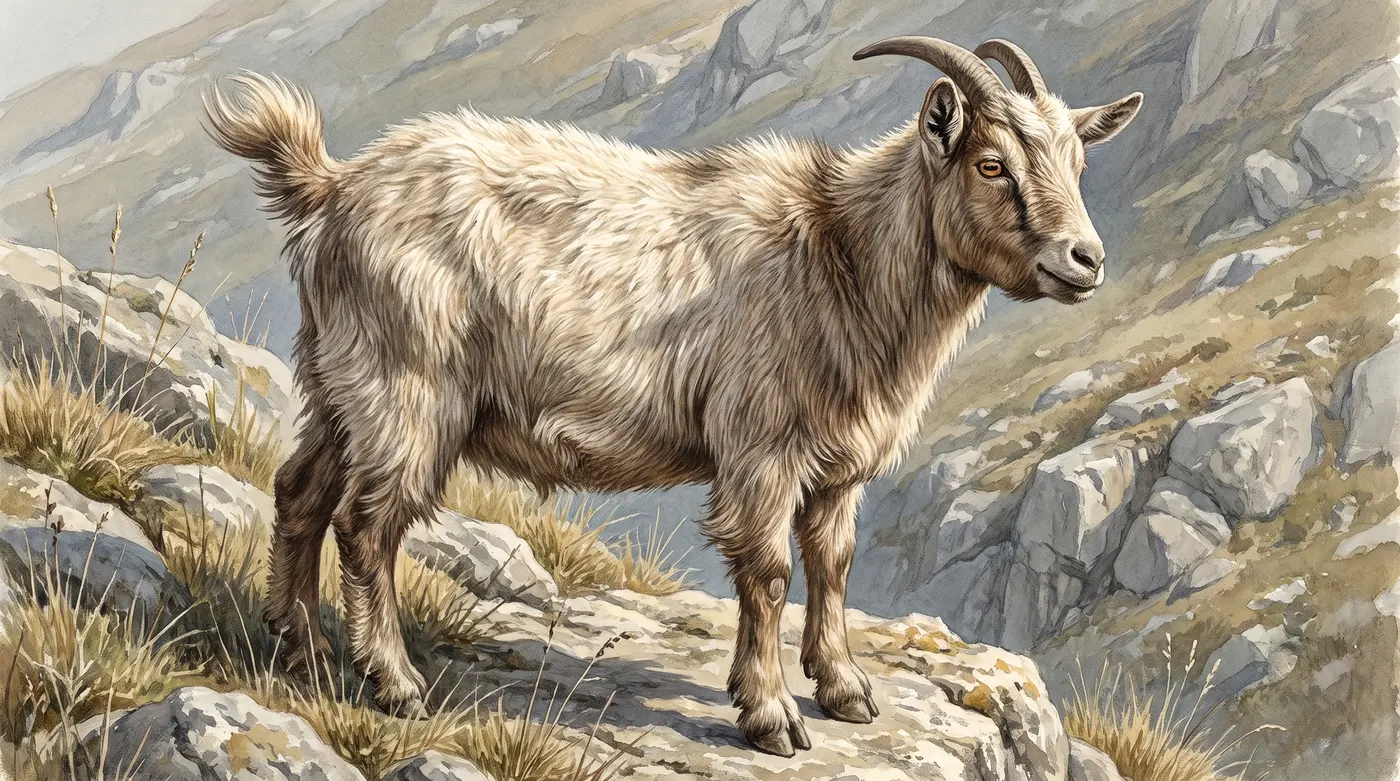
the tail of a goat always points upward, while that of a sheep points downward, making it the fastest way to tell them apart.
its pupils are horizontal slits, a shape that helps it judge distances on steep and rocky slopes in the mountains.
goat butter is always white because the carotene that turns cow butter yellow is transformed into a precursor of vitamin A.
goat milk has less lactose than cow milk, but it is still not suitable for people who are lactose intolerant.
goat meat has no fat between the muscle fibers, so it must be cooked longer and at lower temperatures.
cashmere and mohair come from the hair of goats in cold regions, sheared or combed without harming the animal.
during Yom Kippur two goats were chosen, one was sacrificed and the other released with the sins of the community, creating the term scapegoat.
in Greek mythology the newborn Zeus was nursed by the goat Amalthea in a cave on Mount Ida on the island of Crete.
a goat named William Windsor served in the British military from two thousand one until two thousand and nine.
in Italy there are goats that have returned to the wild on the island of Montecristo and the island of Caprera.
The quiz answers
The first one is the question printed in your book: here is the answer. The other four are extra.
Question 1 of 5★ this one is in your book
When was the goat domesticated?
Question 2 of 5
What shape are a goat's pupils?
Question 3 of 5
How many stomach chambers does an adult goat have?
Question 4 of 5
Why is goat butter white?
Question 5 of 5
How can you tell a goat apart from a sheep?
Try it yourself
Take two one-quart bottles and one one-pint bottle: together they equal the two and a half quarts of milk that a goat produces every single day.
Mark one hundred fifty-five days on the calendar starting today: that is the exact amount of time that passes between mating and the birth of young kids.
Cut out two animal shapes, one with its tail up and one with its tail down: you now have a goat and a sheep to compare.
Data from Wikidata (Q2934) and Wikipedia (Goat).