
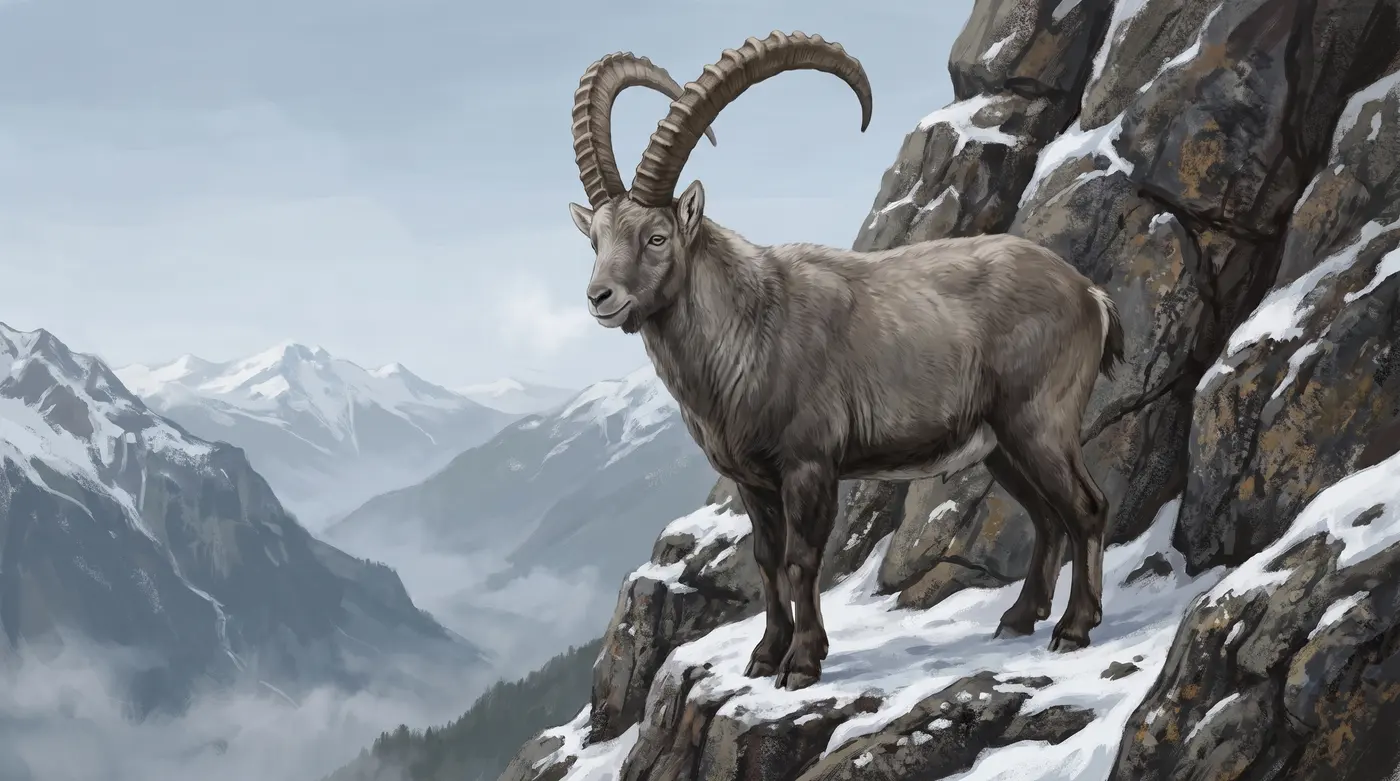
- Status: Safe
- Rocky cliffs of the Alps, between 1,600 and 10,000 feet
Numbers
- Weight
- 203 lbmales from 150 to 260 lb, females from 37 to 70 lb; value chosen at the center of the male range. Wikidata does not report any value
- Length
- 63 inmales from 59 to 67 in, females from 48 to 56 in
- Height
- 37 inshoulder height of males, from 35 to 40 in; females stop at 29 to 33 in
- Lifespan
- 15 yearsreferred to males, from 14 to 16 years; females can exceed 20
- Horn length
- 39 inin males from 27 to 39 in; the oldest individuals exceed 3 feet
- Daily grass intake
- 33 lbsupplemented with juniper shoots, rhododendrons, mosses, and lichens
- Maximum winter altitude
- 11500 ftin winter it prefers well-exposed cliffs between 6,500 and 11,500 feet
Ten fun facts
horn growth stops every November and leaves a ring, allowing experts to calculate the exact age of the animal.
the horns of an old male can exceed three feet in length, while female horns remain smooth and under fourteen inches.
males weigh up to two hundred and sixty pounds while females reach only seventy, showing an enormous difference between sexes.
an ibex can eat up to thirty-three pounds of grass daily and craves salt, which is scarce in high mountain pastures.
one hundred thousand years ago it lived across rocky Europe, and Paleolithic hunters painted it inside the famous Lascaux caves.
during summer, female groups form nursery herds where up to twenty kids are guarded by a few adults while others feed.
in the nineteenth century, powdered horns were sold as medicine, its blood against kidney stones, and its stomach against depression.
King Victor Emmanuel II saved the species in 1856 by protecting the remaining animals inside his private royal hunting reserve.
Aosta Valley and Piedmont are the only regions in the entire Alpine arc where the species never went completely extinct.
Ötzi the Iceman ate dried ibex meat shortly before he died, as revealed by modern scientific analysis from Eurac Research.
The quiz answers
The first one is the question printed in your book: here is the answer. The other four are extra.
Question 1 of 5★ this one is in your book
How can you estimate the age of an ibex?
Question 2 of 5
How many ibex remained in the nineteenth century?
Question 3 of 5
Where do all modern ibex descend from?
Question 4 of 5
How much grass can an ibex eat in a day?
Question 5 of 5
How much does an adult male weigh?
Try it yourself
Count the rings on the horn of an ibex in a photograph. Each ring represents one passed winter, just like the growth rings inside a tree trunk.
Weigh thirty-three pounds of lettuce on a kitchen scale, one bag at a time. That is the exact amount of grass an ibex eats every single day.
Draw one hundred dots on a piece of paper. That was the entire population in the nineteenth century. Now try to imagine fifty-five thousand of them today.
Data from Wikidata (Q168327) and Wikipedia (Alpine ibex).