
- Status: Unknown
- Coastal waters of almost all seas in the Northern Hemisphere
Numbers
- Length
- 16 inmaximum bell diameter, the measurement used to describe the species
- Bell diameter
- 16 inin a perfectly formed specimen
- Tolerated temperature
- 88 degreestolerates from 43 to 88 degrees, with an optimum between 48 and 66
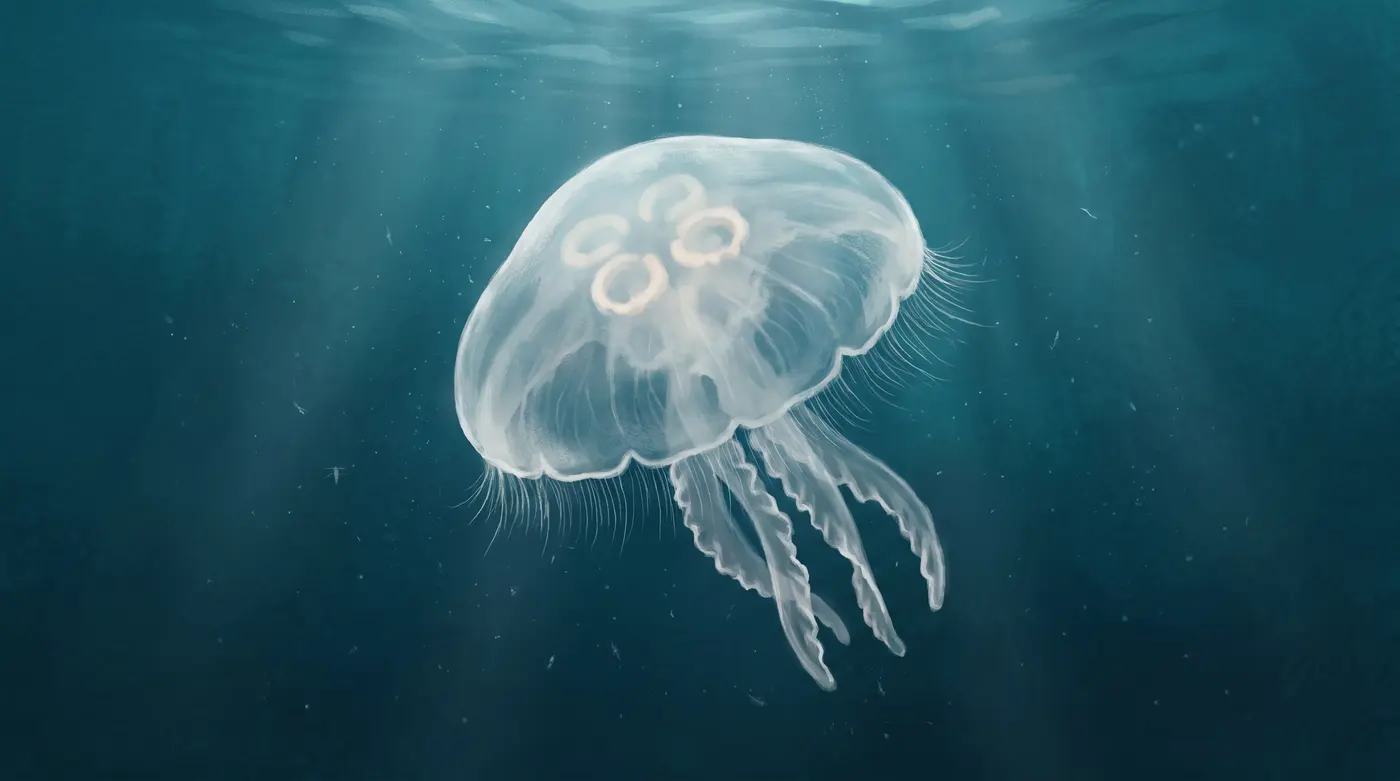
- Four-leaf clover gonads
- 4 gonadsvisible from above through the transparent bell
Ten fun facts
has no respiratory system at all, so oxygen enters and leaves its body by simple diffusion, without any lungs or gills?
the four clover-like structures visible on its bell are not decorations, but rather the gonads, which are its reproductive organs?
its tentacles are armed with nematocysts, stinging capsules that snap open on contact and inject venom to paralyze prey?
the most abundant tissue in its body is mesoglea, a jelly-like substance that is traversed by small muscle channels?
cannot swim against strong ocean currents, so it is often pushed near coasts and gathers in huge groups?
can tolerate water from forty-three to eighty-eight degrees, but thrives best when the temperature stays between forty-eight and sixty-six?
reproduces without a partner during its polyp stage by dividing into stacked disks that detach one by one?
each detached disk is called an ephyra and swims freely until it develops into a complete adult individual?
the four thick oral arms located at the center of the bell become clearly visible only in older individuals?
is regularly caught in Japan, China, Indonesia, and the Philippines, where it is considered a very common dish?
The quiz answers
Five questions about this animal. Pick an answer and find out if it is the right one.
Question 1 of 5
How does the Jellyfish breathe?
Question 2 of 5
What are the four clover-shaped figures on the bell?
Question 3 of 5
How large can the bell measure at most?
Question 4 of 5
What is the name of the stage attached to the seabed?
Question 5 of 5
Which animal is one of its main predators?
Try it yourself
Draw a circle sixteen inches in diameter on a sheet of paper to see the maximum size of the bell. Try covering it completely with both of your open hands.
Stack four paper plates together and pull them apart one at a time from the top to show how the polyp releases young jellyfish into the sea.
Use a thermometer to measure your tap water temperature and compare it with the range of forty-three to eighty-eight degrees in which this species can survive.
Data from Wikidata (Q26864) and Wikipedia (Aurelia aurita).