
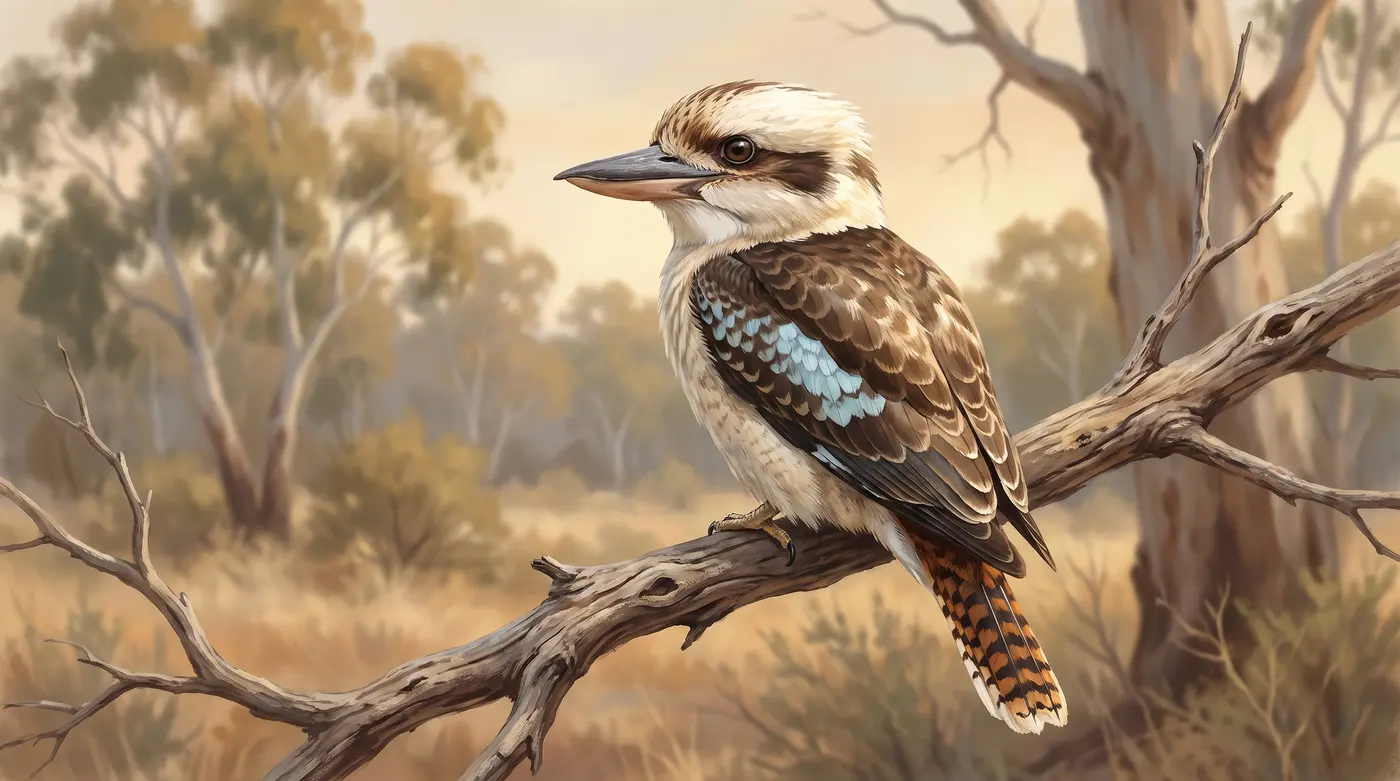
- Status: Safe
- Woodlands and open forests of eastern and southwestern Australia, including Tasmania
Numbers
- Weight
- 10,8 ozmale 6.9-15.9 oz, female 6.7-16.4 oz; the female is on average heavier
- Length
- 18 in16 to 19 inches according to English sources
- Lifespan
- 15 years11 to 15 years in the wild
- Helpers at the nest
- 5 young adultsoffspring from previous years staying in the group
- Care after fledging
- 10 weekssix to ten weeks until young hunt independently
- Maximum weight
- 16,4 ozfemale; no other kingfisher reaches this body mass
Ten fun facts
it is the largest kingfisher in the world and even surpasses the giant kingfisher in body mass.
it lives in dry areas far from water, meaning that fish is almost never part of its regular diet.
it occasionally snatches goldfish from ornamental garden ponds, which is the only time it actually goes fishing.
its laugh is a standard sound effect in jungle movies, even though it never lives in tropical rainforests.
it hunts from ambush, remaining still on a branch until it spots prey on the ground and swoops down.
up to five adult offspring stay with their parents to help defend the territory and feed the new chicks.
it nests in unlined tree cavities and sometimes even digs a tunnel into active termite mounds in trees.
out of three chicks in a clutch, the youngest is often killed by older siblings born earlier.
its scientific name means of New Guinea, but this is an error because the species does not live there.
its common name comes from gugubarra, a word from the Wiradjuri language, an endangered Indigenous Australian language.
The quiz answers
The first one is the question printed in your book: here is the answer. The other four are extra.
Question 1 of 5★ this one is in your book
Which family does the Kookaburra belong to?
Question 2 of 5
How does it capture its prey?
Question 3 of 5
What do adult offspring of the pair do?
Question 4 of 5
Where does it build its nest?
Question 5 of 5
Why does its scientific name mention New Guinea?
Try it yourself
Measure eighteen inches with a tape measure and place it on a table: that is the total length of an adult Kookaburra from beak to tail.
Weigh three three-ounce chocolate bars together: they equal about eleven ounces, the weight of an adult male Kookaburra. Now imagine it flying.
Mark ten weeks on your calendar starting today: that is how long young birds keep being fed by the group after learning to fly.
Data from Wikidata (Q824974) and Wikipedia (Laughing kookaburra).