
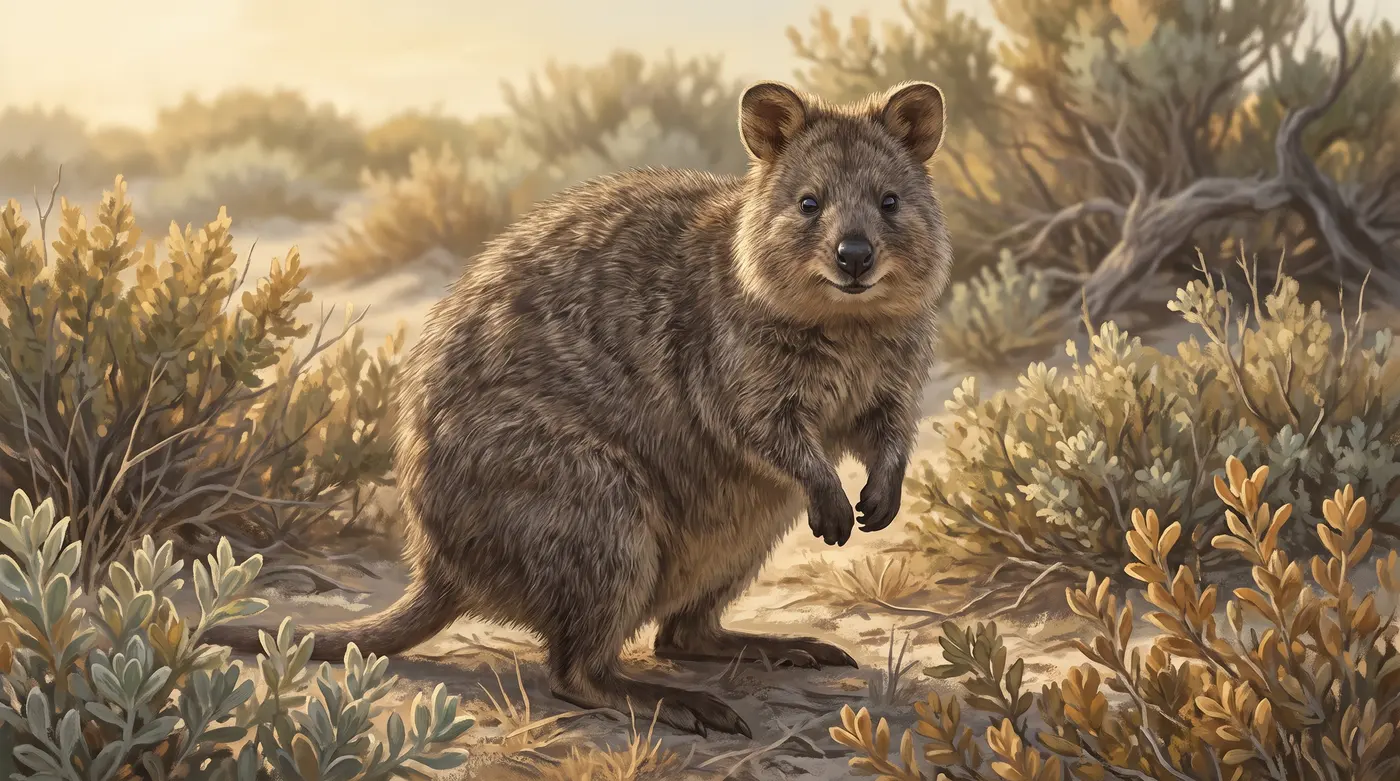
- Status: Threatened
- Southwestern Australia and a few coastal islands, especially Rottnest
Numbers
- Weight
- 8,4 lb5.5 to 11 lb
- Length
- 18,5 inbody 16 to 21 in, tail excluded
- Lifespan
- 10 yearsWikidata value reported in the header of the material, not confirmed by the reference text
- Tail
- 12 in10 to 12 in, short for a macropod
- Babies per year
- 1 babya single birth per breeding season
- Maximum fine for touching it
- 1000 Australian dollars100 dollars normally, up to 1000 if the animal is injured or killed
Ten fun facts
in 1696 Dutch captain Willem de Vlamingh mistook the animal for a giant rat and named the island Rottnest, meaning rat nest.
a Dutch sailor described the quokka as a wild cat in 1650, making it one of the first Australian mammals seen by Europeans.
touching the quokka on Rottnest Island is illegal, with fines starting at one hundred Australian dollars and going up to one thousand.
bread fed to quokkas by tourists genuinely harms their health, which is why feeding these animals is strictly forbidden by law.
the quokka can climb small shrubs and low trees, which is a very unusual ability for a member of the kangaroo family.
its tail measures only ten to twelve inches long, which is remarkably short compared to the tails of other macropods.
on Rottnest Island the quokka breeds only in late summer, whereas mainland populations can reproduce at any time of the year.
on Rottnest Island the main factor limiting quokka reproduction appears to be a shortage of copper in their natural diet.
the offshore islands where the quokka lives are crucial because foxes and cats have never arrived on them to hunt.
the name quokka likely comes from the word gwaga in the Nyungar language spoken by the indigenous Noongar people of Australia.
The quiz answers
The first one is the question printed in your book: here is the answer. The other four are extra.
Question 1 of 5★ this one is in your book
To which animal family does the quokka belong?
Question 2 of 5
Why is it called the happiest animal in the world?
Question 3 of 5
What is strictly forbidden to do with quokkas on Rottnest Island?
Question 4 of 5
What threatens the quokka on the mainland?
Question 5 of 5
How many babies does a female quokka give birth to each year?
Try it yourself
Use a tape measure to mark twenty-one inches on the floor for the maximum body length of a quokka, then add twelve more inches for its tail.
Fill a backpack until it weighs eleven pounds and lift it up with one arm to feel the weight of a large adult quokka living in the wild.
Find Rottnest Island on a map off the coast of southwestern Australia and measure its distance from the mainland to locate its primary natural shelter.
Data from Wikidata (Q726151) and Wikipedia (Quokka).