
- Status: Safe
- Arctic waters of Greenland, Canada, and Russia, year-round
Numbers
- Weight
- 2600 lb1,800 to 3,500 lb
- Length
- 15 ftexcluding tusk; average 13.5 ft in males and 11.5 ft in females
- Lifespan
- 50 yearssome analyses indicate 115 years for females and 84 for males
- Depth
- 5000 ftwinter dives of males
- Tusk
- 10 ftup to 22 lb in weight, base almost 4 in
- Breath hold
- 25 minutesdescent, time at the bottom, and ascent
Ten fun facts
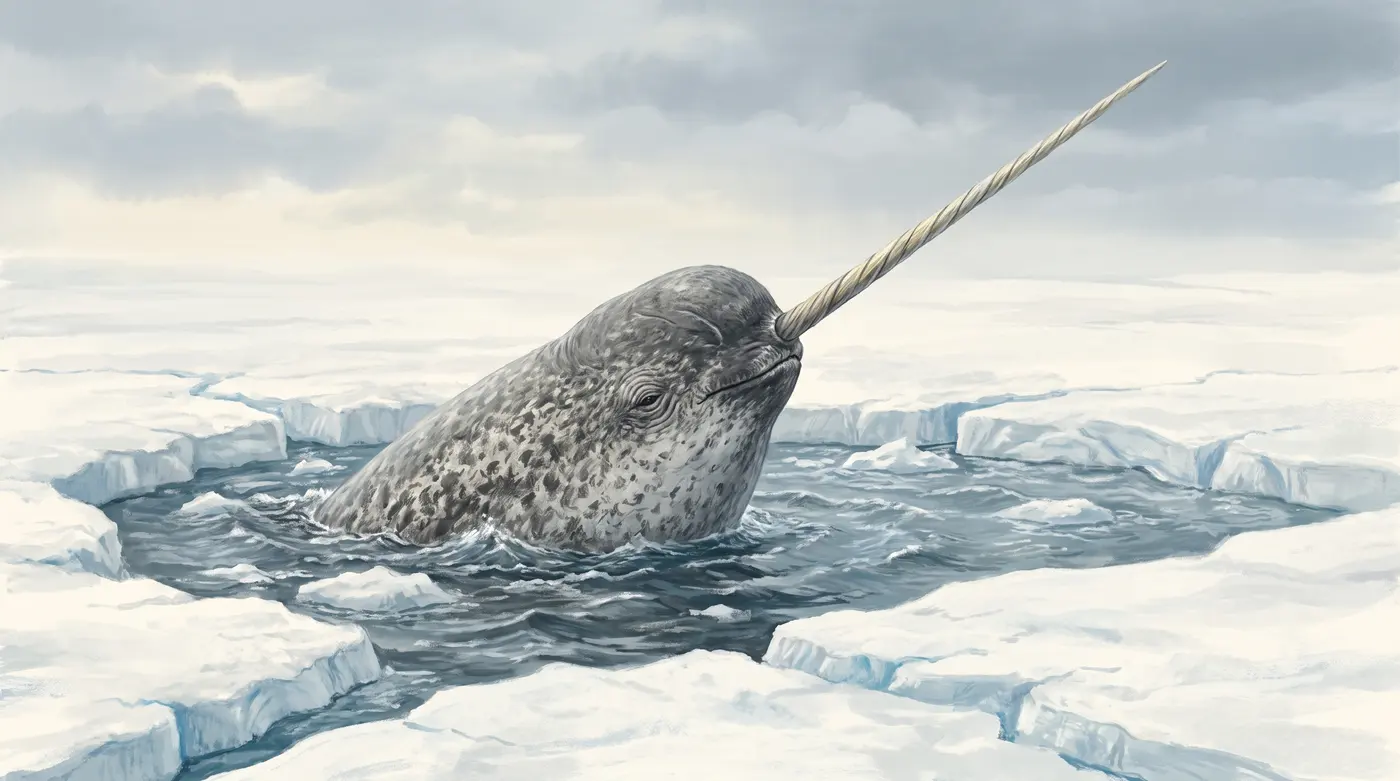
the tusk is the left canine tooth, growing up to ten feet long, weighing twenty-two pounds, and always spiraling to the left.
about one male in five hundred develops two tusks, which happens when the right canine tooth also pierces the upper lip.
only about fifteen percent of females have a tusk, which is usually shorter and has a much less pronounced spiral.
its neck vertebrae are not fused together like those of other whales, allowing the narwhal to turn its head.
in August 2016 a drone captured footage of narwhals using their tusk to strike and stun arctic cod before eating them.
chemical analyses of the eye lens suggest that female narwhals might be able to live for over one hundred years.
during the winter months it dives deeper than two thousand five hundred feet up to twenty-five times every day.
between breathing holes in the ice it cannot swim more than nine-tenths of a mile without coming back up for air.
in 1915 in western Greenland, over one thousand narwhals became trapped together under the ice pack in a single event.
its name comes from the Old Norse word for corpse, referring to its mottled gray skin that resembled a drowned person.
The quiz answers
Five questions about this animal. Pick an answer and find out if it is the right one.
Question 1 of 5
What is the narwhal tusk in reality?
Question 2 of 5
In which direction does the tusk spiral turn?
Question 3 of 5
How many females develop a tusk?
Question 4 of 5
How deep does it dive in winter?
Question 5 of 5
What is the greatest danger for a narwhal?
Try it yourself
Hold a corkscrew and look at it from the side: a narwhal tusk spirals in the exact same direction, always turning left along its entire length.
Use a measuring tape to mark ten feet across the floor, then lay a broom beside it: you will see how long an adult tusk really is.
Draw a circle twenty inches wide on a piece of paper: that is the smallest ice hole an adult narwhal can use to come up and breathe.
Data from Wikidata (Q159426) and Wikipedia (Narwhal).