
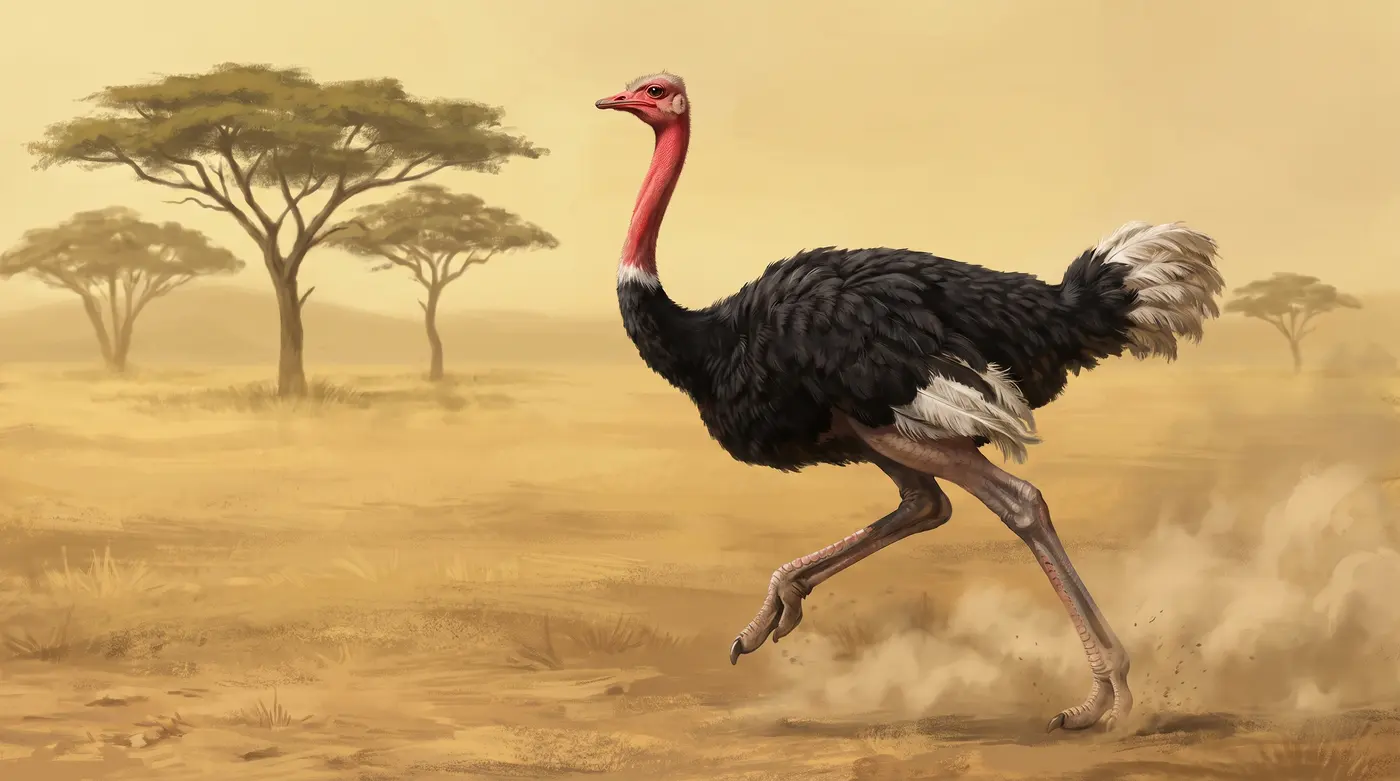
- Status: Safe
- Savannas and steppes of sub-Saharan Africa, from the Sahel to South Africa
Numbers
- Weight
- 310 lbfrom 265 to 350 lb; Wikidata reports 220 and 250 lb for adults and 3.3 lb for the chick
- Length
- 6 ftbeak to tail, minimum stated value
- Height
- 9 ftfrom 8 to 10 ft
- Lifespan
- 40 yearsfrom 30 to 40 years in the wild
- Speed
- 45 mphpeaks over 60 mph
- Egg size
- 25 times a chicken eggthe largest egg among living birds
- Eggs in shared nest
- 20 eggs or morenest shared by several females of the same male
Ten fun facts
the legend that it hides its head in the sand is false, as it actually crouches low pretending to be a bush.
its egg is the largest among living birds and is roughly equivalent to twenty-five chicken eggs.
several females from the same harem lay their eggs in a single nest, which sometimes contains over twenty eggs.
the birds take turns incubating eggs, with the dominant female sitting on them during the day and the male at night.
chicks run and forage right after hatching, becoming completely independent from their parents in just fourteen days.
a surprising fact about chicks is that they search for vital nutrients by foraging through their parents' droppings.
of the four recognized subspecies, the Arabian ostrich is extinct, although the species as a whole remains safe.
the first successful farm in captivity was established in Algeria in 1856, after long being considered impossible.
in ancient Rome, ostrich brains were served at wealthy banquets as a rare and luxurious delicacy.
each foot has only two toes, with the inner toe bearing a claw powerful enough to kill lions and hyenas.
The quiz answers
Five questions about this animal. Pick an answer and find out if it is the right one.
Question 1 of 5
Legend says the ostrich hides its head in the sand out of fear. Is it true?
Question 2 of 5
How many toes does an ostrich have on each foot?
Question 3 of 5
What is one ostrich egg roughly equal to?
Question 4 of 5
Who incubates the eggs at night?
Question 5 of 5
What is its top running speed?
Try it yourself
Draw a circle on the floor as wide as an ostrich nest and try to imagine twenty eggs inside: that is how many a single shared nest can hold.
Run for ten seconds and have a friend measure your distance: at forty-five miles per hour, an ostrich would cover over six hundred feet in that time.
Line up twenty-five chicken eggs, real or drawn: that is equal to the volume of a single ostrich egg, the largest of any bird.
Data from Wikidata (Q17592) and Wikipedia (Common ostrich).